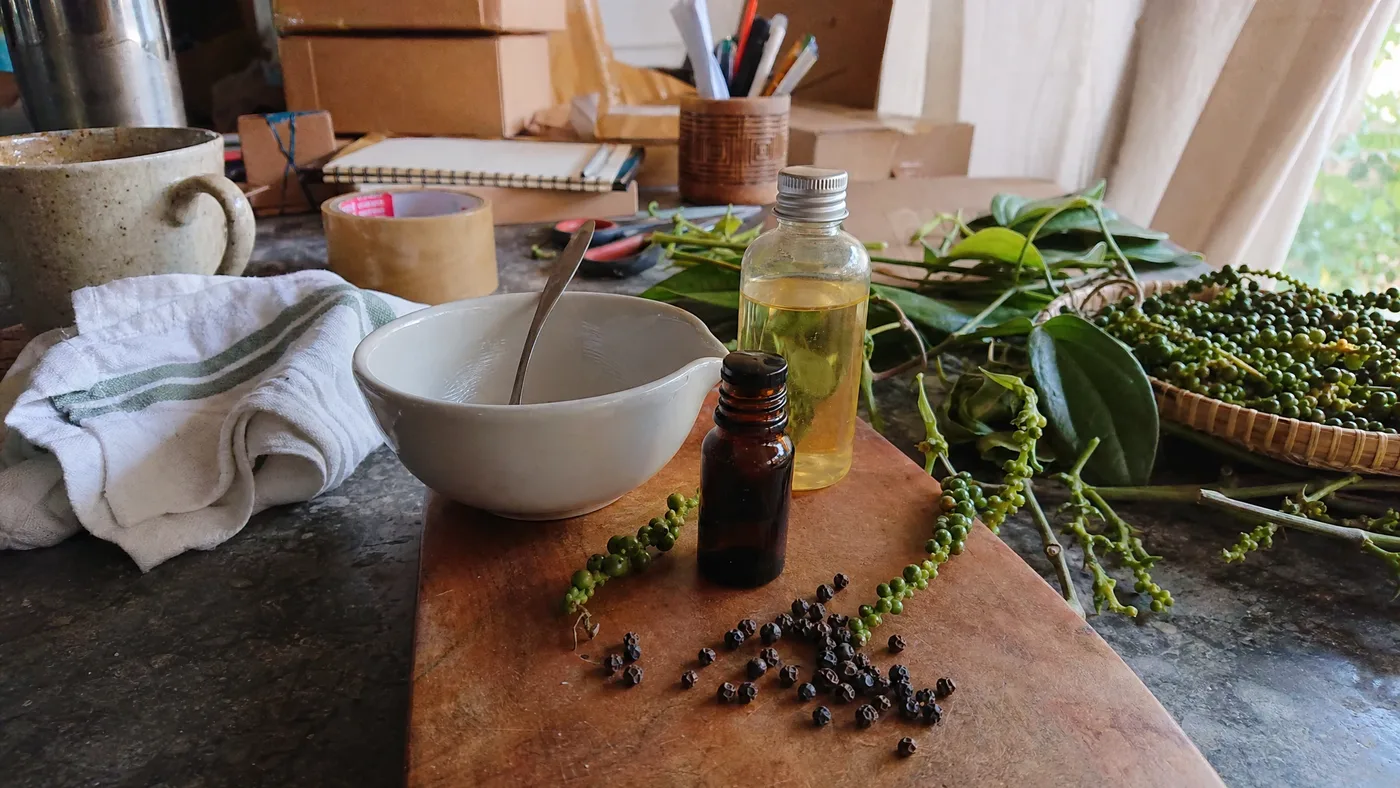
Black Pepper Massage Oil Recipe for Warm-Up and Recovery
Quick answer: Combine 1 fl oz (30 ml) of a light carrier oil, fractionated coconut or sweet almond, with 6 drops of black pepper essential oil for a 1% dilution. That's the safer starting point for a warming massage oil DIY blend. Go up to 12 drops (2%) only for short, targeted limb work, never higher. Patch test first.
A black pepper massage oil recipe is a different project than the muscle rub salve many people reach for first. A salve is thick and meant to stay put: you work it into one knee, one shoulder, and it sits there. A massage oil has a different job. It needs glide, and it needs to keep gliding for several minutes, whether a partner is working your whole back or you're covering both legs solo before a run. That difference changes everything about the recipe, from the carrier oil you pick to how much black pepper essential oil actually belongs in the bottle.

Black Pepper Essential Oil
Our own Black Pepper Essential Oil, in sizes from 0.5 oz to bulk.
From $11.99
Shop Now →The quality of the black pepper essential oil itself matters more in a massage blend than in almost any other use, since you're smelling and feeling it for the whole session. A well-distilled, true Piper nigrum oil carries a round, spicy-warm scent without the harsh, flat edge that cheaper or adulterated oils can have. That's worth knowing before you start measuring, because the oil is also genuinely more expensive to produce than many single-note essential oils: steam distillation of dried peppercorns typically yields only about 2 to 4 percent oil by weight, so it takes a meaningful amount of pepper to fill even a small bottle.
When to Reach for an Oil Instead of a Salve
Reach for a massage oil when you're covering ground: a full back, both legs, a pre-workout rubdown over several muscle groups, or a longer session with a partner's hands doing the work. A salve is the better tool for one specific, contained spot, like a single calf or a lower back spot you can work for a couple of minutes and leave alone. If that's what you're after, our guide on using black pepper essential oil for sore muscles covers that salve-style approach in more detail. This recipe is built for the oil, which means a lighter carrier and a dilution matched to longer contact time over a bigger area.
Choosing Your Carrier Oil
The carrier oil does most of the work in a massage blend. It's what actually touches the skin for the bulk of the session, and it's responsible for how the oil feels: how fast it absorbs, how much glide it gives before it soaks in, whether it leaves a greasy film.
Two carriers work especially well for a black pepper carrier oil blend built for massage:
- Fractionated coconut oil: thin, nearly odorless, stays liquid at room temperature, and absorbs slowly enough to give a long working window. Good for longer sessions.
- Sweet almond oil: a slightly richer feel, a light nutty scent, and a classic massage carrier with a touch more glide retention than fractionated coconut.
Either one is lighter than the carriers typically used in a stay-put salve (think shea or beeswax-thickened blends), which is exactly the point: you want the oil to keep moving across skin, not sit on top of it. Jojoba oil is a workable substitute if you want something closer to the skin's own texture, though it costs more. Avoid heavier, slow-absorbing oils like solid coconut oil or castor oil as your main carrier here; they fight the glide you're trying to build.
Dilution Math: How Much Black Pepper Oil to Use
Black pepper essential oil is potent, and massage covers a larger surface area with more contact time than a quick spot application, so dilution deserves real attention here, not a guess.
Our own guide, black pepper oil on skin: dilution rates and patch test, sets 1% as the conservative, everyday default and 2% as the upper limit, never higher. The same numbers apply to a massage oil:
- 1% dilution (default, recommended for a first-time blend): about 6 drops of black pepper essential oil per 1 fl oz (30 ml) of carrier oil.
- 2% dilution (upper limit, short and targeted use only): about 12 drops per 30 ml, reserved for brief work on a specific limb or muscle group rather than a full-body session.
Those drop counts assume a standard dropper puts out roughly 20 drops per milliliter, which is a reasonable average but not a fixed rule: dropper size, oil viscosity, and even how you tilt the bottle can shift the count a little. Treat 6 and 12 as close estimates, not an exact dose, and count drops the same way each time rather than eyeballing volume.
If you're making a bigger batch for a full-body session, say 2 fl oz (60 ml) of carrier, double everything: 12 drops for 1%, up to 24 for 2%. Start at 1% for any new blend or new person. There's little reason to push toward 2% unless you're working one tight area for a short time and already know how your skin responds.
Full Ingredient List
Difficulty: Easy. Prep time: about 5 minutes, plus a 24 to 48 hour patch test wait before first full use.
- 1 fl oz (30 ml) amber or cobalt glass bottle with a dropper or pump top
- 1 fl oz (30 ml) fractionated coconut oil or sweet almond oil
- 6 drops black pepper essential oil (1% dilution, default), or up to 12 drops (2%) for short, targeted use only
- Optional: 3 to 4 drops of a complementary essential oil (see Variations below)
- Optional: 2 to 3 drops vitamin E oil, as a natural antioxidant for the carrier
- Small funnel
- Label and marker for dating the bottle
Step-by-Step Instructions
- Clean and dry your glass bottle and funnel. Any leftover water can shorten the blend's shelf life.
- Using the funnel, pour 1 fl oz (30 ml) of your chosen carrier oil into the bottle.
- Add your black pepper essential oil: 6 drops for a 1% blend, or up to 12 drops for a 2% blend meant for short, targeted use. Count drops slowly and hold the bottle at a consistent angle.
- If you're using a complementary oil, add those 3 to 4 drops now.
- Add the vitamin E oil if using.
- Cap the bottle tightly and roll it gently between your palms, or turn it end over end a few times, to mix. Avoid vigorous shaking, which can introduce air bubbles.
- Label the bottle with the contents, dilution percentage, and the date you made it.
- Before using the full blend, do a patch test: apply a small amount to a coin-sized patch of skin, such as the inner forearm, and wait 24 to 48 hours. Our dilution and patch test guide walks through exactly how to do this and what to watch for. If the skin looks irritated at any point, wash it off and skip the blend.
Storage and Shelf Life
Store the finished blend in a dark glass bottle, away from direct sunlight and heat, ideally somewhere below room temperature like a linen closet or a bathroom cabinet that doesn't get steamy.
Shelf life depends mostly on the carrier: fractionated coconut oil is highly stable and can last up to 2 years or more under good storage conditions, while sweet almond oil is more perishable and is best used within 6 to 12 months. The black pepper essential oil itself, used at this dilution, isn't the limiting factor. If the blend ever smells off, sharp, or different from when you made it, or the carrier looks cloudy or separated in a way that doesn't shake back together, discard it rather than using it.
How to Apply
Warm a small amount of the oil between your palms before applying it, which makes the first touch more comfortable and helps the oil spread evenly. From there, whether it's a partner's hands or your own working over the area, moving toward the heart is a common massage convention many people follow, though this recipe isn't a substitute for guidance from a trained bodyworker if you want actual technique instruction.
Many people like this blend before activity, when the warm, spicy scent and the glide of the oil make for a pleasant pre-workout massage oil blend over the legs or shoulders, or afterward, as part of winding down. Either way, this is a sensory, at-home ritual rather than a clinical procedure, meant to be enjoyed for how it feels and smells.
Variations and Substitutions
- Carrier swap: jojoba oil for a closer-to-skin feel, grapeseed oil for a very light, fast-absorbing option, or a blend of two carriers to split the difference.
- Added warmth: a drop or two of ginger essential oil alongside the black pepper for extra spice-forward warmth, kept within the same total dilution.
- Softer edge: sweet orange or cedarwood rounds out the sharper top notes of black pepper nicely. For a full list of pairings, see what black pepper essential oil blends well with.
- Unscented base: skip any complementary oil and let the black pepper stand alone if you're sensitive to layered scents.
- Travel size: scale the whole recipe down to a 10 ml roller bottle (2 drops for 1%, up to 4 for 2%) for a portable version.
Safety Notes and Who Should Skip This
Black pepper essential oil is concentrated plant material, and a massage blend covers more skin for longer than a quick application, so a few points are worth repeating:
- Always dilute. Never apply black pepper essential oil directly to skin. Stay within the 1% to 2% range covered above, and default to 1% unless you have a specific, short-term reason to go higher.
- Patch test every new blend, even if you've used black pepper oil before in a different carrier or ratio.
- Skip this blend on broken, cracked, or otherwise compromised skin.
- Skip it over any recent injury that hasn't been assessed by a healthcare provider. A massage oil is not a substitute for that assessment.
- If you're pregnant, check with your healthcare provider before using black pepper essential oil or any essential oil blend, as recommendations vary.
- Keep the blend away from eyes, inner ears, and other sensitive areas, and well out of reach of children and pets.
- This recipe is for topical, cosmetic, and aromatic use only and isn't intended to replace care from a qualified healthcare provider.
For a fuller rundown of diluting and patch testing black pepper oil safely before you mix your first batch, our safety guide covers the full range of considerations.
A black pepper massage oil recipe like this one is simple enough to mix in five minutes, but a little care in the dilution and carrier choice is what separates a blend that feels good from one that's just hot and sharp on the skin. Start at 1%, pick a carrier built for glide, and keep a well-sourced black pepper essential oil on hand for this one and the other blends in your routine.