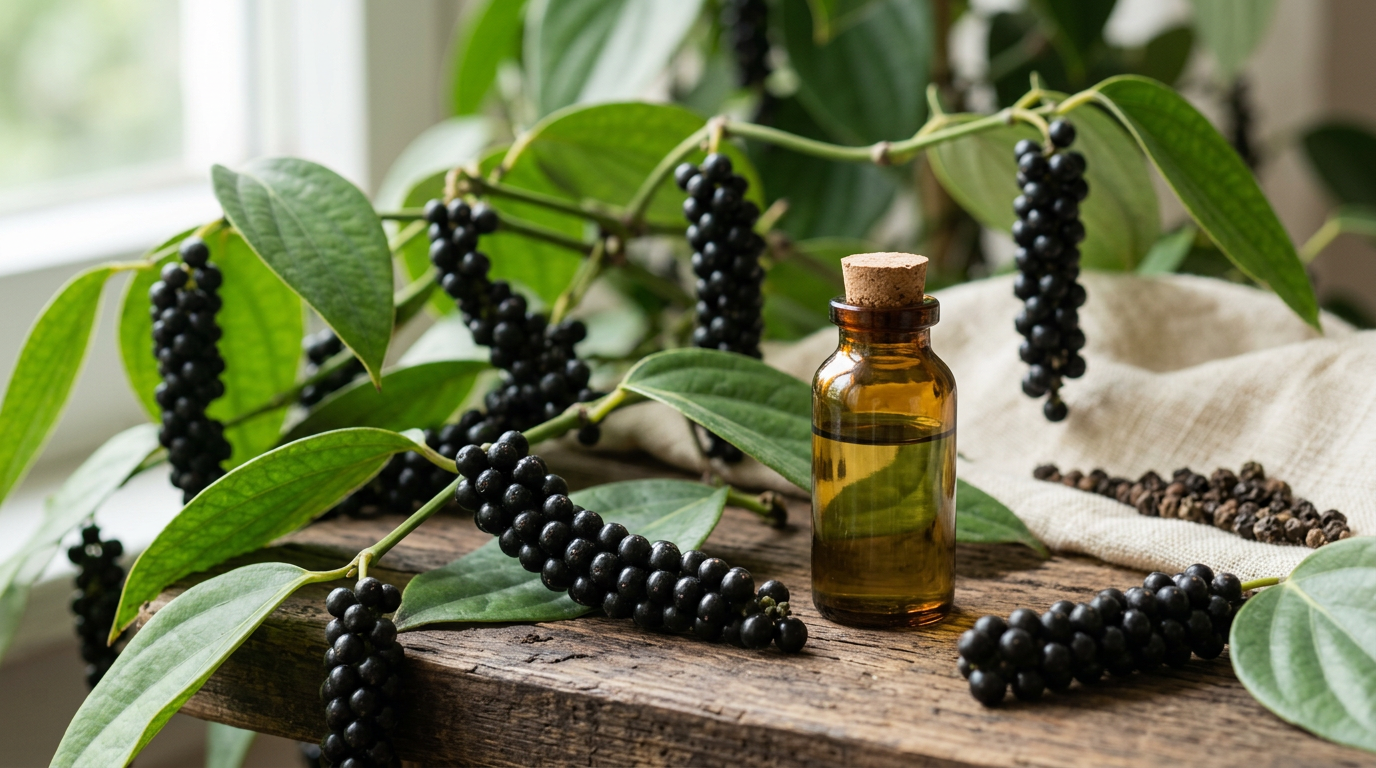
Black Pepper Oil by Origin: A Buyer's Guide to Tellicherry, Vietnam, and Malabar
Walk through the black pepper essential oil section of any online marketplace and you'll notice something odd: the price per ounce can swing from six dollars to thirty, with almost nothing on the label to explain why. Part of that gap is marketing. But part of it is real, and it comes down to one word most shoppers skip right past: origin. Where the peppercorns grew, how they were dried, and how the oil was distilled all show up in the bottle, in the aroma, the color, and the chemistry. This guide walks through the three origins you'll see most often, Tellicherry, Vietnam, and Malabar, so you can shop by what actually matters instead of by whichever bottle has the prettiest label.

Black Pepper Essential Oil
Our own Black Pepper Essential Oil, in sizes from 0.5 oz to bulk.
From $11.99
Shop Now →Why Origin Matters for Black Pepper Essential Oil
Piper nigrum grows across a fairly narrow band of tropical latitudes, and the plant behaves differently depending on soil, elevation, rainfall, and how long the vines are allowed to mature before harvest. Distillers who work with black pepper essential oil origin as a selling point aren't just being romantic about it. The peppercorn's essential oil content, aroma balance, and the ratio of woody to bright top notes genuinely shift from one growing region to the next, the same way a Bordeaux and a Barossa Valley wine taste different despite coming from the same grape family.
For a cosmetic or aromatic product, that difference translates into scent character in a diffuser blend, a soap bar, or a massage oil carrier. A Tellicherry-derived oil tends to read warmer and rounder. A Vietnamese oil often comes across sharper and more citrus-forward. Malabar sits somewhere in between, with a peppery bite that some perfumers describe as the most "classic" black pepper smell. None of these are better in an absolute sense. They're just different tools, and knowing which is which lets you buy the one suited to your project instead of guessing.
Tellicherry Black Pepper Oil: What Makes It Different
Tellicherry isn't a separate species of pepper. It's a grading term from the Malabar coast of Kerala, India, referring to peppercorns that are left on the vine longer and sieved to a larger berry size before drying. Because the berries mature fully, tellicherry black pepper oil is often distilled from corns with a slightly higher oil yield and a rounder, less sharp aromatic profile than lower grades. Reputable suppliers will usually tell you whether their tellicherry oil comes from estate-grown or smallholder cooperative peppercorns, since estate lots tend to have more consistent maturity and therefore more consistent batch-to-batch aroma.
What to expect in the bottle: a warm, slightly sweet top note that settles into a deep, woody, almost leathery base. It layers well in blends with citrus and resinous notes like frankincense, and it's a popular choice for warming winter diffuser blends and spice-forward soap or candle work. Because tellicherry grading commands a premium in the whole-spice market, oil labeled as genuine tellicherry tends to sit at the higher end of the price range, and that premium is usually legitimate rather than inflated.
Vietnamese Black Pepper Essential Oil: The New Contender
Vietnam has become the largest pepper-growing country in the world by volume over the past two decades, and its essential oil exports have grown right along with it. Vietnamese black pepper essential oil tends to come from younger vines and higher-yield cultivars bred for volume rather than the slow, traditional cultivation methods used on older Indian estates. That's not automatically a quality knock. Many Vietnamese distillers run modern, well-controlled steam distillation setups, and the resulting oil is often bright, slightly citrusy, and a touch sharper than Tellicherry, with less of the woody base note.
The real advantage for shoppers is price. Because supply is larger and the growing regions are closer to major shipping ports, Vietnamese oil is usually the most affordable of the three origins discussed here, sometimes by a wide margin. The tradeoff is more variability between suppliers. Vietnam's pepper industry includes everything from small family farms to large industrial operations, so the consistency you get depends heavily on which distiller and which broker a given bottle passed through. This is the origin where checking for a batch-specific lab report matters most, since "Vietnamese" on a label can describe a wide range of actual quality.
Malabar Pepper Oil Sourcing: The Traditional Standard
Malabar pepper oil sourcing refers to peppercorns grown along India's southwestern coast, the same broader region that produces Tellicherry grade but including the full range of berry sizes and harvest timing rather than only the largest, latest-picked corns. Malabar is often considered the benchmark origin for black pepper aroma chemistry because so much of the historical research on Piper nigrup's volatile compounds was conducted on Malabar-grown material. If you've ever seen a black pepper essential oil described as having a "classic" or "true to type" scent, the comparison point is usually Malabar.
Because Malabar sourcing covers a broader harvest than Tellicherry grading alone, it sits in a middle price tier for most brands, above generic blended-origin oil but below oil specifically labeled and graded as Tellicherry. For shoppers who want dependable, recognizably peppery aroma without paying the Tellicherry premium, Malabar is often the best value entry point into single-origin black pepper oil.
Quality Indicators to Check Before You Buy
Origin is one axis of quality, but it isn't the only one, and a poorly distilled Tellicherry oil can be worse than a well-made Vietnamese one. Before adding a bottle to your cart, look for these markers.
- GC-MS report availability. Gas chromatography-mass spectrometry testing breaks down the oil's chemical constituents and confirms it hasn't been diluted with a carrier oil or synthetic isolate. A brand that publishes batch-specific GC-MS results, rather than a single generic report reused across years of stock, is signaling real quality control.
- Piperine and beta-caryophyllene levels. These are two of the compounds most associated with black pepper's characteristic aroma. Reports showing them within the expected natural range for the stated origin are a good sign; wildly low numbers can indicate an old or over-processed batch.
- Color and viscosity. Genuine black pepper oil typically ranges from pale yellow to a light amber, with a thin, watery viscosity. Oil that looks notably thick, dark brown, or cloudy may be old, adulterated, or improperly stored.
- Distillation or "best by" date. Black pepper oil's top notes fade with age and light exposure. A visible distillation date lets you judge freshness instead of guessing.
- Packaging. Amber or cobalt glass, not clear glass or plastic, protects the oil from UV degradation. Clear bottles are a small but telling sign that a seller hasn't thought through shelf stability.
- Botanical name on the label. Look for Piper nigrum listed explicitly. Its absence isn't automatically disqualifying, but its presence is a baseline sign of a label written by someone who takes sourcing seriously.
Key Features to Compare
Here's how the three origins stack up on the features that matter most for a purchasing decision.
| Feature | Tellicherry | Vietnamese | Malabar |
|---|---|---|---|
| Aroma character | Warm, rounded, woody base | Bright, sharp, slightly citrusy | Balanced, classic peppery |
| Typical price tier | Premium | Budget to mid | Mid |
| Batch consistency | High (estate-grade sourcing) | Variable by supplier | Moderate to high |
| Best suited for | Layered fragrance blends, warming winter scents | Budget-conscious buyers, bright top-note blends | General-purpose, true-to-type aroma work |
| Sourcing transparency needed | Confirm grading, not just region | Confirm distiller and lab report closely | Confirm harvest region within Malabar coast |
Top Picks at Different Price Points
You don't need to spend the most to get an honest bottle of oil, but you do need to know what each price tier is actually buying you.
Budget tier (roughly $8 to $14 per half ounce)
At this range, expect Vietnamese-origin oil or blended-origin oil labeled simply "black pepper essential oil" without a specific region. This tier can still be perfectly usable for diffuser blends and DIY soap projects, provided the seller publishes a current GC-MS report. Skip anything in this range that has no lab documentation at all; that's where quality control tends to be weakest.
Mid tier (roughly $15 to $24 per half ounce)
This is where most Malabar-sourced oil lives, along with better-vetted Vietnamese lots from established distillers. Our own Black Pepper Essential Oil (The King of Spice) line sits in this range, sourced with batch-level documentation and packaged in UV-protective glass, and it's a reasonable benchmark for what a mid-tier bottle should include: a stated botanical name, a visible distillation date, and lab paperwork you can actually look at rather than a vague claim of purity on the label alone.
Premium tier ($25 and up per half ounce)
Genuine Tellicherry-grade oil, especially from single-estate sourcing, sits here. At this price, expect full traceability: not just "India" but the specific growing region, the distiller's name, and a batch-matched lab report rather than a generic one. If a bottle claims Tellicherry grading but can't answer basic sourcing questions, the premium price isn't buying you what it should.
Red Flags to Avoid
- No botanical name. If the label just says "black pepper oil" with nothing indicating Piper nigrum, move on.
- Suspiciously low pricing paired with big origin claims. A bottle claiming rare single-estate Tellicherry sourcing at a bargain-bin price is a mismatch worth questioning.
- No lab documentation, or a report that's clearly outdated. A GC-MS report from three years ago attached to a "fresh" listing tells you the seller isn't testing current stock.
- Vague or shifting origin claims. Listings that say "Indian or Vietnamese, depending on availability" are telling you the seller doesn't control sourcing closely enough to guarantee consistency batch to batch.
- Clear glass packaging. A small detail, but one that suggests the seller hasn't thought about shelf life.
- Reviews mentioning a faded or "off" scent shortly after purchase. That pattern usually points to stock that was already old when it shipped.
Where to Buy
Specialty essential oil retailers that focus on single-ingredient, single-origin oils tend to offer more sourcing detail than general wellness marketplaces that carry hundreds of unrelated products. Look for a seller's own site over third-party marketplace listings when possible, since a brand's own product page is more likely to include full batch documentation, distillation dates, and sourcing notes than a stripped-down marketplace listing reformatted by a reseller. If you're buying in bulk for soap making, candle making, or professional blending, ask the supplier directly whether they can provide a certificate of analysis for the specific lot you'd be purchasing, not just a representative sample from an earlier batch.
Local shops that specialize in aromatherapy supplies can also be worth a visit if one exists near you, since you can sometimes smell a tester bottle before committing to a full purchase, and a good origin-focused black pepper oil should smell recognizably peppery and warm rather than flat, dusty, or sharply chemical.
A Few Practical Notes for Use
However you plan to use the oil, whether in a diffuser blend, a carrier-diluted body oil, or a soap or candle project, always dilute black pepper essential oil properly before any skin contact and do a small patch test on a discreet area first, since undiluted essential oils can be irritating to skin even when the oil itself is high quality. People who are pregnant, nursing, or managing an existing skin sensitivity should check with a qualified healthcare provider before starting any new essential oil in their routine. Keep bottles capped tightly, stored away from direct sunlight and heat, and use within the window suggested by the distillation date on the label to get the truest aroma the oil has to offer.
Origin won't tell you everything about a bottle of black pepper essential oil, but it's one of the clearest, most checkable signals available before you buy. Pair it with a look at the lab paperwork, the packaging, and the price, and you'll end up with an oil that actually matches what the label promises, whether that's the rounded warmth of Tellicherry, the bright snap of a Vietnamese lot, or the classic balance of Malabar.