DIY Black Pepper Muscle Rub: A Warming Salve Recipe
Quick answer: This recipe makes about 4 ounces of a solid, meltable black pepper muscle salve using a beeswax-and-carrier-oil base, finished with black pepper essential oil at a 1% to 2% topical dilution (roughly 24 to 48 drops per batch), the same range recommended in our dilution guide for brief, targeted limb use.
Why Make a Salve Instead of Just Diluting Oil in a Bottle
A liquid blend runs. You tip the bottle, a little too much comes out, and most of it ends up on your palm before it ever reaches your shoulder. A salve behaves differently. Beeswax and a carrier oil set up solid at room temperature, so the blend stays put in the tin until body heat melts a thin layer on contact. That matters for two practical reasons. First, it gives you a longer massage window: the salve keeps releasing as you work it in, instead of absorbing in one pass. Second, it controls dose. Because the essential oil is locked into a measured batch rather than floating in a runny carrier, you know roughly how much reaches your skin per scoop, which is the whole point of a homemade muscle balm recipe over a simple roll-on.

Black Pepper Essential Oil
Our own Black Pepper Essential Oil, in sizes from 0.5 oz to bulk.
From $11.99
Shop Now →Difficulty and Prep Time
| Difficulty | Beginner-friendly |
| Active prep time | 15 minutes |
| Cooling and pour time | 30 to 45 minutes |
| Cure time | 24 hours before first use |
| Yield | About 4 oz (120 ml), enough for two 2 oz tins |
Equipment You'll Need
- A double boiler, or a heatproof glass bowl set over a saucepan of gently simmering water
- A heatproof glass measuring cup for the final pour
- A kitchen scale or a set of measuring spoons
- A dropper or pipette for counting essential oil drops accurately
- A small wooden craft stick or mini whisk for stirring
- Two 2 oz tins or one 4 oz tin, with lids, plus a label and pen
Ingredients
- 1/2 cup (120 ml) carrier oil, such as sweet almond oil, jojoba oil, or fractionated coconut oil
- 2 heaping tablespoons (about 25 to 30 g) beeswax pastilles, or candelilla wax for a vegan version
- 1 tablespoon shea butter or cocoa butter (optional, for a softer skin-feel)
- Black pepper essential oil: 24 drops for a 1% dilution (the conservative default), up to 48 drops for a 2% dilution (the upper bound some formulators use for brief, targeted limb work)
- Optional: 8 to 12 drops ginger essential oil and/or sweet marjoram essential oil, counted toward your total drop count so the overall dilution stays within the range above
- A few drops of vitamin E oil (optional, included as a natural antioxidant that can help the carrier oil stay fresh a little longer)
This 1:4 to 1:5 wax-to-oil ratio by volume (roughly 2 tablespoons of wax to 1/2 cup of liquid oil) is a standard starting point in cosmetic salve formulation. It isn't a figure we're claiming to have tested in-house across multiple batches; it's the ratio most beginner salve recipes use because it reliably sets firm enough to hold its shape in a tin but still melts easily on contact with skin. If your finished salve feels too soft after curing, a touch more wax next time will firm it up; too hard, add a little more carrier oil.
Understanding the Dilution Before You Start
Dilution is the part of any homemade muscle balm recipe worth slowing down for. Aromatherapy safety references don't all land on the exact same number for black pepper oil. Tisserand and Young's Essential Oil Safety (2nd edition, 2014) treats black pepper as an oil with no firmly established dermal maximum and no documented contraindications for topical use, which is a very different profile from an oil like clove bud, where the eugenol content carries a strict 0.5% dermal cap. Some tertiary summaries elsewhere cite a working range closer to 0.6% to 1%, so the sourcing isn't perfectly consistent across the literature.
Because of that spread, our own guide to black pepper oil on skin, with dilution rates and patch testing sets 1% as the conservative default for adult body applications, which works out to about 6 drops per 30 ml of carrier. For a batch this size (120 ml of carrier plus wax), that comes to 24 drops. Some formulators go up to 2% (48 drops in this batch) specifically for brief, targeted use on a limb or a single muscle group, which is exactly the kind of localized, short-duration application a shoulder or calf rub represents. We'd suggest starting at 1% and only moving toward 2% once you know how your own skin responds. Read the full guide linked above for the patch-test method itself; we won't repeat it step by step here, but do not skip it.
Step-by-Step Instructions
- Gather everything first. Measure your carrier oil and wax before you turn on any heat. Salve-making moves fast once the wax melts, and you don't want to be hunting for a dropper with hot wax cooling in the pan.
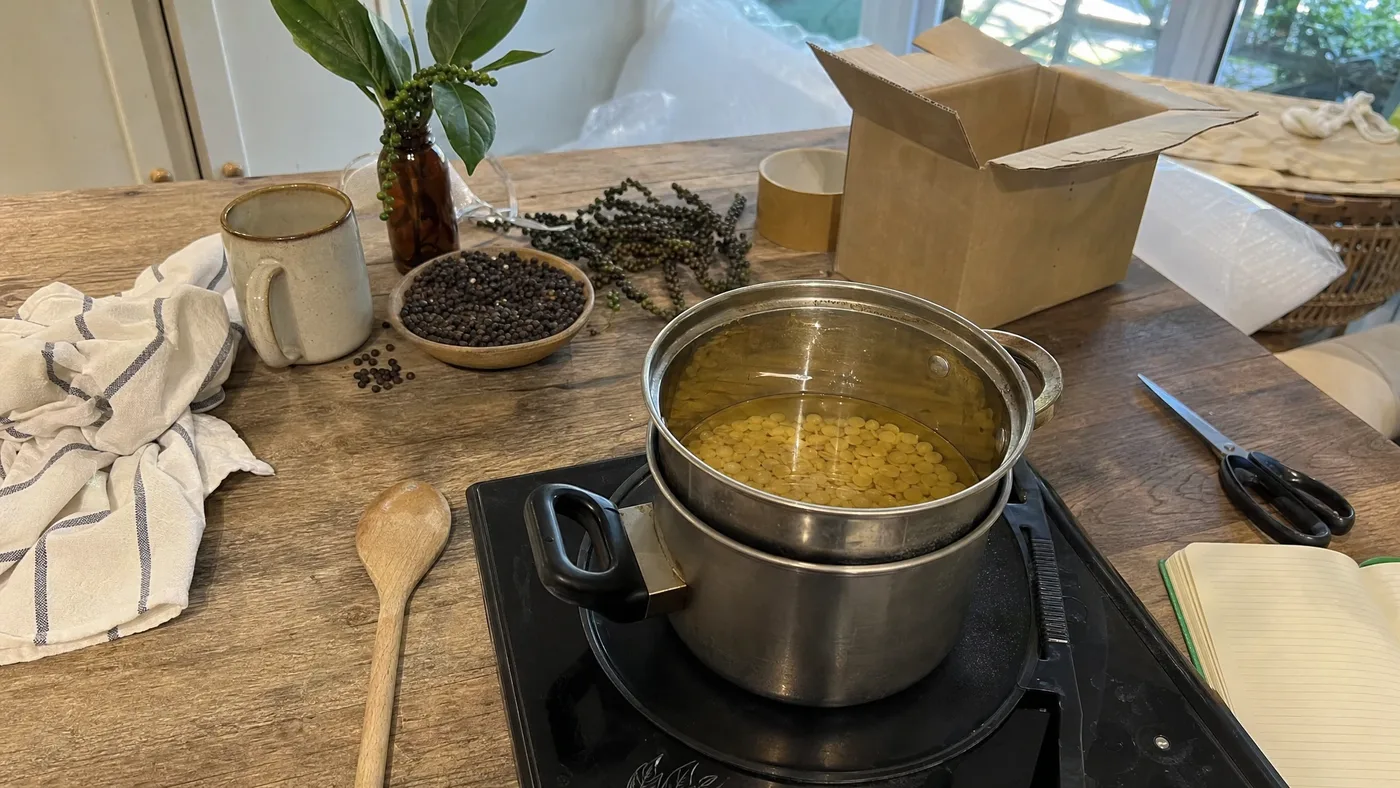
- Melt the carrier and wax together. Combine the carrier oil, beeswax, and shea or cocoa butter (if using) in your double boiler. Warm gently over simmering water, stirring occasionally, until the wax is fully melted and the mixture looks clear rather than grainy. This usually takes 8 to 10 minutes on low heat.
- Remove from heat and cool slightly. Take the bowl off the heat and let it sit for about 3 to 5 minutes. You want it warm and still liquid, but not so hot that it will flash off your essential oils the moment they hit it.
- Add the essential oil. Stir in your black pepper essential oil (plus ginger or marjoram, if using) a few drops at a time, counting as you go so you land on your target of 24 or 48 total drops. Stir gently but thoroughly so the oil distributes evenly rather than pooling at the surface.
- Pour into tins. Working quickly before the mixture starts to set, pour it into your prepared tins. Leave the lids off for now.
- Let it cure. Allow the salve to cool at room temperature, undisturbed, for at least an hour before capping. Then let it sit, capped, for a full 24 hours before the first use. This gives the wax time to fully set and the scent to settle rather than smelling sharp and raw.
- Use. Scoop a small amount, about the size of a pea to a dime depending on the area, and massage into the muscle you're working on until it's absorbed.
Safety Warnings
- Patch test first. Apply a small amount of the finished salve to a coin-sized patch of skin on your inner forearm and wait 24 hours before using it more broadly. Our dilution and patch-test guide walks through the full method.
- Halve the dilution for sensitive skin or first-time use. If you've never used black pepper oil topically before, or you know your skin tends to react, make your first batch at half strength (12 drops instead of 24) rather than starting at the higher end.
- Avoid broken or irritated skin, the eye area, and mucous membranes. This salve is formulated for intact skin over muscle tissue only.
- Keep out of reach of children, and don't apply to children without guidance from a healthcare provider.
- If you're pregnant, nursing, or managing an existing skin sensitivity, check with a qualified healthcare provider before adding any new essential oil blend to your routine.
- Stop use if you notice redness, itching, or discomfort that doesn't resolve shortly after rinsing the area with mild soap and water.
Storage Instructions and Shelf Life
Store the finished salve in its tin with the lid on, away from direct sunlight and heat sources (a bathroom cabinet works better than a sunny windowsill, since warmth will soften it). Kept this way, a batch made with fresh carrier oil typically holds its quality for about 6 to 12 months, though carrier oils like sweet almond or jojoba have their own shelf lives that will ultimately set the ceiling. If the salve starts to smell flat, sour, or noticeably different from when you made it, that's a sign it's past its best and it's time to make a fresh batch rather than keep using it.
Variations and Substitutions
- Add ginger essential oil. Ginger is a commonly paired oil in warming massage blends, and it's reasonable to combine a few drops with black pepper here, though this is a formulation choice based on how the two are typically used together rather than a claim about tested results.
- Add sweet marjoram essential oil. Marjoram is another oil frequently blended into muscle-focused salves for its grounding, herbaceous character alongside black pepper's sharper note.
- Vegan version. Swap the beeswax for candelilla wax in roughly the same ratio; candelilla sets slightly harder, so you may want to use a touch less.
- Butter-forward version. Increase the shea or cocoa butter and reduce the liquid carrier oil slightly for a richer, more balm-like texture that glides further during a longer massage.
- Travel-size batch. Halve every measurement above for a single 2 oz tin, and halve your drop count accordingly to keep the same percentage dilution.
How People Use This Blend
Many people like to work a black pepper salve for muscles into tired areas before or after activity, as part of a broader routine that includes stretching, rest, and ordinary warm-up and cool-down habits. The warming sensation some people report from black pepper and other warming massage oils is an experiential one tied to how these blends feel on the skin during a warm massage session, not a specific mechanism we're claiming for this oil. Worth noting: steam-distilled black pepper oil doesn't carry meaningful piperine into the finished oil, since piperine stays behind in the spent plant material during distillation. If you want a deeper look at how people incorporate black pepper oil into a muscle-care routine generally, our article on black pepper essential oil for sore muscles covers that in more detail.
A Note on Sourcing
If you're shopping for an oil to build this blend around, look for a steam-distilled Piper nigrum oil, which is the traditional extraction method suited to this kind of warming massage blend.
Safety Reminder
This recipe is intended for an ordinary after-activity muscle-care routine only. It is not a substitute for guidance from a qualified healthcare provider, and anything that doesn't resolve with ordinary rest, or that feels like more than routine muscle fatigue, is worth a conversation with a professional rather than something to manage with a DIY salve alone.