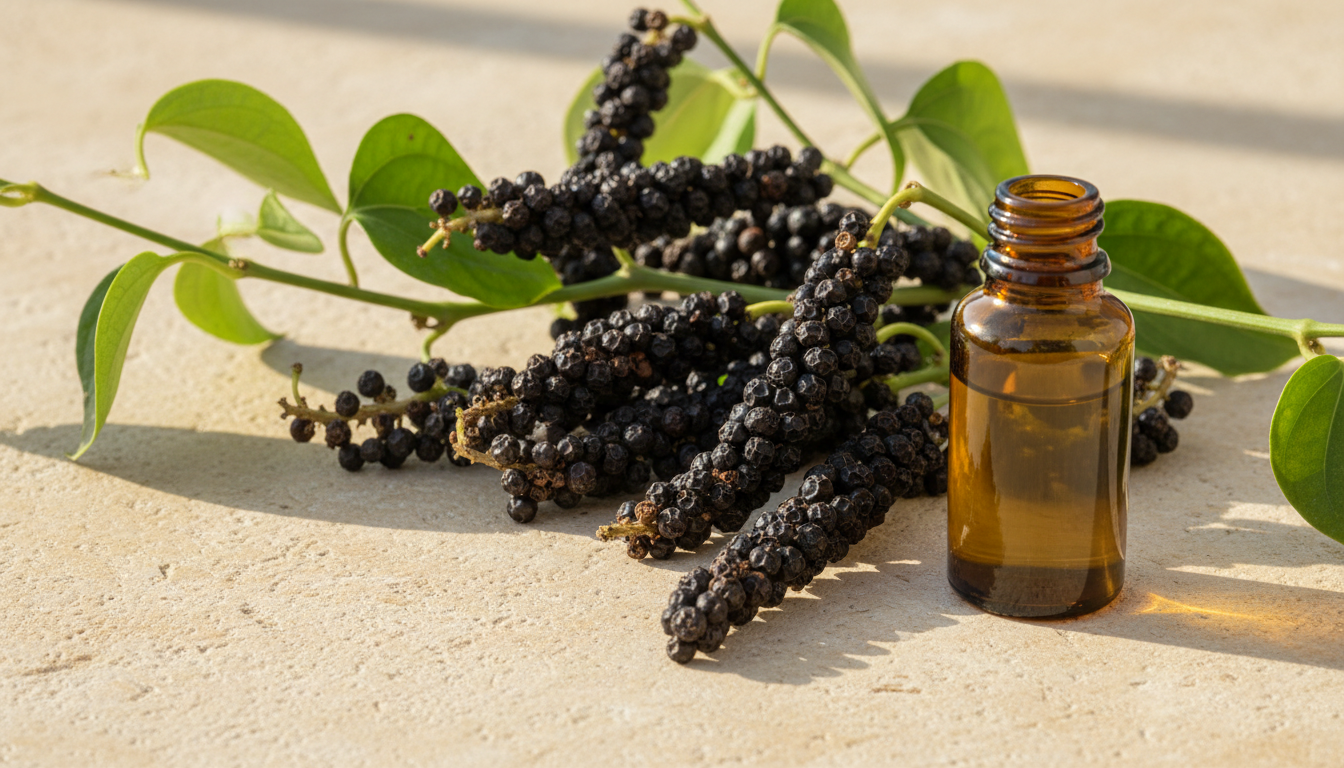
Steam-Distilled vs CO2-Extracted Black Pepper Oil: A Buyer's Guide
Black pepper essential oil shows up on ingredient lists for candles, colognes, soap bars, and diffuser blends, but not every bottle labeled "black pepper oil" was made the same way. The extraction method behind the bottle shapes everything from the scent profile to the price tag, and most shoppers never ask about it. This guide walks through the two dominant production methods, the quality markers worth checking before you buy, and where the real value sits at each price point.

Black Pepper Essential Oil
Our own Black Pepper Essential Oil, in sizes from 0.5 oz to bulk.
From $11.99
Shop Now →Understanding the Two Extraction Methods
Nearly every black pepper oil on the market comes from one of two processes: steam distillation or CO2 extraction. Both start with dried Piper nigrum berries, but the mechanics diverge sharply, and so does what ends up in the bottle.
Steam Distilled Black Pepper Oil
Steam distillation is the traditional route and still the most common. Crushed peppercorns sit in a still while pressurized steam passes through the plant material, carrying volatile aromatic compounds up and over into a condenser. The vapor cools back into liquid, separating into oil and hydrosol. This is the method behind the vast majority of black pepper oil sold for candle making, soap, and fragrance blending, largely because the equipment is widely available and the process scales well for commercial batches.
The result is a thinner, more mobile oil with a bright, sharp, peppery top note that reads as warm and slightly woody underneath. Because steam distillation only pulls the volatile fraction, it leaves behind piperine, the compound responsible for pepper's pungent bite, along with the heavier resins. That makes steam distilled oil lighter in both viscosity and aroma weight, which is exactly what most fragrance and candle formulators are after.
CO2 Extracted Black Pepper Oil
CO2 extraction uses carbon dioxide pushed to a supercritical state, somewhere between a gas and a liquid, to pull aromatic and non-volatile compounds out of the plant material at relatively low temperatures. Once the pressure drops, the CO2 reverts to gas and evaporates off completely, leaving a concentrated extract behind.
Because supercritical CO2 pulls a broader range of compounds than steam ever touches, CO2 extracted black pepper oil is noticeably thicker, often described as viscous or resin-like, with a deeper, rounder aroma that carries more of pepper's actual spice character rather than just its bright top note. It also captures trace amounts of piperine and heavier plant constituents that steam distillation leaves behind, which is part of why CO2 extracted oil smells closer to fresh-cracked pepper straight out of the bottle. The tradeoff is cost: the equipment is specialized and expensive to run, so CO2 extracted oil commands a noticeably higher price per ounce.
What to Look For: Quality Indicators
Extraction method is only one piece of the puzzle. A poorly sourced CO2 extract can still disappoint, and a well-made steam distilled oil can outperform expectations. Here's what separates a quality bottle from a mediocre one, regardless of method.
- Botanical name on the label. Look for "Piper nigrum" printed on the packaging. A supplier that skips the Latin name is often skipping other documentation too.
- Country of origin. Reputable sellers name where the pepper was grown, most commonly India, Sri Lanka, Madagascar, or Vietnam. Vague sourcing language like "tropical regions" is a soft dodge.
- Third-party GC/MS testing. Gas chromatography-mass spectrometry reports show the actual chemical makeup of a given batch. A supplier willing to share a batch-specific report, not a generic sample report from years ago, is signaling confidence in what's actually in the bottle.
- Batch or lot numbers. Crop conditions vary year to year, and a proper lot number lets a supplier trace a bottle back to its specific harvest and testing record.
- Extraction method stated plainly. If a listing doesn't say whether the oil is steam distilled or CO2 extracted, that omission alone is worth pausing on.
- Amber or cobalt glass packaging. Essential oils degrade under light exposure. Clear glass or plastic bottles are a sign of corners cut somewhere in the supply chain.
- Color and viscosity that match the method. Steam distilled oil should run pale yellow to light green and pour easily. CO2 extract should be darker, amber to olive, and noticeably thicker. If a "CO2 extracted" oil pours like water, ask questions.
Key Features to Compare
When you're weighing black pepper oil extraction method against your own project needs, these are the practical differences that matter most.
| Feature | Steam Distilled | CO2 Extracted |
|---|---|---|
| Aroma profile | Bright, sharp, peppery top note | Deep, rounded, closer to fresh-cracked pepper |
| Viscosity | Thin, free-flowing | Thick, resin-like |
| Typical price per ounce | Lower | Noticeably higher |
| Common uses | Candles, cologne blends, soap, diffusers | High-end perfumery, small-batch formulation |
| Availability | Widely stocked | Specialty and niche suppliers |
| Shelf life (properly stored) | 1 to 2 years | Slightly longer, due to heavier compound content |
For most candle and soap makers, steam distilled oil is the practical choice. It disperses evenly in wax and cold process batches, and the price point supports larger production runs. CO2 extract earns its premium in fine fragrance work and small-batch formulations where a deeper, more authentic pepper note is worth paying for.
Top Picks by Price Point
Rather than chase a single "best" bottle, it helps to know what a fair price actually buys you at each tier.
Budget Tier (roughly $8 to $15 per 10ml)
At this range, expect steam distilled oil, likely sourced from a large-scale supplier blending multiple harvests together. That's not automatically a problem. Look for a supplier that still publishes a GC/MS report and states the country of origin, even if it's a blended-lot product. Skip anything in this range with no testing documentation at all; that's where quality slips.
Mid-Range (roughly $15 to $30 per 10ml)
This is where single-origin steam distilled oils live, along with some smaller-batch producers who name a specific farm or region rather than a country in general. Batch-specific testing becomes standard at this tier, and color consistency across purchases is a good sign of a stable supply chain.
Premium Tier ($30 and up per 10ml)
This is CO2 extract territory, along with limited-run steam distilled oils from small estates. At this price, documentation should be non-negotiable: batch-specific GC/MS reports, named origin, and clear extraction method. If a listing charges premium prices without premium paperwork, that's a mismatch worth questioning.
Red Flags to Avoid
- No extraction method listed. If the product page never says steam distilled or CO2 extracted, the supplier may not know or may not want to say.
- Price too low for the claimed method. CO2 extraction is expensive to run. Any bottle claiming CO2 extraction at steam-distillation prices deserves a closer look.
- Vague or missing origin. "Sourced globally" or no country listed at all usually means blended, untraceable stock.
- No batch testing on request. A legitimate supplier can produce a current GC/MS report when asked. Repeated deflection is a signal to move on.
- Overstated language on the label. Marketing copy that leans heavily on sweeping wellness promises rather than describing the oil itself, its scent, its origin, its extraction, often means the seller is compensating for thin sourcing.
- Inconsistent color or scent between orders. If a repeat purchase smells or looks noticeably different from the last bottle with no explanation, ask the supplier about the batch change.
Where to Buy
Specialty essential oil retailers that focus specifically on single-oil sourcing, rather than broad wellness marketplaces carrying hundreds of unrelated products, tend to have tighter quality control and more willingness to share testing documentation. Look for sellers who publish their sourcing story, including the specific region and harvest season, and who make GC/MS reports available without a hard sell to get them. A supplier's willingness to answer direct questions about extraction method and origin, before you buy, is often the clearest signal of how the rest of the business is run.
For candle and soap makers ordering in bulk, ask about volume pricing on steam distilled oil directly from the supplier rather than defaulting to whatever quantity is listed on a marketplace page. For fragrance work where CO2 extract's deeper profile matters, buying direct from a supplier who specializes in CO2 extraction (rather than one offering it as a single line item among many steam distilled oils) usually means fresher stock and better documentation.
Making the Choice
Neither extraction method is objectively better. Steam distillation delivers a bright, versatile oil at a price that supports real production volume, and it's the right call for the vast majority of candle, soap, and cologne applications. CO2 extraction delivers a rounder, more concentrated aroma at a price that only makes sense when that specific character is the point of the project. Match the method to what you're actually making, verify the paperwork before you buy, and the extraction method stops being a mystery on the label and starts being a deliberate choice.