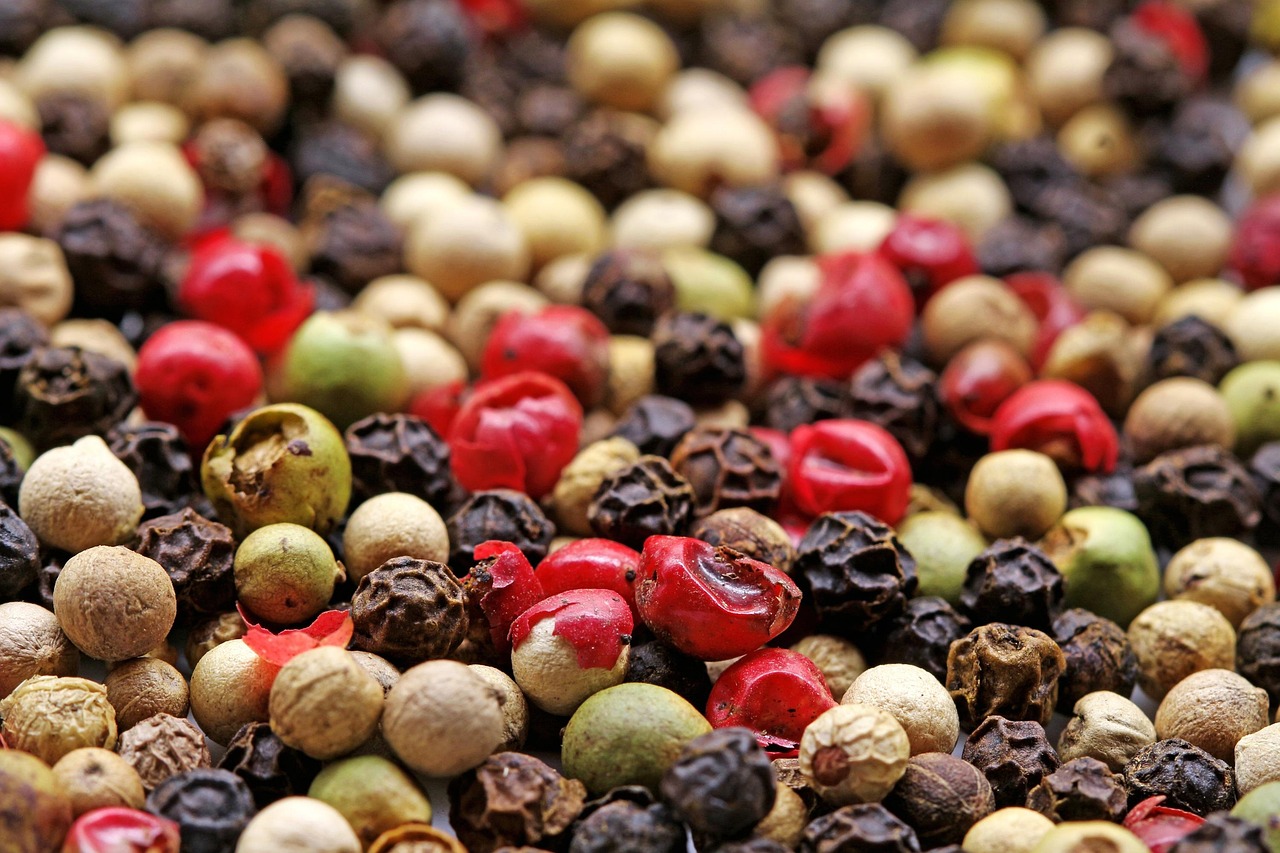
A Short History of Black Pepper: The Spice That Moved Empires
Few plants have shaped human civilization quite like Piper nigrum. For more than two millennia, the small, sun-dried berries of this tropical vine dictated the fates of merchants, monarchs, and entire trade routes. Black pepper was currency, status symbol, and obsession. Today, its steam-distilled essential oil carries that same ancient complexity into modern cosmetic and aromatic routines. Understanding where this spice came from, and what it actually contains at a molecular level, makes every drop of the oil feel a little more meaningful.
Black Pepper Origins: A Vine from the Western Ghats
The story of black pepper begins in the humid hill forests of Kerala, in the southwestern corner of India. The Piper nigrum vine is indigenous to this region, thriving in the warm, rainfall-rich foothills of the Western Ghats. Archaeological evidence and Sanskrit texts suggest the spice was in active use in the Indian subcontinent well before 2000 BCE. The ancient city of Calicut (present-day Kozhikode) became so synonymous with pepper export that European traders coined the phrase "Malabar pepper" to describe what was, for centuries, the world's most commercially significant spice.
For a closer look at the plant itself, its growth habits, and how the berries become essential oil, the guide on Piper nigrum: the vine behind black pepper essential oil covers the botany in satisfying depth.
From India, pepper traveled early. Egyptian records reference "grains of pepper" in medicinal and culinary contexts, and famously, black peppercorns were discovered in the nostrils of Ramesses II during his mummification, placed there sometime around 1213 BCE. Exactly how the spice reached Egypt remains a matter of scholarly debate, but the find confirms that long-distance pepper commerce existed long before the well-documented Roman trade era.
The Black Pepper Spice Trade: Commerce That Rewrote Maps
By the height of the Roman Empire, black pepper had become so valuable that Roman historian Pliny the Elder complained bitterly in his Naturalis Historia (circa 77 CE) that Rome was hemorrhaging gold eastward to pay for it. He estimated that India drained approximately 50 million sesterces from Rome annually, with pepper among the leading culprits. Pliny found the obsession baffling. He couldn't understand why anyone would pay so much for something that merely tasted sharp. His readers apparently disagreed.
The fall of Rome in 410 CE was punctuated, at least symbolically, by the Visigoth king Alaric's ransom demand: 3,000 pounds of pepper alongside gold and silver. Pepper was not a seasoning at this point. It was hard currency.

Through the medieval period, the black pepper spice trade flowed primarily through Arab intermediaries who controlled the overland and sea routes connecting the Malabar Coast to the markets of Alexandria, Venice, and Genoa. The Italian city-states grew spectacularly wealthy managing this flow. Venice, in particular, built much of its famous civic infrastructure on spice profits. The desire to bypass Arab and Venetian middlemen was one of the clearest commercial drivers behind the Age of Exploration.
When Vasco da Gama rounded the Cape of Good Hope in 1498 and arrived in Calicut, he asked local traders what he was looking for. The answer, reportedly, was simple: Christians and spices. The Portuguese crown wanted direct access to pepper. Da Gama's voyage succeeded, and within decades Portugal had established a seaborne spice empire that radically disrupted centuries of established trade patterns. The Dutch followed. Then the British East India Company. The history of black pepper is, in many ways, the history of early globalization itself.
Chemical Composition: What Makes Black Pepper Essential Oil Distinctive
Steam-distilled black pepper essential oil captures the volatile aromatic compounds of the dried, unripe berry. The resulting oil is a complex mixture, and its character shifts depending on when the berries were harvested, how they were dried, and how the distillation was conducted.
The dominant compound in most analyzed samples of black pepper essential oil is beta-caryophyllene, a sesquiterpene that contributes the oil's characteristically woody, spicy-sweet depth. Research published in journals covering natural product chemistry consistently identifies beta-caryophyllene as one of the more studied sesquiterpenes in botanical science, with investigators observing a range of interesting properties worth continued study.
Other significant compounds typically found in gas chromatography profiles include:
- Limonene: A monoterpene that adds a faint citrus brightness to the overall scent profile.
- Alpha-pinene and beta-pinene: These pine-forward compounds are common across many conifer and spice essential oils and contribute to the oil's fresh, green opening note.
- Sabinene: Adds a slightly woody, herbal nuance.
- Delta-3-carene: A cyclic monoterpene present in varying amounts depending on origin and harvest timing.
- Myrcene: Contributes an earthy, musky base note.
- Alpha-terpinene and gamma-terpinene: Lighter, citrusy-herbal monoterpenes that round out the mid-notes.
Notably, black pepper essential oil contains very little piperine, the alkaloid responsible for the sharp, nose-burning heat of freshly ground pepper in the kitchen. Piperine is non-volatile and does not carry over meaningfully into steam-distilled oil. This is why the essential oil smells complex and spicy-sweet rather than eye-wateringly hot. It is a point worth understanding clearly before purchasing, since the aromatic experience differs substantially from the culinary one.
If you're weighing the differences between a true steam-distilled oil and a synthetic scent product, the article on black pepper essential oil vs. black pepper fragrance oil breaks down exactly what changes between the two formats.
What Research Suggests

Scientific interest in Piper nigrum and its constituents has grown considerably over the past few decades. Most peer-reviewed work focuses on piperine (found in whole pepper and extracts) rather than the distilled essential oil specifically, so it is important to distinguish between research on pepper extracts and research on the volatile oil fraction.
For the essential oil itself, some research suggests that beta-caryophyllene may interact with the body's endocannabinoid system via CB2 receptors, which has generated interest among researchers studying olfactory and topical applications. These are early-stage observations. They are not conclusions about efficacy or appropriate use.
Separately, some investigators have examined the aromatic properties of black pepper vapor in the context of sensory research. One frequently cited Japanese study observed that inhaling black pepper aroma produced measurable physiological responses related to craving and autonomic nervous system activity in smokers attempting to quit. The research framed these as preliminary findings requiring further controlled study.
In cosmetic formulation contexts, beta-caryophyllene has attracted attention as a potential skin-conditioning ingredient, with some in-vitro work suggesting it may support a calmer-feeling surface environment. Again, these are research observations rather than settled conclusions.
Safety Profile and Contraindications
Black pepper essential oil is generally considered safe for cosmetic and aromatic use when handled correctly. The International Fragrance Association (IFRA) and Research Institute for Fragrance Materials (RIFM) have reviewed the compound and it appears in their databases without significant restriction flags at standard use levels.
That said, responsible use requires attention to a few key areas:
Skin Application
Black pepper essential oil should always be diluted in a carrier oil before any skin contact. A general guideline for cosmetic formulation is a maximum of 1 to 2 percent dilution in leave-on products. The oil can be warming and may cause a reddening sensation on sensitive skin at higher concentrations. A patch test on a small area of the inner forearm, observed for 24 hours before broader application, is always advisable.
Phototoxicity
Black pepper essential oil is not considered phototoxic in the way that cold-pressed citrus oils are. However, since formulations vary, confirming the specific oil's profile with the supplier's safety data sheet is good practice.
Population Considerations
Pregnant or nursing individuals, children, and people with known sensitivities to spice-family botanicals should consult a qualified healthcare provider before incorporating black pepper essential oil into their routines. The warming character of the oil makes it unsuitable for use near the eyes or on broken or compromised skin.
Inhalation
For diffusion, standard aromatherapy guidelines suggest intermittent diffusion periods (30 to 60 minutes on, with breaks) rather than continuous all-day exposure. People with respiratory sensitivities should introduce the oil gradually.
Sourcing and Quality Indicators
The quality of black pepper essential oil varies considerably depending on geographic origin, harvest practices, and distillation method. Knowing what to look for protects both your investment and your formulations.
Origin
Malabar Coast pepper (Kerala, India) remains the benchmark for aromatic complexity. Sri Lankan and Vietnamese pepper are also commonly distilled, producing oils with slightly different chemical profiles. Some suppliers offer single-origin oils with clear provenance documentation. Traceability to a specific farm or cooperative is a meaningful quality signal.
Gas Chromatography / Mass Spectrometry Testing
A reputable supplier will provide GC/MS analysis for each batch. Look for beta-caryophyllene content in the range commonly reported in literature (roughly 10 to 35 percent depending on origin and harvest timing) and confirm that the monoterpene fraction is present and intact. Adulteration with synthetic aroma chemicals, or blending with cheaper spice oils, can show up as unusual peaks or abnormal ratios in a GC/MS report.
Color and Viscosity
Quality black pepper essential oil is typically pale yellow to colorless and mobile (thin in consistency). A cloudy or viscous oil may indicate oxidation or contamination.
Organic Certification
For formulators prioritizing certified organic inputs, USDA or EU organic certification provides a degree of assurance regarding pesticide and synthetic fertilizer use during cultivation. Organic certification does not automatically signal superior aromatic quality, but it does address sourcing ethics for buyers who value that transparency.
For a broader orientation to what black pepper essential oil is, how it's made, and where it fits in cosmetic and aromatic applications, the complete guide to black pepper essential oil is a useful starting point for newcomers and experienced formulators alike.
From Trade Route to Apothecary Cabinet
The arc from ancient Malabar trading posts to the small amber bottle on a modern formulator's bench is longer and stranger than most people realize. Black pepper moved entire civilizations. It funded fleets, motivated explorers, and made city-states fabulously wealthy. The essential oil distilled from its berries is, in that sense, a concentrated inheritance from one of the most consequential agricultural products in human history.
What makes it worth studying carefully today is not nostalgia. The chemistry is genuinely interesting, the sourcing landscape rewards attentive buyers, and the aromatic profile is complex enough to reward years of formulation experimentation. Approach it with the same care its history demands.