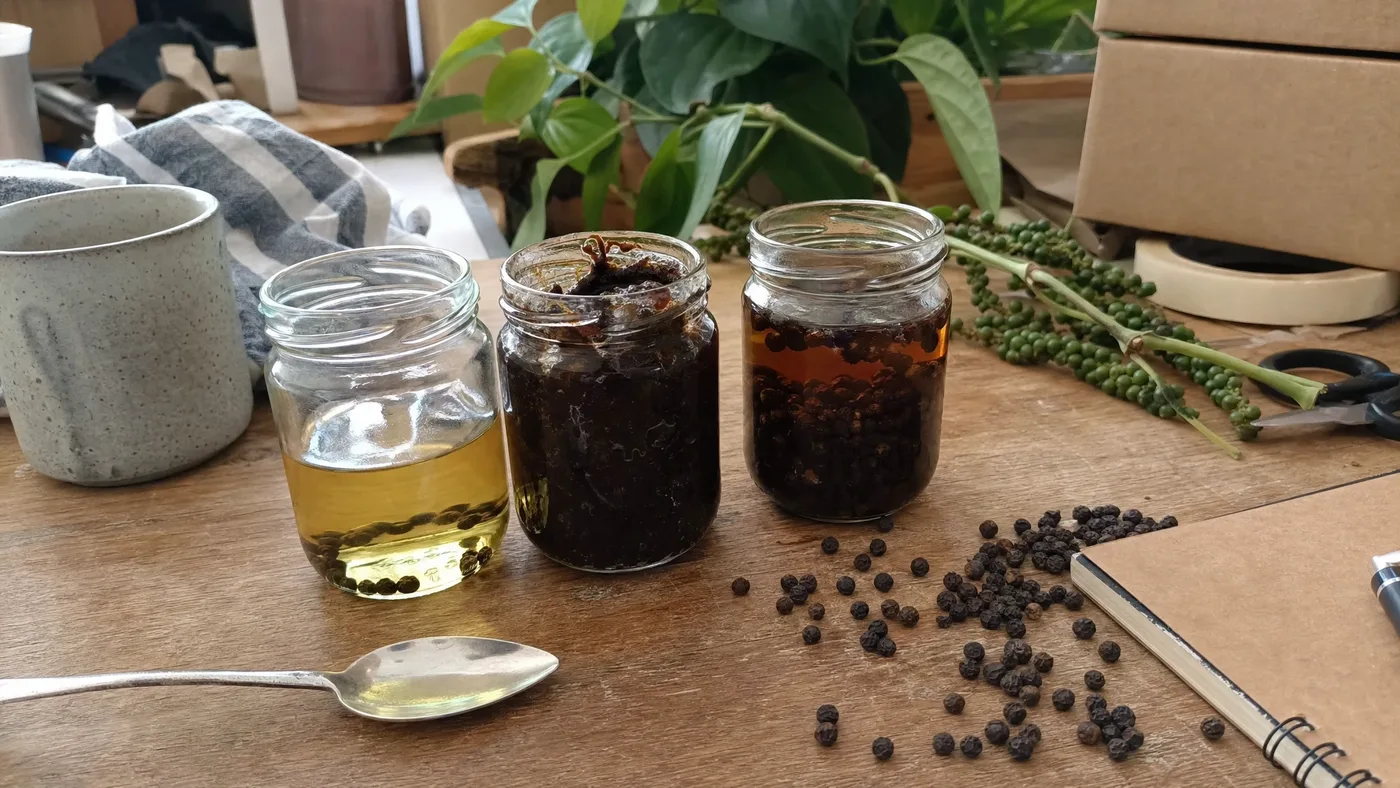
Black Pepper Essential Oil vs. Oleoresin and Infused Pepper Oil
Search "black pepper oil" and three very different products turn up on the same results page: a thin, clear steam-distilled essential oil marketed for diffusers and perfumery, a thick amber concentrate called oleoresin that food manufacturers buy by the drum, and a jar of peppercorns steeped in olive or sunflower oil that looks like something from a home kitchen. All three come from the same plant, Piper nigrum. Past that, they are not interchangeable, and buying the wrong one for your purpose is an easy, avoidable mistake.

Black Pepper Essential Oil
Our own Black Pepper Essential Oil, in sizes from 0.5 oz to bulk.
From $11.99
Shop Now →This is a different question from natural versus synthetic pepper scent. If you're weighing a true botanical extract against a lab-built fragrance compound, our fragrance oil comparison covers that directly. Here, all three products are genuinely derived from real peppercorns. They just go through different processes that leave very different materials behind.
Quick Answer
- Black pepper essential oil: steam-distilled from peppercorns, carrying the volatile aromatic compounds and little to none of the pungent bite. Used in diffusers and perfumery.
- Black pepper oleoresin: a solvent- or CO2-extracted concentrate that keeps both the aromatic oil and the non-volatile pungent compounds, including piperine. Used almost exclusively as a food-flavoring ingredient in the spice industry.
- Black pepper infused oil: dried peppercorns steeped in a carrier oil such as olive or sunflower oil. A kitchen-style infusion with no standardized potency, sold mainly for culinary or folk use.
What Actually Sets Them Apart
The difference comes down to extraction. Steam distillation pulls out only the volatile terpenes in the peppercorn, the light, warm, slightly woody-spicy compounds responsible for the oil's scent. Piperine, the compound behind black pepper's characteristic heat, is not volatile. It stays in the plant material and never makes it into the distillate. That's the main reason true essential oil smells unmistakably like pepper but doesn't deliver pepper's bite on the tongue. For a closer look at what's actually in the bottle, see our breakdown of black pepper essential oil's chemistry and scent profile.
Oleoresin is pulled out differently, typically with a solvent such as hexane or ethanol, or increasingly with supercritical CO2, and the process is built to capture everything: the volatile oil and the heavier, non-volatile pungent compounds, piperine included. A 2017 study in the Journal of Essential Oil Bearing Plants compared the chemical composition of black pepper essential oil and oleoresin side by side and confirmed what the two extraction methods suggest: these are materials with meaningfully different compound profiles, not simply the same oil at two different strengths. That distinction is the root of a lot of the labeling confusion when both show up online under the same "black pepper oil" name.
Infused oil skips industrial extraction altogether. It's whole or cracked peppercorns left to steep in a base oil for days or weeks, sometimes with gentle warmth to speed things along. Whatever aroma and flavor transfers depends entirely on the batch: how long it steeped, how finely the pepper was cracked, how fresh the corns were to begin with. There's no lab specification behind it, just the maker's own process.
Comparison at a Glance
| Attribute | Essential Oil | Oleoresin | Infused Oil |
|---|---|---|---|
| Extraction method | Steam distillation | Solvent or CO2 extraction | Steeping in a carrier oil |
| What's retained | Volatile aromatic terpenes only | Volatile oil plus non-volatile pungent compounds | Whatever aroma and flavor transfers from whole peppercorns |
| Piperine content | None to trace | High, often standardized for food formulation | Low and inconsistent |
| Typical use | Diffusing, perfumery, diluted skin application | Food flavoring, spice-industry formulation | Cooking, dressings, home kitchen use |
| Typical form/viscosity | Thin, mobile liquid | Thick, sticky, resin-like | Thin to medium, ordinary oil consistency |
| Skin-safety profile | Formulated for dilution before skin contact | Not designed for skin application; highly concentrated | Generally mild, but unstandardized and not lab-verified |
Pros and Cons
Black Pepper Essential Oil
- Pros: consistent, known composition batch to batch; well suited to diffuser blends and perfumery work; blends readily with citrus and wood notes; a small amount covers a lot of scent ground.
- Cons: little to no pungency or heat; not useful as a food flavoring; costs more per ounce than infused oil; still needs to be diluted before it touches skin.
Black Pepper Oleoresin
- Pros: delivers full pepper heat and flavor in a concentrated form; batch-to-batch potency that manufacturers can formulate against; long shelf stability.
- Cons: thick and sticky, awkward to measure or handle outside an industrial setting; not formulated for skin or diffuser use; usually sold in bulk quantities aimed at manufacturers rather than home shoppers; hard to find at ordinary retail.
Black Pepper Infused Oil
- Pros: simple to make at home with minimal equipment; genuinely useful in the kitchen as is; no industrial processing involved.
- Cons: potency varies widely between batches and brands; shorter shelf life than a true essential oil or oleoresin; not suited to diffusing or topical use beyond the kitchen; no lab-verified composition behind the label.
Which One Do You Actually Want?
Cooking and Flavoring
If the goal is heat and flavor in food, essential oil is the wrong tool. It lacks piperine almost entirely, so a few drops in a sauce will add a sharp, soapy-smelling note without any of the pepper bite you're after. Infused oil is the right category for home cooking: drizzle it over roasted vegetables, whisk it into a dressing, finish a dish with it. Oleoresin technically delivers the strongest flavor payload of the three, but it's rarely sold in consumer-sized bottles, and its intensity makes it easy to overdo without a scale and some trial batches behind you.
Diffusing and Aromatherapy Blends
Essential oil is the only one of the three actually built for this job. It's volatile by nature, which is exactly what lets it disperse through a diffuser and fill a room with scent. Oleoresin is far too thick and sticky to run through diffuser hardware, and it isn't formulated with air diffusion in mind. Infused oil won't work either, since the carrier oil it's suspended in doesn't evaporate, so there's nothing to carry a scent into the air.
Perfumery and Natural Scent Work
Essential oil fits here too. Its clean terpene profile blends well into citrus and woody accords, and it's manufactured with the expectation that it will eventually be diluted and worn on skin. Oleoresin is a poor match for this kind of work: it's intensely concentrated, resinous, and was never designed for skin dilution the way essential oil is. Infused oil lacks the standardized aromatic strength that precise perfumery formulation depends on, so it's not a practical substitute either.
DIY Infused Oil at Home
If you want to make your own peppery oil, infused oil is the category to reach for, not essential oil. Start with whole dried peppercorns, crack them lightly to expose more surface area, and submerge them in a neutral carrier oil. Keep the finished oil refrigerated, use it within a reasonably short window, and discard it if the color, smell, or texture changes in any way. Don't substitute a few drops of essential oil for an infused oil in a recipe. Essential oil is far more concentrated, isn't meant to be dosed by the spoonful the way a kitchen infusion is, and will taste nothing like the result you're expecting. If you do keep essential oil on hand for skin or diffuser use, dilute it in a carrier oil before it touches skin, and patch test a small area first, waiting a day to check for any reaction, since undiluted essential oils can be irritating.
A Word on Labels
Because all three products share the "black pepper oil" name online, the label matters more than the price or the packaging. Before buying anything for topical or diffuser use, check whether the listing explicitly says "essential oil," "oleoresin," or "infused oil." Given how much the category names overlap in casual use, a bottle marketed loosely as just "pepper oil" could reasonably be any of the three, and mislabeling of this kind is common enough in the market that it's worth treating vague wording as a reason to look elsewhere rather than assume. If a listing calls itself "100% pure" without naming steam distillation as the extraction method, that's a gap worth asking about before you buy. If you have questions about how a specific product fits your routine, a qualified healthcare provider is the right person to ask, not a product listing.
Our own black pepper oil is steam-distilled essential oil, not an oleoresin and not a kitchen infusion, which is why we formulate and sell it for diffusing and diluted skin use rather than cooking.
The Verdict
These three products aren't the same ingredient at three price points. They're different tools built for different jobs. If you want pepper's heat and flavor, reach for infused oil at home or oleoresin if you're formulating at scale, and don't expect true essential oil to deliver on either front: it simply doesn't carry piperine in any meaningful amount. If you want pepper's warm, spicy scent for a diffuser blend or a perfume formula, essential oil is the only one of the three actually designed for that purpose. Oleoresin is too concentrated and sticky for skin or air, and infused oil has no volatile component to project scent at all.
The fix for most of the confusion is simple: read the label before you buy, and match the product category to what you're actually trying to do with it.