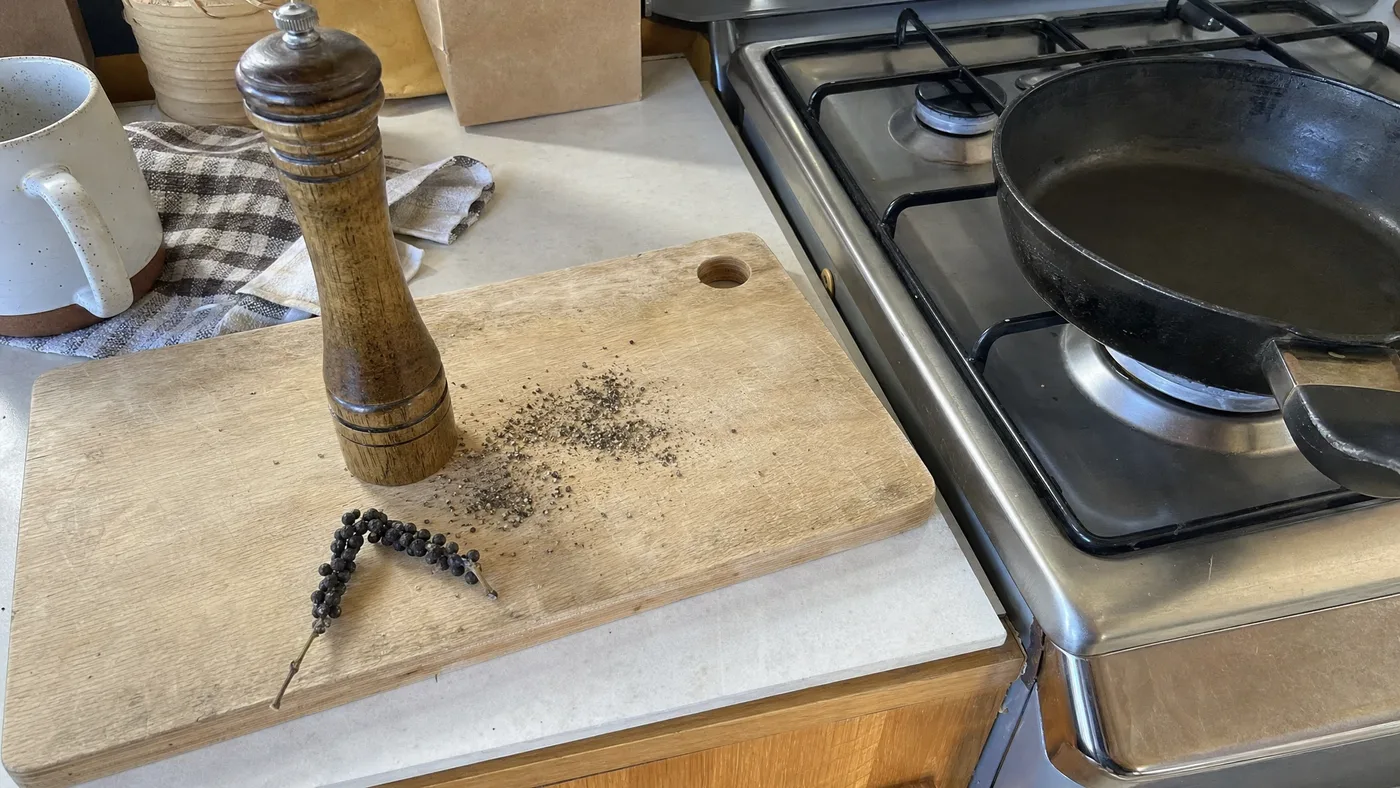
Cooking with Black Pepper Essential Oil
If you searched for "cooking with black pepper essential oil," you're probably standing in your kitchen looking at a small amber bottle from a diffuser kit, wondering if a drop or two could do for a sauce what a pepper grinder does. It's a reasonable question. The short answer is below in the quick-answer box, and the longer answer explains a distinction that the spice and flavoring industry draws clearly but that almost never makes it onto a retail aromatherapy label.

Black Pepper Essential Oil
Our own Black Pepper Essential Oil, in sizes from 0.5 oz to bulk.
From $11.99
Shop Now →Quick answer: Aromatherapy-labeled black pepper essential oil, including this brand's, is not labeled or intended for culinary use. If you want a stronger, more concentrated pepper flavor in your cooking, reach for ground pepper, whole peppercorns, or a product explicitly labeled food grade. An aromatherapy bottle meant for a diffuser or a topical blend is a different product made for a different purpose.
What "Food Grade" Actually Means, and Why It Doesn't Apply to This Bottle
Here's the part of the story that usually gets skipped. The Flavor and Extract Manufacturers Association (FEMA) does maintain GRAS (Generally Recognized As Safe) listings for black pepper flavoring substances used in commercial food manufacturing: FEMA 2844 for Pepper, Black; FEMA 2845 for Pepper Black Oil; and FEMA 2846 for Pepper Black Oleoresin, all recognized under 21 CFR 182.20. That's a real regulatory fact, not a marketing claim.
But it's easy to misread what that fact actually covers. FEMA GRAS status applies to flavoring substances formulated, dosed, and manufactured specifically for food production: measured into a sauce base at a food chemist's bench, diluted to a known concentration, and built into a product designed to be eaten. That is a different product category from a steam-distilled essential oil bottled for a diffuser, a perfumery blend, or a diluted topical application. A FEMA listing for pepper black oil as a food-industry flavoring ingredient is not a safety endorsement of pouring drops from a retail aromatherapy bottle into a pot on your stove. Different formulation, different dosing, different label, different intended use.
What You're Actually Trying to Do
People rarely land on this search by accident. Usually the real goal is a more concentrated, longer-lasting pepper flavor than fresh-cracked pepper delivers, something closer to what shows up in restaurant pepper sauces or finishing oils. That's a legitimate culinary goal. It just points toward a different shelf than the one your aromatherapy oil sits on.
The food-safe route for that goal is peppercorn-infused cooking oil: a kitchen staple made by steeping whole peppercorns in a neutral cooking oil over gentle heat, then straining. It is not a distilled essential oil. It's closer to a flavored oil you'd find next to the chili oil at a grocery store, made with ordinary pantry ingredients and ordinary pantry techniques. Ground pepper and good peppercorns, freshly cracked right before serving, also go a long way further than most people give them credit for. If you want something closer to a commercial flavoring, look for a product explicitly labeled food grade on its packaging, sold and formulated for that purpose, rather than repurposing a bottle labeled for diffusing or topical blending.
How to Make Peppercorn-Infused Cooking Oil
This is the practical version of what most people searching for a pepper flavor boost are actually after. It uses whole peppercorns and a cooking oil you already trust in food, not an essential oil.
What You'll Need
- 1/2 cup whole black peppercorns
- 1 cup neutral cooking oil (grapeseed, light olive oil, or avocado oil all work well)
- A small saucepan
- A fine mesh strainer or cheesecloth
- A clean, dry glass bottle or jar with a tight lid
Steps
- Lightly crack the peppercorns. Use the flat of a knife or a mortar and pestle to crack, not pulverize, the peppercorns. Cracking exposes more surface area to the oil without turning everything into fine dust that's hard to strain out later.
- Warm the oil gently. Pour the oil into the saucepan and heat it over low heat until it's warm to the touch but nowhere near smoking. You're coaxing flavor out slowly, not frying the peppercorns.
- Add the peppercorns and steep. Stir the cracked peppercorns into the warm oil and let the pan sit off the heat, covered, for 30 to 45 minutes. Longer steeping builds a stronger flavor, but there's a point of diminishing returns where the oil picks up bitterness instead of brightness.
- Strain thoroughly. Pour the oil through a fine mesh strainer lined with cheesecloth into your storage bottle. Press gently on the solids to release the last bit of oil, then discard the spent peppercorns.
- Label and date the bottle. Write the date on the bottle or jar. Infused oils don't keep indefinitely, and tracking how long it's been sitting matters more than it seems like it should.
- Refrigerate and use within two weeks. Because garlic, herb, and spice-infused oils can support bacterial growth at room temperature, keep peppercorn oil refrigerated and use it up within about two weeks rather than storing it on the counter like a plain cooking oil.
Tips and Common Mistakes
- Don't skip the low heat. High heat on raw peppercorns scorches them fast and turns a fragrant infusion into a flat, acrid one.
- Don't over-steep. An hour is usually plenty. Overnight steeping at room temperature is both a flavor risk and a food safety risk.
- Don't skip straining fully. Leftover pepper fragments floating in the oil speed up spoilage and cloud the finished product.
- Don't store it warm. Keep infused oils in the refrigerator, not next to the stove, no matter how good it looks sitting out.
What to Expect
A properly strained peppercorn-infused oil generally carries a noticeably sharper, more rounded pepper flavor than a few turns of a pepper grinder, and it holds up well drizzled over roasted vegetables, finished soups, or a steak just off the pan. Results vary a bit by peppercorn freshness and steeping time, so it's worth adjusting to taste on a second batch once you've got a feel for your own kitchen.
Why Essential Oils Don't Behave Like Food Extracts
The underlying reason an aromatherapy bottle and a food flavoring preparation aren't interchangeable comes down to concentration and chemistry. A steam-distilled essential oil is an extremely concentrated form of a plant's aromatic compounds, often representing the volatile oil extracted from a large quantity of raw material into a small bottle. Whole-spice extracts and food-industry flavoring preparations used under FEMA GRAS listings are formulated and diluted specifically to behave predictably in a food matrix, accounting for how fat-soluble compounds disperse (or fail to disperse) in a watery sauce or broth. Essential oils generally don't mix evenly into water-based foods the way a ground spice does, which means a drop can end up concentrated in one bite rather than spread through the dish, and the intensity of that concentrated drop bears little resemblance to the mild, even heat of fresh-cracked pepper.
Already Have Aromatherapy Black Pepper Oil in the Kitchen?
If a bottle meant for your diffuser ended up near your spice rack and you're wondering whether a past accidental taste is something to think about, we've covered that directly in our guide on ingesting black pepper essential oil, including what the safety and side-effect picture looks like in this breakdown of safety and side effects. For quick answers to the most common questions people ask us about this oil, our black pepper essential oil FAQ is a good place to start.
For everyday cooking, the simplest fix is also the most reliable one: keep the aromatherapy bottle on the shelf where it belongs, next to the diffuser and the carrier oils for topical blending, and keep a good pepper grinder and a jar of infused oil within reach of the stove instead.