How to Read a Black Pepper Oil GC-MS Report
A GC-MS report is a lab test that separates an essential oil into its individual aromatic compounds and identifies each one by mass. The single most useful thing a buyer can check on one is whether the major compounds, and their rough percentages, fall within the published range for black pepper oil, rather than taking the marketing copy on the label at face value.
If you've shopped for black pepper essential oil for more than a few minutes, you've probably run into the letters "GC-MS" or seen a supplier mention a "COA" (certificate of analysis) somewhere in the product description. For most buyers, that's where the research stops. The term sounds authoritative, the document looks scientific, and it's tempting to treat its mere existence as proof that a bottle is what it claims to be. It isn't, not by itself, but learning to actually read one turns it from a trust symbol into a genuinely useful piece of evidence.

Black Pepper Essential Oil
Our own Black Pepper Essential Oil, in sizes from 0.5 oz to bulk.
From $11.99
Shop Now →This guide walks through what a GC-MS report measures, what a typical black pepper oil COA shows, the reference standard labs compare results against, and where the limits of the method sit. If you'd rather skip the literacy lesson and just want a bottle that's already been vetted, our quality guide and our own black pepper essential oil are a reasonable place to start, but understanding the report helps with every bottle you buy after this one too.
What GC-MS Actually Does
GC-MS is shorthand for gas chromatography-mass spectrometry, and it's really two instruments working in sequence. The gas chromatography half does the separating: a tiny sample of the oil is vaporized and pushed through a long, narrow, coiled column by an inert carrier gas. Different compounds in the oil travel through that column at different speeds depending on their size, polarity, and how strongly they interact with the column's coating. A compound like a small, non-polar monoterpene moves through relatively quickly; a larger, more complex sesquiterpene takes longer. By the time the sample reaches the far end of the column, what went in as one mixed liquid comes out as a sequence of distinct bands, each one a single (mostly) pure compound, spread out over time.
The mass spectrometry half does the identifying. As each separated compound exits the column, it's bombarded with electrons, which breaks it into charged fragments in a pattern that's highly specific to its molecular structure. The instrument records that fragmentation pattern and compares it against a reference library, essentially a fingerprint match, to say "this is alpha-pinene" or "this is beta-caryophyllene." Put the two halves together and you get a method that doesn't just say an oil contains dozens of aromatic compounds; it says which ones, in what order they eluted, and roughly how much of each is present.
What a Report Typically Shows
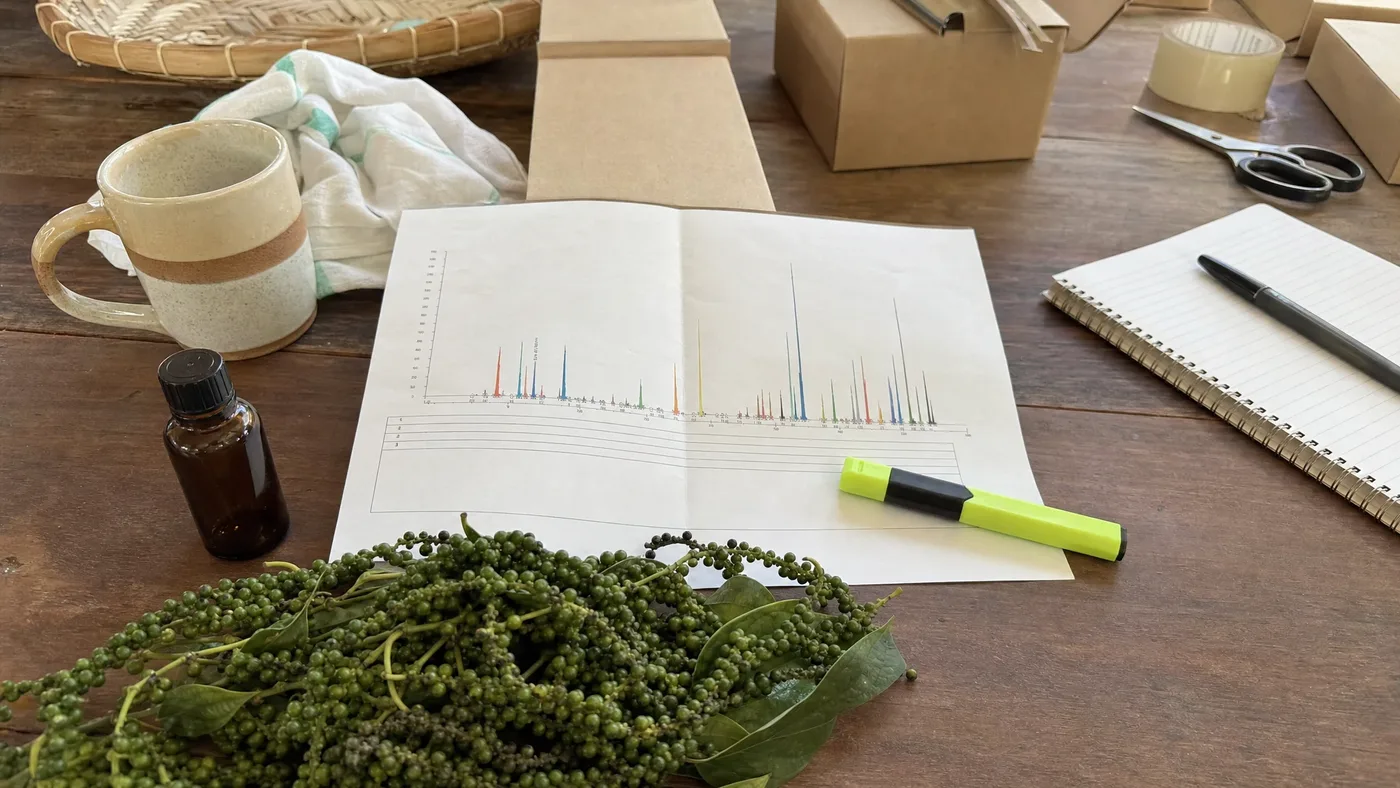
A finished GC-MS report usually has two parts that matter to a non-chemist reader. The first is the chromatogram itself: a line graph with time along the bottom axis and signal intensity up the side. Each spike, or peak, on that graph represents one compound eluting from the column at that moment. A clean black pepper oil chromatogram tends to show a cluster of tall peaks early on (the lighter monoterpenes) and another cluster later (the heavier sesquiterpenes), with a long tail of smaller peaks representing minor constituents present in trace amounts.
The second part is the compound list: a table pairing each identified peak with a name and a percentage of the total oil. Some labs add a third column showing a reference range, a published "expected" percentage window for that compound in an authentic oil of that species, so you can see at a glance whether your sample's number falls inside or outside the normal band. That reference range column, when it's present, is doing most of the useful work in the whole document. A compound list with no comparison point is just a list of numbers; you have no way to judge whether 28% beta-caryophyllene is ordinary or alarming without something to measure it against.
The Real Reference Point: ISO 3061
That comparison point already exists, and it has a name: ISO 3061:2008, "Oil of black pepper (Piper nigrum L.)." This is the international standard that defines what black pepper essential oil is supposed to look like, smell like, and chemically contain. It covers basic physical properties (appearance, odor, density, optical rotation, refractive index) and, importantly, it lays out a normative chromatographic profile, meaning a defined range of expected percentages for the oil's major compounds, with separate allowances for oils from different growing regions, since black pepper grown in different climates and soils naturally produces slightly different ratios of its key constituents.
This is the detail most marketing copy skips over. A label can say "GC-MS tested" without saying tested against what. The more meaningful question is whether a lab (or a supplier relaying a lab's findings) is comparing a batch's result against an ISO-referenced range or another published compositional range for black pepper oil, rather than just producing a number with no context. A report with a percentage and nothing to measure it against tells you very little on its own.
We've written in more depth about the specific compounds that make up black pepper oil, and the rough proportions you'd expect to see, in our properties and chemistry guide, so we won't re-derive the full compound list here. In short: beta-caryophyllene is typically the largest single constituent by a wide margin, with limonene, sabinene, and pinene among the other major players, alongside a longer tail of minor sesquiterpenes and monoterpenes. What matters for reading a GC-MS report is less memorizing exact numbers and more recognizing whether the major names on the list match what's expected, and whether their percentages sit in a plausible range rather than wildly off from it.
What GC-MS Alone Can Miss
GC-MS is genuinely good at catching gross mismatches: an oil sold as black pepper that's actually mostly a cheaper filler oil, or one that's missing its major constituents entirely, will usually show up as obviously wrong on a standard chromatogram. What it's much weaker at catching is a more sophisticated kind of adulteration, where someone adds a synthetic (lab-made) version of a compound that naturally occurs in the oil anyway, at a percentage that looks perfectly normal on paper.
The reason this slips past standard GC-MS is structural. Mass spectrometry identifies a compound by its fragmentation fingerprint, and a synthetic beta-caryophyllene molecule fragments identically to a naturally derived one; they're the same molecule, just sourced differently. A routine GC-MS run has no way to distinguish them, so a batch bulked out this way can post a compound list that matches the ISO reference range almost perfectly while still being partly synthetic.
Essential-oil-authentication literature describes two methods built specifically to catch this gap. Chiral gas chromatography separates compounds not just by size and polarity but by their molecular "handedness," since many naturally occurring terpenes exist predominantly as one mirror-image form while their synthetic counterparts are typically produced as a roughly even mix of both. Isotope-ratio mass spectrometry (GC-IRMS) goes a step further, measuring the ratio of carbon isotopes within a compound, which tends to differ measurably between plant-derived and petrochemically synthesized material. Research in food and fragrance authentication has used both techniques to flag adulteration that standard GC-MS missed entirely.
The practical takeaway for a buyer: these more sophisticated tests exist, but they're expensive and slow compared to routine GC-MS, and most consumer-facing certificates of analysis simply don't include them. A standard COA is a meaningful piece of evidence, not an exhaustive one. It's worth knowing the difference between "this lab checked everything possible" and "this lab ran the standard, affordable screen," because almost every COA you'll encounter as a shopper is the latter.
A Worked Example: Reassuring Versus Concerning
Without fabricating specific numbers from a real tested batch, it's still useful to describe in general terms what a reassuring report tends to look like next to one that raises questions.
A reassuring black pepper oil GC-MS report shows the expected major compounds present in roughly their expected proportions: beta-caryophyllene as the largest single peak by a clear margin, a reasonable showing of limonene, sabinene, and pinene, and a long tail of smaller, named peaks accounting for the rest. The minor compounds vary a bit from batch to batch, which is normal and even expected given natural variation in growing conditions and harvest timing, but nothing on the list is wildly out of range, and there's no unexplained large peak that doesn't correspond to a compound you'd expect to find in black pepper oil at all.
A report worth questioning tends to show one of two patterns. The first is a dominant compound that simply doesn't belong, something that isn't part of black pepper oil's known profile showing up as a major constituent, which usually points to dilution with another oil or a synthetic filler. The second is subtler: a percentage breakdown that reads as suspiciously tidy, round numbers that don't reflect the small, irregular variation you'd expect from a natural, batch-to-batch agricultural product. Real plant material is a little messy. A compound list that looks too clean can be a sign the numbers were smoothed over rather than measured.
[NEED FROM SME: do we have a real, publishable GC-MS report or COA for our black pepper oil? If yes, this section should walk through our actual report instead of a generic, illustrative example.]
Safety Profile and Contraindications
A compound list on a GC-MS report tells you what's in the oil, but it doesn't tell you how to use it safely, and a clean chromatogram is not a safety clearance on its own. Black pepper essential oil is concentrated plant material and should always be diluted in a carrier oil before it touches skin; common recreational dilution guidance for an undiluted essential oil like this falls well under 5%, and lower for anyone with sensitive skin. Before using any new oil on a larger area, apply a small diluted amount to the inner forearm and wait a day to check for any reaction.
Keep black pepper oil away from the eyes and other sensitive areas, and store it somewhere children can't reach it on their own. If you're considering it around young children at all, read our dedicated guide on black pepper oil and kids first, since dilution needs and appropriate use change significantly with age. Anyone pregnant, nursing, or managing an existing health situation should check with a qualified healthcare provider before introducing a new essential oil into a routine, and an essential oil is never a substitute for guidance from that provider.
Some published research has looked at how individual compounds found in black pepper oil, including beta-caryophyllene, interact with biological pathways in laboratory and animal studies. This is early-stage, mechanistic research, not a demonstration of what the finished essential oil does for a person using it at home, and it shouldn't be read as a claim about outcomes. A GC-MS report confirms composition; it doesn't confirm, or rule out, how an individual's skin or body will respond to that composition.
Sourcing and Quality Indicators
A GC-MS report is one input into a quality judgment, not the whole judgment. A few other things worth checking alongside the chemistry:
- Botanical name on the label. It should read Piper nigrum. A common name alone ("black pepper oil") leaves room for substitution.
- Extraction method and plant part. Steam-distilled from dried peppercorns is standard for this oil; a listing that's vague about method or part used is worth a second look.
- Country or region of origin. Because ISO 3061 allows for regional variation, knowing the origin helps a lab (or you) judge the chromatogram against the right version of the reference range.
- Batch-specific testing. A COA tied to a specific lot number and production date is more meaningful than a generic "typical analysis" document that could apply to any batch the supplier has ever made.
- Willingness to share the report at all. A supplier that provides a GC-MS report on request, rather than only a marketing summary of it, is signaling something about how they handle quality control more broadly.
None of these checks, including the GC-MS report itself, function as an absolute guarantee of purity on their own. Together, they build a reasonably strong case. Our own sourcing and testing approach, along with more detail on what to look for from any supplier, is laid out in our guide to buying pure black pepper essential oil.
Reading the Report Is the Skill
A GC-MS report rewards a reader who knows what to look at. Check whether the major compounds, beta-caryophyllene first, then limonene, sabinene, and pinene, show up roughly where ISO 3061 and published compositional data say they should. Notice whether the percentage breakdown looks like it came from a real, slightly irregular batch of plant material or from a dataset that's been smoothed into something suspiciously tidy. And hold the whole document at the right weight: it's strong evidence of what's in the bottle, not an absolute guarantee, and it's silent on the more sophisticated adulteration that chiral GC and GC-IRMS are built to catch. We test our own black pepper essential oil with exactly that comparison in mind, and we'd rather a customer know how to read the result than just take our word for it.