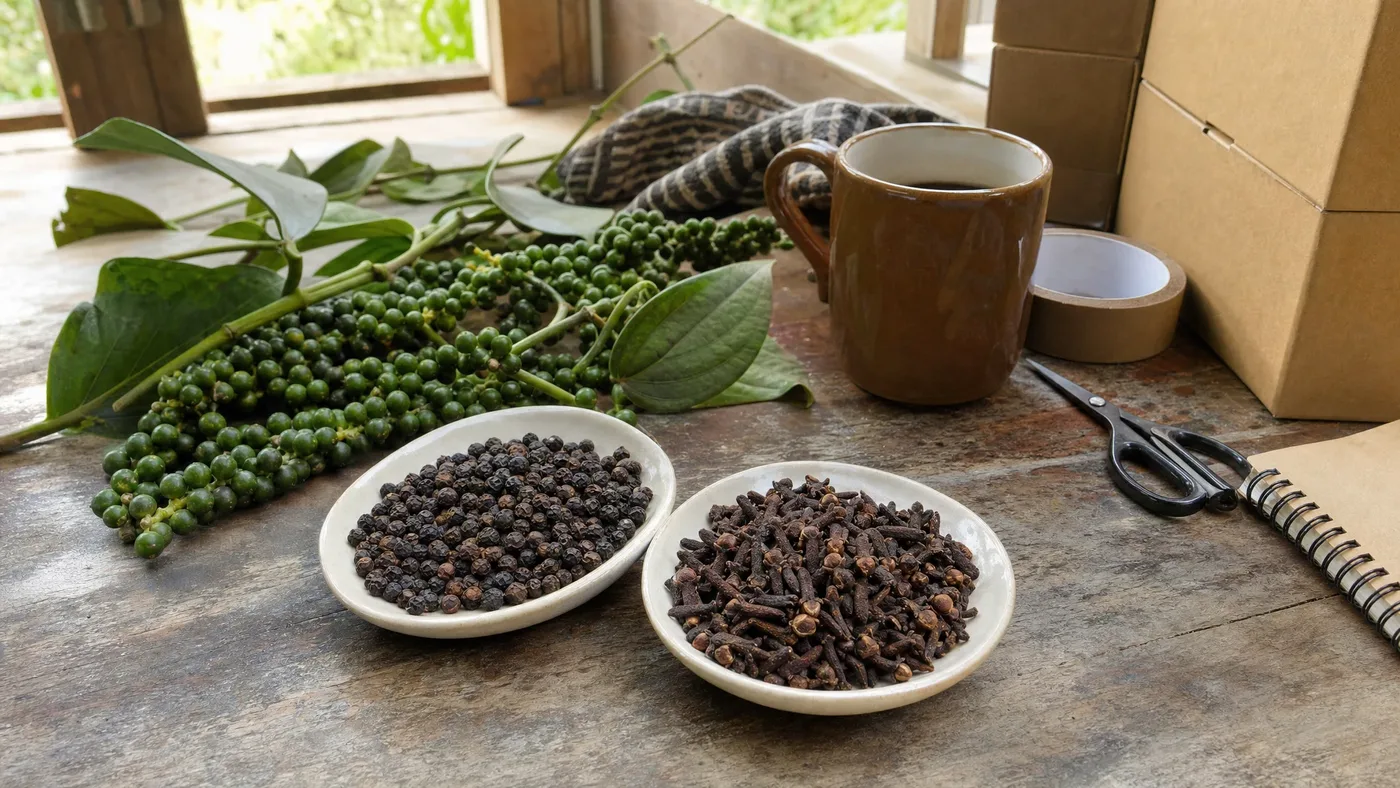
Black Pepper vs Clove Essential Oil: Which Is Safer to Use?
Walk down the "warm spice" shelf of any essential oil retailer and black pepper and clove bud sit side by side like they belong to the same family. Both smell spicy. Both get marketed for cozy, grounding blends. Both show up in the same seasonal diffuser recipes. That shared packaging is exactly why so many shoppers assume they carry the same level of risk on skin, and that assumption is wrong. The chemistry behind these two oils is not remotely similar, and the dermal safety guidance for each reflects that gap clearly.

Black Pepper Essential Oil
Our own Black Pepper Essential Oil, in sizes from 0.5 oz to bulk.
From $11.99
Shop Now →If you're building a spice-oil collection and want to know where black pepper essential oil's chemistry and aromatic profile fits into that picture, it's worth understanding before you reach for either bottle in an undiluted or lightly diluted blend.
The quick answer
Black pepper essential oil and clove bud essential oil are not interchangeable from a skin-safety standpoint. Clove bud oil carries a strict, well-documented dermal maximum because of its very high eugenol content, a compound closely tied to skin sensitization and mucous membrane irritation. Black pepper oil has no comparably strict ceiling in the safety literature and no specific documented contraindication for topical use at reasonable dilution. That does not make black pepper oil risk-free, and it does not make clove oil unusable. It means the two oils sit in meaningfully different risk tiers, and a shopper who treats "spicy and warming" as a stand-in for "similar risk profile" is working from the wrong mental model.
Black pepper vs clove essential oil at a glance
| Attribute | Black Pepper Essential Oil | Clove Bud Essential Oil |
|---|---|---|
| Dominant constituent | Mostly monoterpenes and sesquiterpenes (such as limonene and beta-caryophyllene); no single compound dominates the profile | Eugenol, reported in composition studies at up to roughly 85% of the oil |
| Typical dermal maximum (per Tisserand & Young, Essential Oil Safety, 2nd ed., 2014) | No firmly established maximum; secondary summaries vary, with some citing no noted limit and others suggesting a conservative ceiling around 1% | 0.5%, set specifically because of eugenol-driven sensitization and mucous membrane concerns |
| Bath use caution | No specific caution noted in the major safety references | Advised against, even when diluted, due to mucous membrane exposure risk |
| Use around young children (age 2 and under) | No specific contraindication documented | Topical use advised against on this age group |
| Typical aromatic role | Warming blends, woody-spice perfumery accords, grounding base-to-middle notes | Historically tied to culinary and traditional mouth-care practices; a strong, dominant spice note used sparingly in blending |
| Mucous membrane sensitivity concern | Lower level of documented concern | Significant, well-documented concern |
Why eugenol changes the entire safety conversation
Eugenol is the reason clove bud oil behaves so differently from almost every other spice oil on the shelf, black pepper included. Composition analyses of clove bud oil consistently report eugenol making up the large majority of the oil, sometimes cited as high as approximately 85%. That concentration is unusual. Most essential oils are complex mixtures where no single constituent dominates to that degree, which is part of why their safety profiles tend to be more forgiving.
Eugenol itself is recognized in the safety literature as a skin sensitizer, meaning repeated or concentrated exposure can increase the likelihood of a reactive response over time, and as an irritant to mucous membranes specifically. That combination is why Tisserand and Young set clove bud oil's dermal maximum at a strict 0.5%, a notably lower ceiling than most essential oils carry, and why their guidance explicitly cautions against bath use even at diluted concentrations and against topical application on children age two and under. None of that is marketing caution. It's a direct response to a compound that shows up in this oil at unusually high levels.
Black pepper oil doesn't have an equivalent single dominant compound driving a similar concern. Its profile is a blend of terpenes that, individually and collectively, haven't earned the same strict dermal ceiling in the major safety references. That's genuinely useful context if you're comparing black pepper against other warm spice oils like ginger and cardamom, since the safety profiles across that whole category tend to cluster closer to black pepper's lower-concern pattern than to clove's.
Black pepper essential oil: pros and cons
Pros:
- No firmly established strict dermal maximum in the major safety references, giving blenders more working room at sensible dilutions
- No specific documented contraindication for use around older children in the way clove carries
- A versatile, warm, woody-spice note that blends well in perfumery and massage-style carrier blends
- Complex multi-compound profile rather than one dominant, higher-risk constituent
Cons:
- Sources aren't perfectly consistent on an exact dermal percentage, so "no documented maximum" should be read as comparatively lower risk, not as license for unlimited use
- Still a concentrated plant extract that can irritate skin if used without proper dilution
- Less culinary and historical documentation around topical use compared to clove's long traditional record
Clove bud essential oil: pros and cons
Pros:
- A long, well-documented history in culinary use and traditional practices across several cultures
- An intensely warm, distinctive spice note that's hard to replace in certain blending profiles
- Widely available and well-studied, meaning its risks are clearly mapped rather than unknown
Cons:
- Very high eugenol content drives a strict 0.5% dermal maximum, the strictest ceiling of the two oils by a wide margin
- Documented caution against bath use even when diluted
- Documented caution against topical use on children age two and under
- Meaningfully higher documented potential for skin sensitization and mucous membrane irritation with careless use
Best for: matching the oil to the use case
- Best for everyday diluted skin blends: black pepper essential oil, given its comparatively lower documented dermal risk
- Best for perfumery and warming diffuser blends: both oils work, though black pepper is the easier one to handle confidently at a wider range of dilutions
- Best for households with young children: black pepper oil, used at sensible dilution, over clove bud oil, which carries a specific caution for this age group
- Best for an intense, traditional spice accord in small, carefully measured amounts: clove bud oil, respected for what it is rather than avoided altogether
- Best for bath-blend use: black pepper oil is the more appropriate choice; clove bud oil is specifically cautioned against here
Spice oils compared: scent and use-case differences
Beyond the safety gap, these oils simply read differently on the skin and in the air. Black pepper is peppery and bright up front, settling into a dry, woody warmth that plays well as a background note. It's the kind of oil that supports a blend rather than announcing itself. Clove bud is the opposite: dense, sweet-sharp, and immediately dominant. A little goes a long way in a formulation, which is part of why traditional recipes that use clove tend to measure it in drops rather than percentages.
That intensity is also why clove's reputation as the "strongest" spice oil persists. It's not wrong, aromatically. The mistake is translating aromatic strength into an assumption about skin safety, when the actual safety gap is driven by eugenol concentration, not by how strong the scent is.
The verdict
On dermal safety specifically, black pepper essential oil is the comparatively lower-risk choice between the two. The gap isn't close. Clove bud oil's high eugenol content earns it a dermal maximum roughly a fraction of what more forgiving oils allow, plus explicit cautions against bath use and use around young children. Black pepper oil carries no equivalent documented restriction in the major safety references, though that should be read as "comparatively lower documented concern," not as an invitation to skip dilution altogether.
If you want one spice oil in your collection that you can reach for more freely across skin-safe blends, black pepper is the more flexible, lower-risk option of the two.
When clove still earns a place in your cabinet
None of this makes clove bud oil a bad oil. It makes it an oil that demands much more careful handling. Clove's long culinary history and its traditional association with mouth-care practices in various cultures are well documented as historical use, not as a basis for applying the oil directly to skin or mucous membranes today. If you love the scent and want it in a diffuser blend or a very lightly dosed perfumery accord, that's a reasonable use. What changes is the margin for error: at 0.5% dermal maximum, measuring matters far more than it does with a more forgiving oil.
Patch testing, every time
Regardless of which oil you choose, dilution and a patch test are non-negotiable steps, not optional ones. Apply a properly diluted blend to a small area of skin, such as the inner forearm, and wait 24 to 48 hours before wider use. If you notice redness, itching, or discomfort, discontinue use and wash the area. Our guide on black pepper oil dilution rates and patch testing walks through specific ratios for different uses, and the same patch-testing discipline applies even more strictly to clove bud oil given its lower dermal ceiling.
If you're ready to build a warm spice blend around the lower-risk option of the two, our black pepper essential oil is sourced and tested with exactly this kind of careful, informed use in mind, a practical starting point for anyone who wants that signature warmth without clove's narrower margin for error.
Always consult a qualified healthcare provider before using any essential oil, particularly if you are pregnant, nursing, managing a sensitive skin condition, or applying products to children.