Is Your Black Pepper Essential Oil Pure? How to Spot Adulteration
Quick answer: You can't fully verify black pepper oil purity by smell alone. Gross dilution sometimes shows up on a paper dry-down test, but sophisticated synthetic-terpene bulking requires lab analysis, such as GC-MS checked against the ISO 3061:2008 reference profile, chiral GC, or isotope-ratio mass spectrometry. Ask suppliers for a batch-specific Certificate of Analysis.

Black Pepper Essential Oil
Our own Black Pepper Essential Oil, in sizes from 0.5 oz to bulk.
From $11.99
Shop Now →Our companion piece, How to Buy Pure Black Pepper Essential Oil, covers the basics: reading the label, checking for a batch number, confirming botanical name and origin. That's the right place to start if you haven't shopped for black pepper oil before. This guide goes a layer deeper. It's about how adulteration is actually detected, both in a lab and at your kitchen table, and it's honest about where a shopper's own senses run out of road. If you're comparing a bottle on your counter against what a quality-focused producer like Black Pepper Essential Oil aims to deliver, the gap between what you can check at home and what requires instrumentation is worth understanding before you spend money on a "premium" oil that may not be what the label implies.
Why Black Pepper Oil Gets Cut: The Economics of Adulteration
Black pepper essential oil is steam distilled from dried, crushed peppercorns, and the yield is low. Published extraction data generally puts it somewhere around 2 to 4 percent oil by weight of the dried fruit, depending on the pepper's origin, maturity at harvest, and how the distillation is run. That means it takes a genuinely large quantity of peppercorns, themselves a globally traded spice with their own price swings, to produce a modest volume of essential oil. That low yield is a real cost driver, not a marketing talking point, and it's the single biggest reason black pepper oil sits at a higher price point than oils distilled from more generous plant material.
Low yield is also exactly the kind of economic pressure that invites corner-cutting. The most common approach isn't crude dilution with vegetable oil, though that happens too. More often it's bulking the batch with cheaper, chemically similar terpenes, things like limonene or pinene, which occur naturally in black pepper oil already in small amounts but can be added synthetically or sourced from cheaper plants to stretch a batch's volume while keeping the overall scent profile in the neighborhood of the real thing. Blending in a lower-cost spice oil is another route, since certain spice oils share overlapping aromatic notes and are far less expensive to produce. None of this is visible on a label. A bottle can say "100% pure black pepper essential oil" and still contain a meaningful percentage of material that didn't come from a peppercorn.
The Sniff Test and Paper Dry-Down: What They Can (and Can't) Tell You
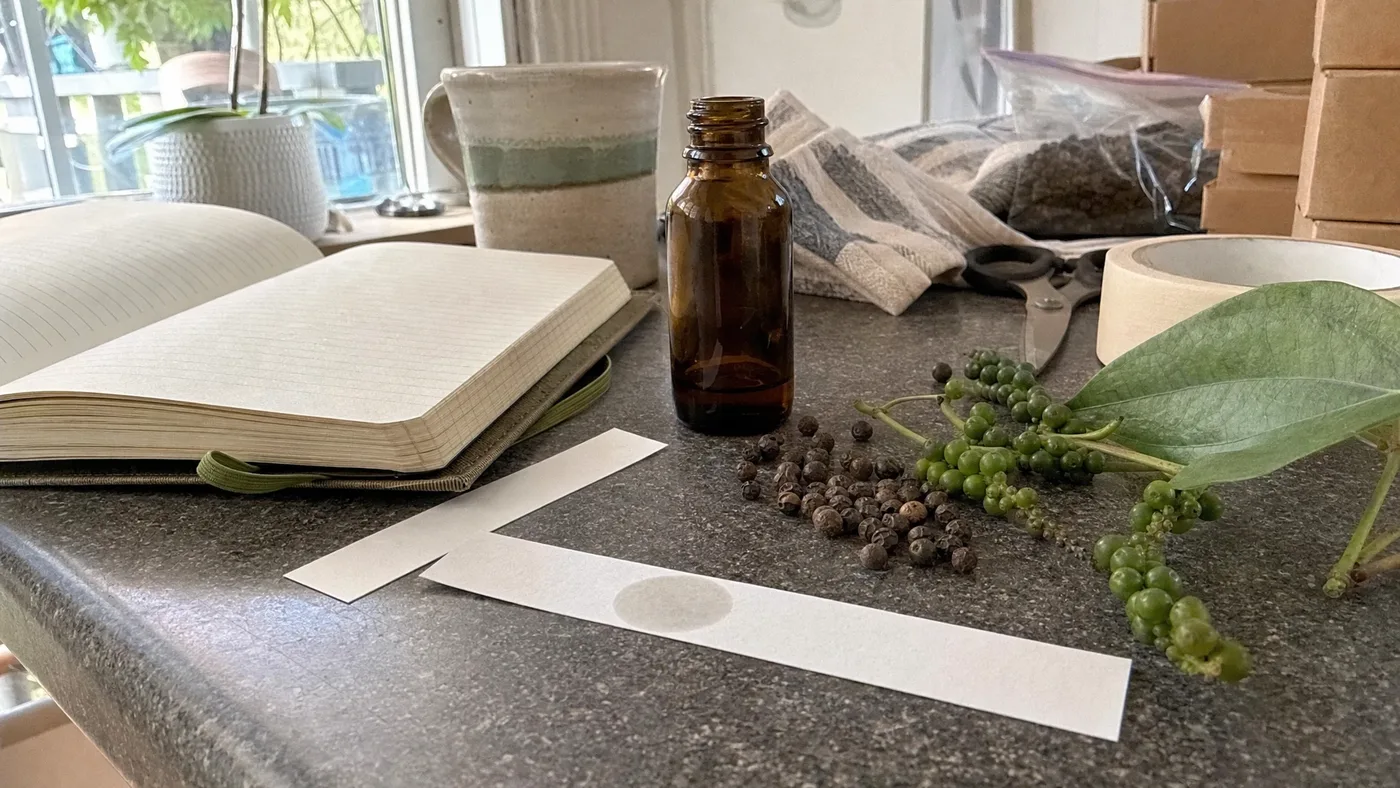
A lot of buying guides recommend the paper dry-down test: put a drop of oil on a strip of plain paper and watch how it evaporates over a few hours. Pure essential oils generally evaporate fully and cleanly, while oils cut with a fixed carrier oil often leave a visible ring or oily residue behind. This test is worth doing. It's free, it takes no equipment, and it genuinely does catch gross dilution, a bottle padded out with a carrier oil or a cheap filler.
What it does not catch is more sophisticated adulteration. If a producer has bulked a batch with synthetic limonene or pinene rather than a fixed oil, that material is volatile too. It will evaporate off the paper right alongside everything else, leaving no residue and no obvious tell. Your nose has the same limitation. Black pepper oil's aroma is a blend of dozens of compounds, and swapping or adding a percentage of a chemically similar terpene can shift the scent only subtly, in a way that's easy to miss unless you have an unadulterated reference sample sitting right next to it for comparison, which almost nobody does. Treat a sniff test and a dry-down test as a first filter that can rule out the most obvious fakes, not as proof of purity. Being honest about that limit is part of being an informed buyer.
How Labs Actually Detect Adulteration
Real verification happens with instrumentation, and there are a few distinct methods worth knowing about, because they catch different things.
GC-MS Against the ISO 3061:2008 Profile
Gas chromatography-mass spectrometry (GC-MS) separates an oil into its individual chemical components and measures their relative proportions. For black pepper oil specifically, there's a published reference standard: ISO 3061:2008, "Oil of black pepper (Piper nigrum L.)." It specifies acceptable ranges for appearance and odor, physicochemical properties like density and optical rotation, and, most usefully for authentication purposes, a normative chromatographic profile covering oils from different countries of origin. A lab can run a sample through GC-MS and compare the resulting chemical fingerprint against that standard to see whether the composition falls inside the expected range, or whether it shows an unusual spike in a cheap terpene that doesn't belong at that concentration.
For more on what that chemical fingerprint actually consists of, our black pepper oil properties and chemistry breakdown walks through the major compounds and what they contribute to the oil's character.
Chiral GC: Catching Synthetic Look-Alikes
Standard GC-MS has a known blind spot. Many terpenes exist in nature as a specific mirror-image form, called an enantiomer, while cheap synthetic versions are often produced as a mixture of both mirror-image forms or as the "wrong" one entirely. On an ordinary GC-MS chromatogram, these can look identical because the molecules share the same mass and basic structure. Chiral GC uses a specialized column designed to separate these mirror-image forms from each other, and it's become a standard tool in essential oil authentication work precisely because it catches synthetic terpene additions that regular GC-MS misses. This kind of analysis has been documented most extensively in research on oils like lavender, where synthetic linalool and linalyl acetate are common adulterants, but the same underlying chemistry and the same detection logic apply to any oil, black pepper included, where single-enantiomer synthetic terpenes could be used to bulk a batch.
GC-IRMS: Verifying Natural Origin
Isotope-ratio mass spectrometry, usually run in combination with gas chromatography as GC-IRMS, measures the ratio of stable isotopes, mainly carbon, within individual compounds in the oil. Compounds that a plant biosynthesizes through photosynthesis carry a characteristic isotope signature that differs measurably from the same compound made synthetically from petroleum feedstocks. Published authentication research on oils like fennel, anise, and lavender has used GC-IRMS to distinguish naturally occurring compounds from synthetic additions and to help confirm a plant's claimed botanical origin, since isotope ratios can also shift with growing region and climate. It's a more specialized and more expensive test than standard GC-MS, which is why it tends to show up in disputed cases or in rigorous third-party authentication work rather than routine quality control.
It's worth being straightforward here: published adulteration research tends to focus more often on oils like lavender, peppermint, and citrus oils, since they're higher-volume commodities with a longer history of documented fraud cases. Black pepper oil doesn't have the same depth of published adulteration literature attached to its name specifically. That doesn't mean it's immune to the practice, given the yield economics described above, it means the same detection principles that have been validated on other oils are the ones that would apply if a lab tested a black pepper oil sample.
What to Ask a Supplier For
None of the lab methods above are something you can run yourself. What you can do is ask the right question. A generic spec sheet listing typical density and refractive index ranges tells you almost nothing, since it describes the category, not the bottle in your hand. What actually matters is a current, batch-specific Certificate of Analysis (COA) or GC-MS report tied to the lot number on your bottle. A supplier that tests its own batches, or sends them to a third-party lab, should be able to produce that document on request. A supplier that can't, or that stalls when you ask, is telling you something.
[NEED FROM SME: does Black Pepper Essential Oil publish a COA or batch GC-MS report for its own product? If yes, link it here and this section should say so directly instead of speaking generically.]
Quality Indicators Worth Checking Before You Buy
- Botanical name on the label. It should read Piper nigrum, not a vague "black pepper fragrance" or "black pepper blend."
- Extraction method stated. Steam distillation is the traditional and most common method; some producers now offer CO2-extracted oil, which tends to capture a fuller spice character. See our comparison of steam-distilled versus CO2-extracted black pepper oil for how that choice affects aroma, cost, and what each method includes in the final oil.
- Origin and harvest region named. Reputable producers are usually willing to say where their peppercorns were sourced, since origin affects the oil's chemical profile under ISO 3061:2008's different reference ranges.
- Packaging. Dark amber or cobalt glass, never clear plastic, since essential oils degrade under light and can interact with certain plastics over time.
- Batch or lot number printed on the bottle, which is what ties the physical product to any COA a supplier can provide.
Key Features to Compare Across Brands
When you're weighing one bottle against another, a few comparison points matter more than glossy packaging or marketing copy:
- Price relative to yield. Given the 2 to 4 percent extraction yield discussed earlier, black pepper oil has a realistic cost floor. A price dramatically under that floor is a red flag, not a bargain.
- Documentation offered. Does the listing mention a batch-specific COA, GC-MS testing, or is it limited to general "pure and natural" language with no data behind it?
- Bottle size versus use case. A 5ml or 10ml bottle makes sense for sampling a new supplier before committing to a larger size.
- Extraction method transparency. As covered in the steam-distilled vs. CO2 comparison, this affects both scent and price, and a supplier should state which method they use.
Top Picks at Different Price Points
Rather than naming specific competing brands, it's more useful to think in tiers, since the right choice depends on how you plan to use the oil and how much documentation you need upfront.
Entry tier: A small bottle, 5 to 10ml, from a supplier that at minimum states botanical name, origin, and extraction method on the label. This is a reasonable way to sample an oil's aroma and quality before buying larger.
Mid tier: A 15 to 30ml bottle from a supplier willing to discuss batch testing or provide documentation on request, even if it isn't posted publicly. Black Pepper Essential Oil's standard sizing sits in this range and is a sensible default for most home use once you've confirmed a supplier's labeling and sourcing practices hold up.
Bulk/professional tier: Larger volumes intended for formulators or frequent use, where a batch-specific COA stops being a nice-to-have and becomes a reasonable expectation given the volume and cost involved.
Red Flags That Should Make You Walk Away
- No batch or lot number anywhere on the bottle or listing. Without one, there's no way to connect the physical product to any testing documentation, even if testing exists.
- Price far below the going rate for a low-yield oil. Given the extraction economics covered above, an unusually cheap bottle is more likely explained by dilution or synthetic bulking than by a supplier passing along efficiency gains.
- Vague "pure and natural" language with no supporting data. These phrases are marketing, not evidence. A supplier confident in their oil's composition will generally say so with specifics, not just adjectives.
- Reluctance to answer direct questions about extraction method or origin. A straightforward supplier can usually answer these without hesitation.
Where to Buy Black Pepper Essential Oil
Buying direct from a producer that publishes clear sourcing information generally gives you the most recourse if something seems off, since you can ask questions and expect a specific answer tied to a specific batch. Specialty aromatherapy retailers that curate their supplier list are a reasonable second option, particularly ones that list botanical names and origins consistently across their catalog rather than only on a few flagship products. Large general marketplaces can carry genuinely good oils, but listings there are harder to vet since third-party sellers can share a single product page, and a positive review history doesn't tell you anything about what's actually in a given bottle. Wherever you buy, the questions from this guide travel with you: is there a batch number, is the price consistent with the oil's real production cost, and will the seller answer specific questions about testing and origin rather than deflecting to general reassurance.
A careful look at labeling, a realistic sense of what an oil like this costs to produce, and a willingness to ask suppliers pointed questions will get most buyers most of the way to a confident purchase. For the remaining gap, the one a sniff test can't close, batch-specific documentation from the supplier is the only real substitute, which is worth keeping in mind whether you're comparing Black Pepper Essential Oil against another bottle or just deciding whether to trust the one already in your cart.