DIY Black Pepper Cologne with Cedar and Frankincense
Most colognes open with a splash of citrus and hope for the best. Black pepper does it differently: it begins dry and a little sharp, then settles into a warm, woody middle, which makes it a natural lead for a scent that wants to smell like a spice drawer and a cedar chest. This is a small formula for a 50 g batch, worked out from published perfumery ratios and our own dilution guidance.

Black Pepper Essential Oil
Our own Black Pepper Essential Oil, in sizes from 0.5 oz to bulk.
From $13.99
Shop Now →Start with the ceiling, then pick the scent
A widely used reference puts eau de cologne at 2 to 3% aromatic material, eau de toilette at 5 to 15% and eau de parfum at 15 to 20% (Wikipedia, Perfume). Home recipes often overshoot because the maker counts drops instead of percentages. Our skin guidance for black pepper oil is 0.5% to 2% with a patch test first, and the EFSA opinion on the oil describes it as an irritant to skin and eyes and a skin and respiratory sensitiser, a classification taken from the applicant's safety data sheet (EFSA FEEDAP Panel, 2022).
So the design rule is a 2% total aromatic load, the bottom of the cologne band and the top of our guidance. If you want a louder scent, change the balance of the oils before you raise the percentage.
Before you measure anything, spend a few minutes just smelling. Dip a paper strip in each oil on its own and hold the three side by side: the pepper dry and bright, the cedarwood dusty and dry, the frankincense a little lemony and resinous. Knowing each one alone makes it much easier to tell what the blend is doing later.
The formula, by weight
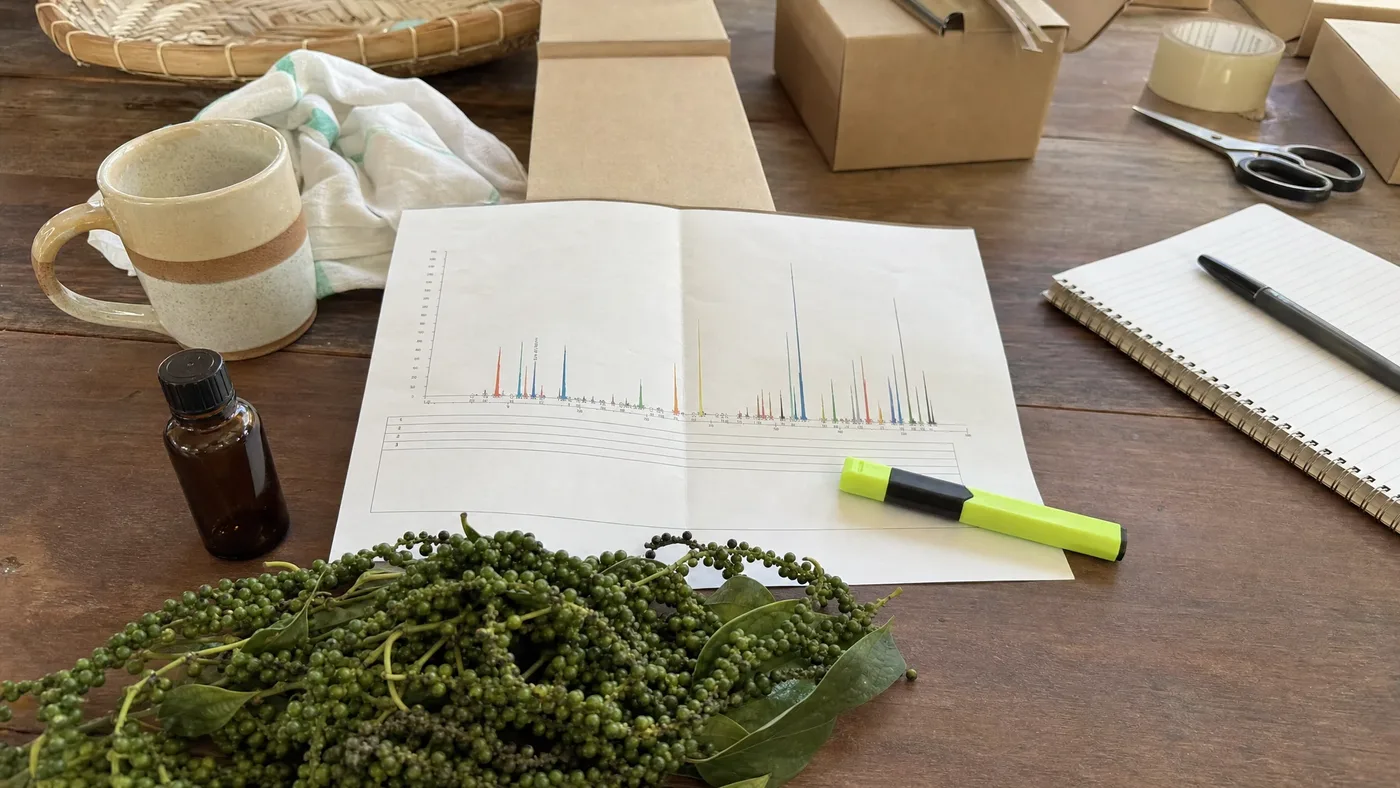
Weigh, do not count drops. A drop of pepper oil and a drop of a thick resin are different amounts, and the percentage is what you are controlling. For reference, the batch on our published Certificate of Analysis has a relative density of 0.873, so 1 g of the oil is about 1.15 ml, or roughly 23 drops at the rough convention of 20 drops per ml.
| Ingredient | Grams | Share of cologne | Approx. drops |
|---|---|---|---|
| Black pepper essential oil | 0.40 | 0.8% | 9 |
| Cedarwood essential oil | 0.40 | 0.8% | 9 |
| Frankincense essential oil | 0.20 | 0.4% | 5 |
| High-proof perfumer's or cosmetic-grade ethanol | 49.00 | 98.0% | |
| Total | 50.00 | 2.0% aromatic |
Pepper leads, cedarwood gives it a dry wood to rest on, and frankincense rounds out the middle. All three sit comfortably together: we recommend black pepper with cedarwood and frankincense, and our pairing guide goes through other partners. We sell the black pepper oil only, so source the other two from a supplier who can name the species and lot and supply an IFRA certificate for fine fragrance. Cedarwood travels under several botanical names, so check which one you are buying.
We left citrus out on purpose. A bright bergamot or lemon top is the classic partner for pepper, but the IFRA Standards Library lists separate standards for several expressed citrus oils, with limits that depend on the oil and the product category (IFRA Standards Library). If you add one, take its permitted level from the supplier's certificate and subtract that share from the others so the total stays at 2%.
Equipment, and respect for the ethanol
You need a scale that reads to 0.01 g, a clean glass beaker, a stirring rod and a dark glass bottle with a fine-mist atomiser. Ethanol is the one real hazard in this recipe. PubChem lists closed-cup flash points of 12.0 C, 13 C and 14.0 C from different sources (PubChem, Ethanol), which is below ordinary room temperature, so mix away from candles, stoves and pilot lights with a window open. Tisserand's retail label for black pepper oil itself carries the statement "Flammable liquid and vapour" (Tisserand).
Steps
- Tare the beaker and weigh the oils in order: frankincense, cedarwood, then black pepper last, so you can stop if you overshoot the one you are judging.
- Stir the oils for a minute and smell a strip dipped in the mix.
- Add ethanol up to 50.00 g total and stir gently.
- Bottle, label with the date and formula, and keep somewhere dark and cool.
- Let it rest a couple of days before judging. Perfumers commonly rest a blend, and 48 hours is a convention rather than a rule, so smell at intervals.
What the finished scent should do
A good cologne has an opening, a middle and a dry-down. Expect the pepper to speak first, a dry sparkle in the first minutes, then the cedarwood and frankincense to come forward as the alcohol evaporates. Spray once onto a strip of paper, wave it, and come back to it after ten minutes, thirty minutes and a few hours. The scent you meet at the end is the one that will be on your clothes at the end of the day.
If it smells sharp or unfinished at first, resist the urge to fix it straight away. Alcohol makes a young blend smell thin, and a couple of days in the dark often rounds it out. If it still feels unbalanced after that, change one oil at a time and write down what you changed.
Wearing it
Patch test first with a little on the inner forearm, as we describe in our dilution and patch test guide. Spray onto clothing or a small patch of skin, away from the face and eyes. Peppercorns owe their distinctive peppery aroma in part to a compound called rotundone (Wood et al., Journal of Agricultural and Food Chemistry, 2008), which is a fun thing to remember when someone asks what you are wearing. For more on pepper as a perfume note, see black pepper in modern fragrance.
Black Pepper Essential Oil
Black Pepper Essential Oil from our own shop, in sizes from 0.5 oz to bulk.
From $13.99
Shop Now →