How to Read a Black Pepper Oil GC-MS Report
A GC-MS report looks wonderful and says nothing to most of us: a wiggly line with a forest of peaks, a table of Latin-sounding names, a column of numbers. The good news is that you do not need a chemistry degree to get real value from one. You need five or six questions, and a rough idea of what a black pepper oil is supposed to look like.

Black Pepper Essential Oil
Our own Black Pepper Essential Oil, in sizes from 0.5 oz to bulk.
From $13.99
Shop Now →What the machine is doing
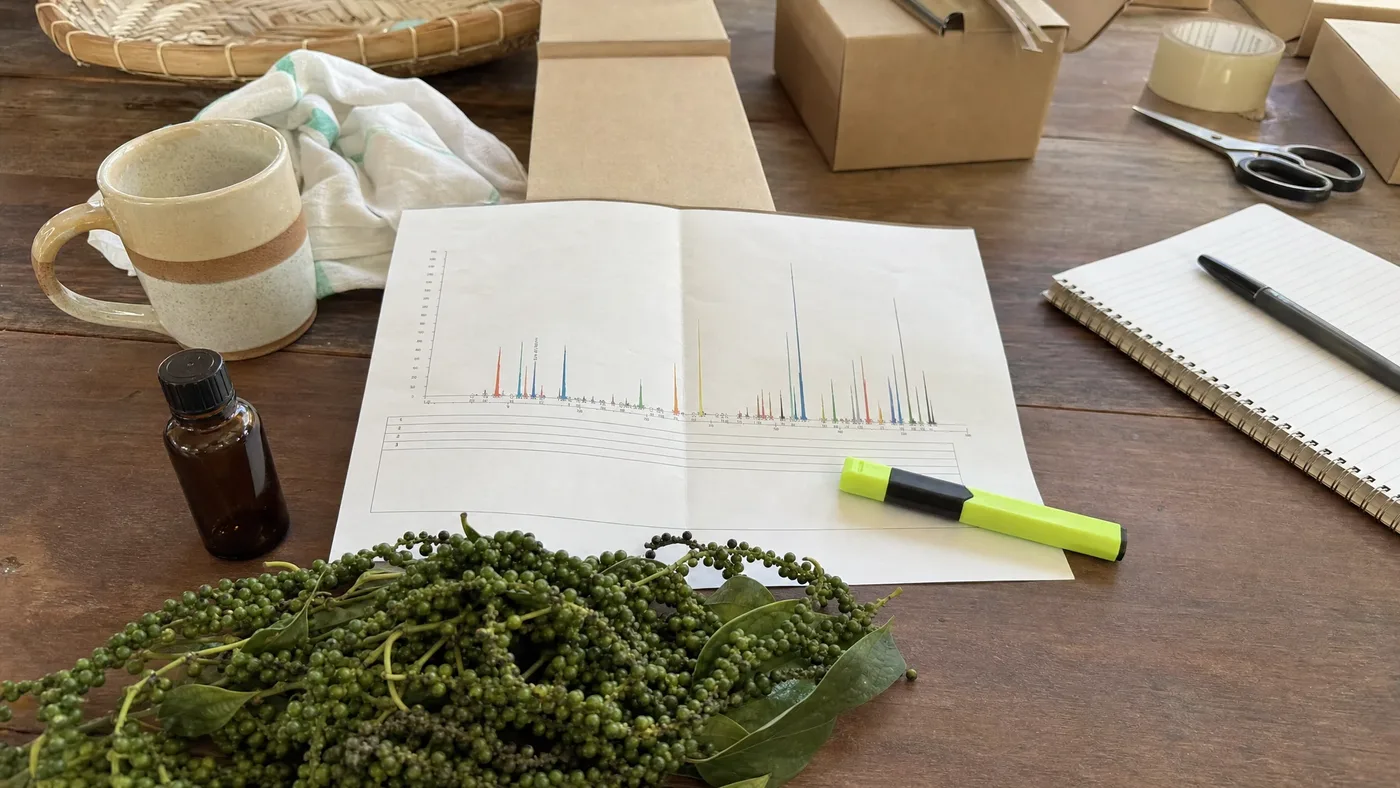
GC-MS stands for gas chromatography with mass spectrometry. A tiny sample of oil is vaporized and carried through a long coiled column, where its compounds travel at different speeds and come out one after another. Each one then passes into a second instrument that breaks it into fragments and matches the pattern to a library, which is how it earns a name. Every peak on the chart is one compound, and its size reflects how much of the oil it makes up.
The percentages on most reports are shares of the total peak area, so they describe proportions, not weights. That is the same convention the EFSA panel used when it reported black pepper oil composition as percent of GC area.
The yardstick: what black pepper oil usually looks like
A list of numbers only means something next to a reference. For black pepper, the sensible one is ISO 3061:2008, the international standard for the oil, which the EFSA panel used as the basis for its own specification. EFSA's ranges for the main compounds, with the average it measured across five commercial batches, look like this:
| Compound | Specification range | Five-batch average |
|---|---|---|
| Beta-caryophyllene | 12.0 to 40.0% | 25.6% |
| Limonene | 7.0 to 20.0% | 12.5% |
| Sabinene | 4.0 to 17.0% | 9.4% |
| Alpha-pinene | 2.5 to 16.0% | 8.9% |
Those batches were Sri Lankan oils, and the ranges are wide on purpose, because origin, plant part and drying all move the numbers. Our post on black pepper oil chemistry shows how far published samples can differ. Treat the table as a neighborhood and not a bullseye.
Here is a trick that works for beginners: before you look at any number, read the top of the page. The name of the oil, the lot, the date and who ran the test tell you whether you are holding a document about your bottle or one about oil in general. Only then does it make sense to look at the table.
Six things to check on any report
- Is it the right plant and part? It should say Piper nigrum and fruit. Leaf oil has a completely different profile.
- Do the big names show up? Beta-caryophyllene, limonene, sabinene and the pinenes should lead the list, in plausible shares.
- Does it name a batch and a date? A report tied to a lot number is about that lot. A generic "typical analysis" is about oil in general.
- What is it compared against? A range or a standard such as ISO 3061 gives the numbers meaning.
- Is the origin stated? It tells you which version of the range to hold the numbers against.
- Is anything large and unfamiliar? A big peak that does not belong to pepper is worth a question to the seller.
Reading the table like a person, not a lab
Do not try to understand every row. Most reports list dozens of tiny compounds, and the trace ones are there for completeness. Put a finger on the top four or five rows and ask whether those are the compounds you expected. Then glance at the bottom of the list and see whether anything is flagged or unfamiliar. That takes two minutes, and it will catch most of what an ordinary buyer can catch.
Keep the report with your records, filed by lot number, and note the date you received it. If you make products from the oil, a tidy folder is the thing you will be glad of later.
What a report can and cannot settle
GC-MS is very good at spotting an oil that is mostly something else. It is less able to tell where a molecule came from, because a molecule made in a lab and the same molecule made by the plant fragment the same way. By reasoning, a report that matches the ranges shows the oil is in the right territory, and is not on its own a guarantee of origin. That is why careful buyers read the report alongside the seller's other paperwork, as in our adulteration checklist, and ask questions when something is missing.
Physical constants help here too. Density, refractive index and optical rotation narrow the field quickly, but several terpene-rich oils could land in the same window, so they sit alongside a GC profile and do not replace one.
Our own paperwork
The Certificate of Analysis we publish is not a GC-MS report. It covers one batch, PEBHMBPNINC002A, and gives relative density 0.873, refractive index 1.484 and optical rotation of -15.5 degrees at 20 C, each beside its stated range, with a conclusion that the tested parameters comply with pharmacopoeia standards for Piper nigrum oil. If your formulation calls for a compound breakdown, ask us in writing through the contact page and give us the lot number from your bottle. We will send what we have for that lot.
If you are comparing suppliers, our posts on why black pepper oil prices vary and steam-distilled versus CO2 oil may help.
Black Pepper Essential Oil
Black Pepper Essential Oil from our own shop, in sizes from 0.5 oz to bulk.
From $13.99
Shop Now →Sources & Further Reading
- EFSA FEEDAP Panel, 2022. Safety and efficacy of feed additives prepared from Piper nigrum L. EFSA Journal 20(11):e07599. pmc.ncbi.nlm.nih.gov/PMC9641382
- Our published Certificate of Analysis for batch PEBHMBPNINC002A. blackpepperessentialoil-coa.pdf