Black Pepper Oil and Digestion: Why Spice Is Not Oil
Search for black pepper oil and digestion and you will find a lot of confident answers, most of them borrowed from the spice in the kitchen. It is worth pulling the two apart, because a peppercorn and a drop of its oil are quite different materials.

Black Pepper Essential Oil
Our own Black Pepper Essential Oil, in sizes from 0.5 oz to bulk.
From $13.99
Shop Now →What the spice has that the oil does not
The bite of a peppercorn is mostly piperine, which makes up a few percent of the dried fruit (Ziegenhagen et al., Foods, 2021). Piperine does not travel with the steam in distillation. In a European assessment of five batches of steam-distilled black pepper oil, piperine averaged below 0.0005% (EFSA FEEDAP Panel, 2022). So the oil is no concentrated version of the spice. It is the volatile, aromatic part: terpenes such as beta-caryophyllene, limonene, sabinene and alpha-pinene.
That is why any claim built on what the spice does in the body does not transfer neatly to the oil. Whatever a pinch of pepper in dinner does, the oil is a separate subject.
Smell the difference yourself
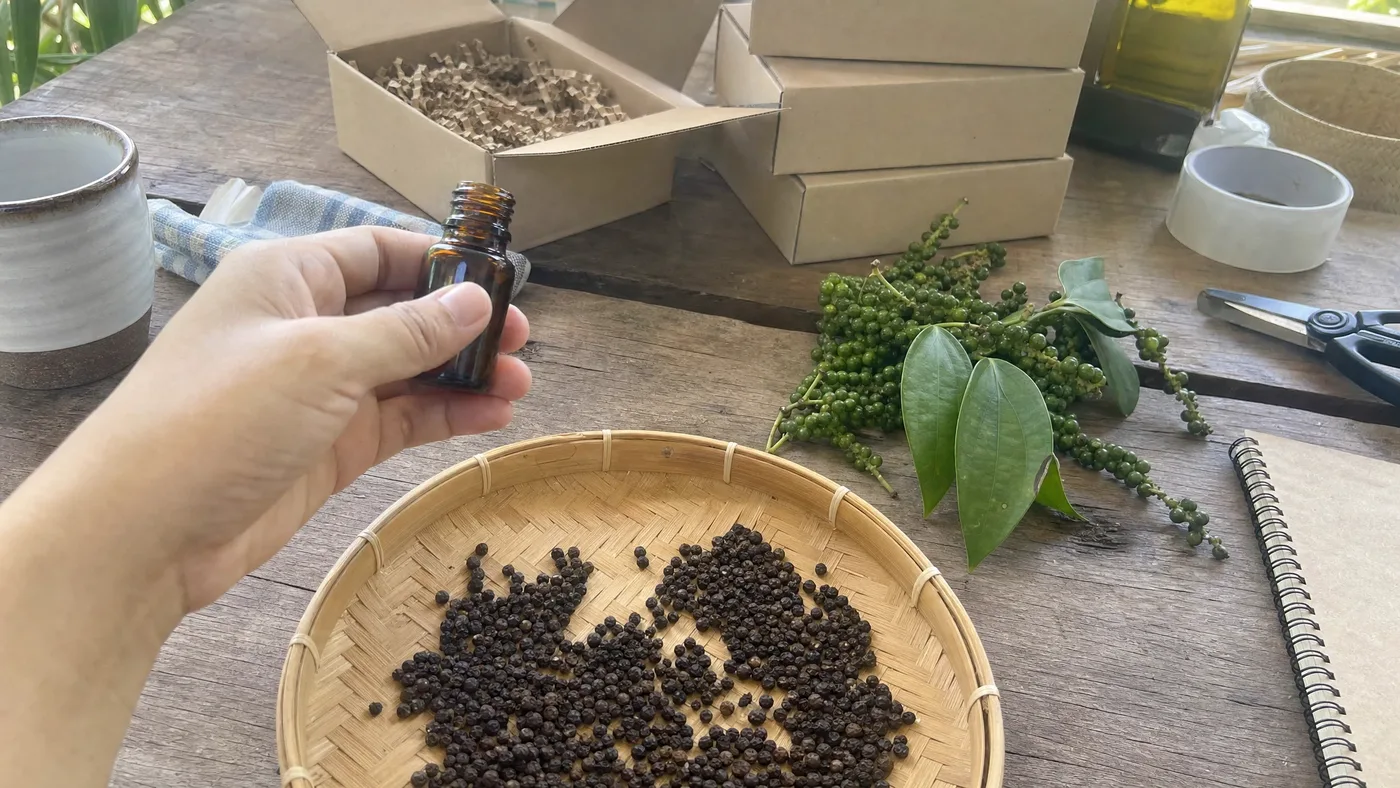
The easiest way to see how far apart these two are is to use your nose. Crack a few peppercorns in a mortar, or grind a pinch, and breathe in: you get a dusty, hot, almost tickling smell that catches at the back of the nose. Then open a bottle of the oil and hold it a little way off. You will notice something drier and more polished, a sharp spicy opening that settles into a woody warmth, with none of that dusty tickle. Same plant, two very different personalities.
A note on the word "spicy"
It is easy to hear "spicy" and think "hot," because that is what spice usually means at the dinner table. In perfumery the word means something different. A spicy scent is dry, a little sharp and slightly warm, the way a cupboard of cinnamon sticks, cloves and peppercorns smells when you open the door. That is the sense in which we call our oil spicy, and it is the whole reason people like it in a diffuser or a blend.
Where we draw the line
We sell black pepper oil as an external cosmetic oil, for scent and for massage blends diluted in a carrier. We do not make digestive claims for it, and in the US the FDA treats the intended use as what decides whether a product is a cosmetic or a drug (FDA, Aromatherapy). Digestive comfort is a health topic. If it is a concern for you, a doctor or pharmacist is the right person to ask.
Why we do not suggest swallowing it
This is the part people look for, so we will be direct. Black pepper oil does not taste hot, which makes it look harmless on a spoon, and that is not an invitation. Our guidance is never to take it internally. The National Capital Poison Center advises that essential oils be kept locked away from children and pets, and that if one is swallowed you use its online tool or call your poison center, which in the US is 1-800-222-1222 (poison.org, Essential Oils). Pet Poison Helpline adds that cats and birds are at the greatest risk from essential oils (Pet Poison Helpline). If you want pepper in food, use the peppercorns from your grocery store.
Keep it out of the spice rack
One habit is worth building if you cook a lot: do not store the bottle with your kitchen spices. A small amber bottle looks a lot like a flavoring at a glance, and a busy kitchen is exactly where a mix-up happens. Our advice is to keep it capped, in a dim, cool cabinet away from direct sunlight, and well away from anything you cook with.
If you are cooking and want that peppery fragrance to fill the room, the simplest route is also the oldest one: crack the peppercorns just before you use them and let the smell rise from the mortar. Save the bottle of oil for the moments when you want the same family of scent in a place where food does not belong.
What the oil is good for
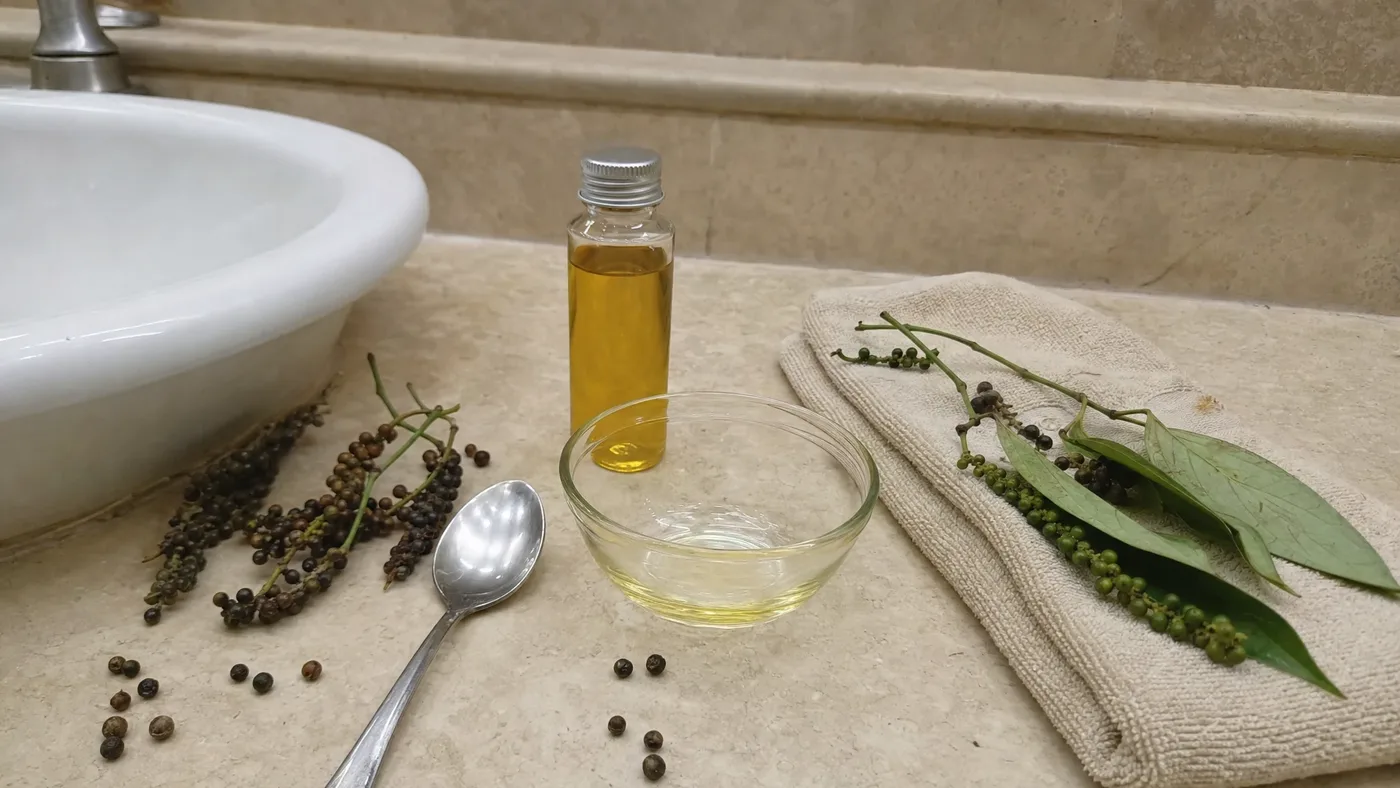
Here is what we do enjoy it for: its aroma. It is dry, warm and peppery, opening sharp and settling into wood, and it works beautifully in a diluted massage oil or a diffuser blend. For skin we recommend 0.5% to 2% in a carrier oil with a patch test first, and for the abdomen, as for any other area, the same rule of staying gentle and diluted. Skip it on broken skin and keep it away from the eyes.
If you are pregnant, the Tisserand Institute advises seeking a doctor's or suitable practitioner's guidance before using essential oils. Keep it away from children and pets.
Where the scent fits into an ordinary day
If you like the smell of pepper and want it around the house, think of the oil the way you would think of a candle or a perfume rather than a seasoning. A few drops in a diffuser while you wash up after dinner, or a blend with bergamot or cedarwood for the entryway, gives you that dry, peppery warmth without a single grain of pepper on the table. The kitchen keeps the spice, and the oil gets the room.
For more on what pepper oil is and is not, our post on what the research shows gives the wider picture, our post on swallowing the oil goes further on that question, and our guide to dilution and patch tests shows how to prepare it for the skin.
Black Pepper Essential Oil
Black Pepper Essential Oil from our own shop, in sizes from 0.5 oz to bulk.
From $13.99
Shop Now →