Black Pepper Oil Properties: Why No Two Lists Agree
Ask ten chemistry pages what is in black pepper essential oil and you will get ten tidy lists, and they will not agree. That is not because anyone is wrong. "Black pepper oil" is one name for a family of oils that shifts with the country, the plant part, the drying and the still. Once you know that, the chemistry gets a lot more interesting, and a lot easier to use when you are choosing a bottle.

Black Pepper Essential Oil
Our own Black Pepper Essential Oil, in sizes from 0.5 oz to bulk.
From $13.99
Shop Now →The same cast, in different proportions
Open almost any analysis of Piper nigrum fruit oil and the same names turn up: beta-caryophyllene, limonene, sabinene, alpha-pinene, beta-pinene and delta-3-carene. Beta-caryophyllene is the warm, woody, spicy backbone, limonene is the bright citrus note, and the pinenes add a green, resinous snap. A review by Dosoky and colleagues found that published oils are mostly monoterpene hydrocarbons, the light and lively fraction, followed by sesquiterpene hydrocarbons like caryophyllene, the deeper one.
What changes is the proportion. A few samples show how far it can swing:
| Sample | Reported main components |
|---|---|
| Five commercial batches, Sri Lankan origin (EFSA panel, 2022) | Beta-caryophyllene about 26%, limonene about 12.5%, sabinene about 9%, alpha-pinene about 9% |
| Seed oil from Bangka Belitung, Indonesia (Nurjanah, 2025) | Beta-caryophyllene 37%, limonene 13%, delta-3-carene 11% |
| Dried fruit from Cameroon (Jirovetz, 2002) | Germacrene D 11%, limonene 10%, beta-pinene 10%, beta-caryophyllene 7% |
| Fruit stored and dried in different ways (Orav, 2004) | Beta-caryophyllene anywhere from about 1% to 70% |
Different labs, methods and fruit, so these are not rankings. They simply show that any single percentage list describes one sample.
What nudges the numbers
The plant part. Oil from the leaves is a different thing. In a 2024 study of a Brazilian cultivar, the leaf oil was dominated by gamma-elemene and curzerene, nothing like the fruit oil. Our oil is steam-distilled from peppercorns, which is the berry.
Drying and age. Orav and colleagues found that green peppercorns dried by sublimation gave far more oil, and far more of the light monoterpenes, than green peppercorns dried slowly in air. After a year of room-temperature storage the fruit gave less oil, with fewer terpenes and more oxygenated compounds. That was pepper, not bottled oil, but it hints at why freshness and handling matter to the bright top of the scent.
The method. Steam distillation, hydrodistillation, solvent and CO2 extraction each pull a different fraction. We compare the main alternatives in our post on oil versus absolute.
Think of it like a harvest
The easiest way we know to hold all this in your head is to think of pepper oil the way you would think of tomatoes or honey. Two jars can both be honest and still taste different, because the weather, the soil and the timing were different. A pepper oil is the same kind of natural thing, so a little variation is normal and nothing to worry about.
It also explains why we are wary of anyone who promises a single fixed recipe for "the" black pepper oil. What you can count on is the family resemblance: dry, warm, peppery, a sharp start and a woody finish. The exact balance of those parts is where each lot gets its own character.
The ingredient that is not there
Piperine, the compound that gives the spice its bite, barely distils. The EFSA panel found it below 0.0005% on average across its five batches. So the oil carries the aroma of pepper without the heat of the spice, which is why we describe it as dry, warm and peppery, opening spicy and sharp before settling into woody warmth. Our piperine post goes deeper, and our scent profile is the place to meet the aroma itself. That does not make the oil mild on skin. The EFSA panel treats it as an irritant to skin and eyes and a sensitiser, which is why we recommend 0.5% to 2% in a carrier and a patch test first.
Let your nose do part of the work
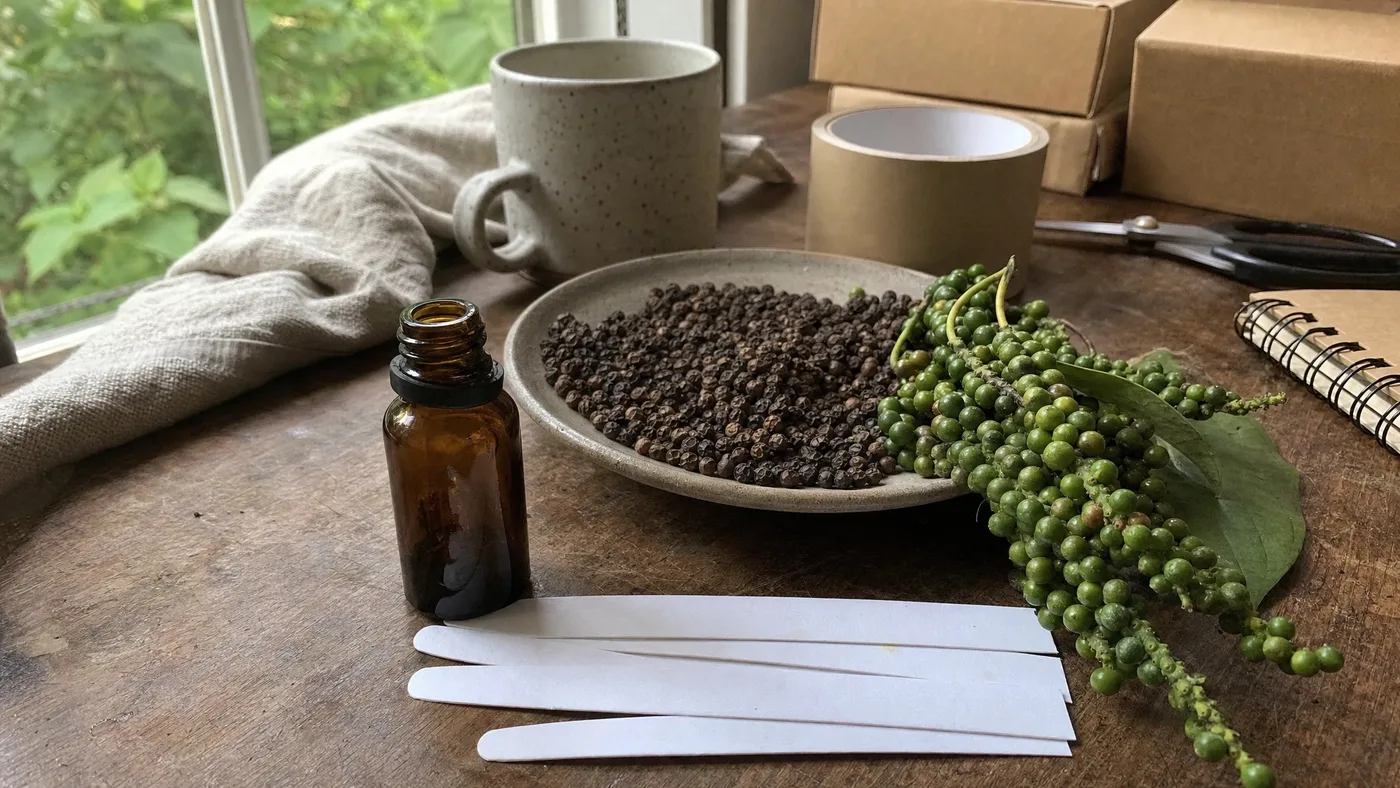
You do not need a lab to start comparing oils. Put a drop of each on its own paper strip, label the strips, and smell them at the same moments: right away, after ten minutes, and after an hour. You will notice which one opens brighter, which one dries down woodier, and which one you keep going back to. Numbers on a page and the scent on a strip are two halves of the same picture, and it helps to have both.
How to use this when you shop
Think of the table as a spread, not a target. A report with beta-caryophyllene around a quarter of the oil and limonene, sabinene and alpha-pinene making up much of the rest sits in familiar territory. A report with a long list of unusual peaks, no stated origin or no date is a prompt to ask a question. Our guide to reading a GC-MS report shows how.
The Certificate of Analysis we publish for one batch (PEBHMBPNINC002A) lists relative density 0.873, refractive index 1.484 and optical rotation of -15.5 degrees at 20 C, each within its stated range. If you need the compound profile for your formulation, ask us in writing through the contact page and include your lot number. For the wider quality picture, see our adulteration checklist.
Black Pepper Essential Oil
Black Pepper Essential Oil from our own shop, in sizes from 0.5 oz to bulk.
From $13.99
Shop Now →Sources & Further Reading
- EFSA FEEDAP Panel, 2022. Safety and efficacy of feed additives prepared from Piper nigrum L. EFSA Journal 20(11):e07599. pmc.ncbi.nlm.nih.gov/PMC9641382
- Dosoky NS et al., 2019. Volatiles of black pepper fruits (Piper nigrum L.). Molecules 24(23):4244. pmc.ncbi.nlm.nih.gov/PMC6930617
- Nurjanah S et al., 2025. Essential oils from different parts of Piper nigrum L. Food Sci Nutr 13(11):e71205. pmc.ncbi.nlm.nih.gov/PMC12618210
- Jirovetz L et al., 2002. Aroma compound analysis of Piper nigrum and Piper guineense essential oils from Cameroon. J Chromatogr A 976:265-275. pubmed.ncbi.nlm.nih.gov/12462618
- Orav A et al., 2004. Effect of storage on the essential oil composition of Piper nigrum L. fruits of different ripening states. J Agric Food Chem 52(9):2582-2586. pubmed.ncbi.nlm.nih.gov/15113161
- Feitosa BS et al., 2024. Chemical composition and biological activity of Piper nigrum L. cv. Guajarina essential oils and aroma. Molecules 29(5):947. pmc.ncbi.nlm.nih.gov/PMC10934927