What Does Black Pepper Oil Smell Like? Start to Finish
Open a bottle of black pepper essential oil expecting a sneeze and you will probably be surprised. The first impression is dry and sharp, but there is no burn in the nose, and over the next few minutes the scent turns warmer and woodier. It is one of the more rewarding oils to smell slowly.

Black Pepper Essential Oil
Our own Black Pepper Essential Oil, in sizes from 0.5 oz to bulk.
From $13.99
Shop Now →How we describe it
We describe our black pepper oil as dry, warm and peppery, opening spicy and sharp before settling into a woody warmth. In perfumery terms it sits as a middle to base note, which means it does not vanish in a few minutes the way a bright citrus does. The Certificate of Analysis we publish for one batch lists the aroma as complying with the standard description of spicy, warm and woodsy, so that is a fair summary of what to expect.
Putting words to it
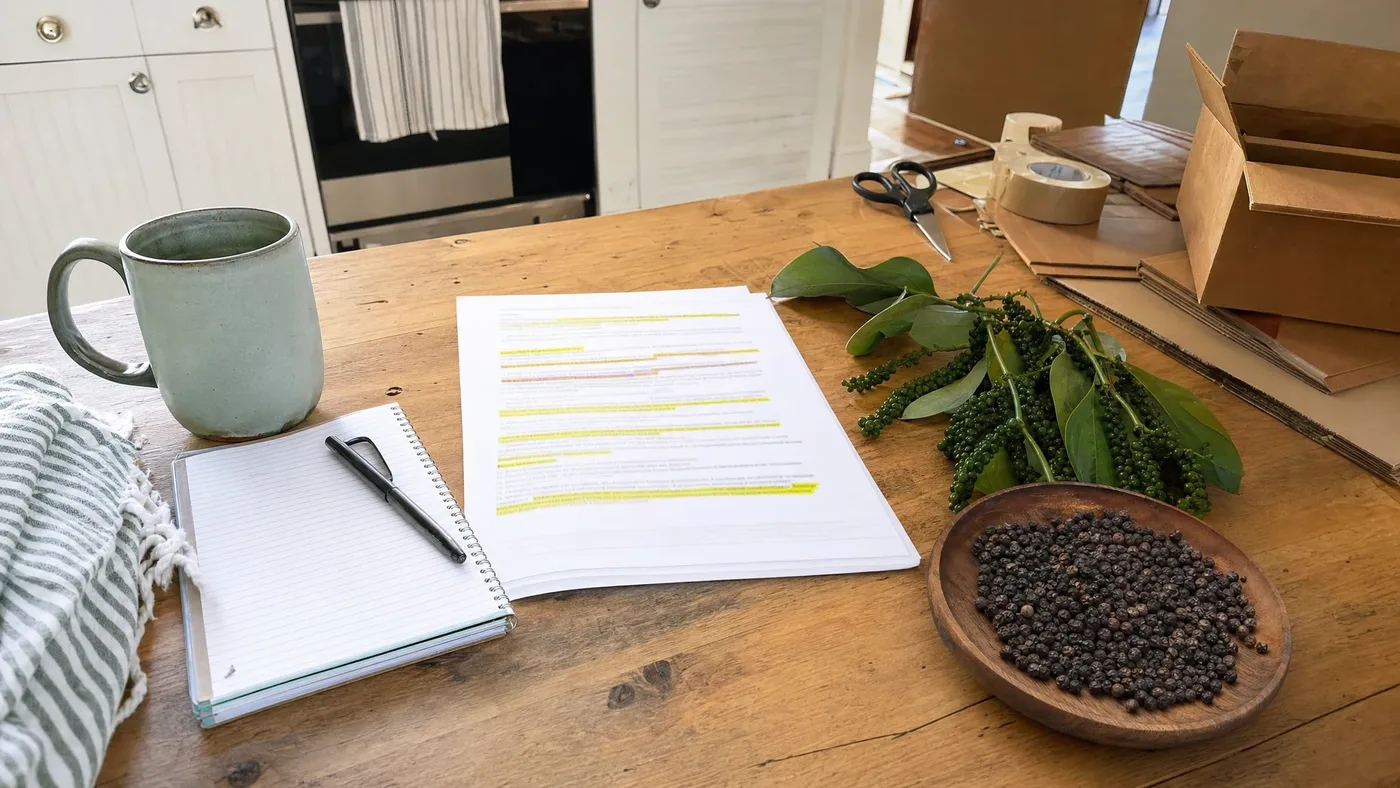
Scent is hard to describe, so it helps to borrow from things you already know. Imagine cracking fresh peppercorns over a wooden board: that dry, slightly dusty snap is where the oil starts. A minute later, think of warm timber, like the inside of a cedar drawer. That is the direction the scent travels. If you have a favorite word for it, write it down. People tend to land on words like dry, warm, spicy, woody or sharp, and none of them is wrong.
The molecule that smells like pepper
Here is the surprising part. When researchers went looking for the compound that gives pepper its distinctive peppery smell, the answer was not one of the big, abundant ones. It was rotundone, a trace compound found in black and white peppercorns, and it is so potent that its odour activity value in pepper was estimated at 50,000 to 250,000 (Wood et al., J Agric Food Chem, 2008). The same study found that about 80% of the people on its panel could smell it, while around 20% could not detect it even at very high concentrations.
So when a friend says an oil smells "not very peppery" to them, they may be telling the truth. Noses really do differ. Rotundone also forms as the fruit's alpha-guaiene oxidises in air (Huang et al., J Agric Food Chem, 2014), which is part of why handling and age change how pepper smells.
What fills the rest of the scent
Most of the bulk of a pepper oil is terpenes. A sniffing study of Cameroonian pepper, which analysed the aroma while a person smelled each compound as it came off the instrument, found limonene, the pinenes, beta-caryophyllene and germacrene D among the main components, and linked several of them to the pepper character. Perfumers in that study called the result a fine, pleasant black pepper note (Jirovetz et al., J Chromatogr A, 2002).
In plain terms, we read it like this. The light, citrusy and piney molecules give the sharp, bright opening. The heavier woody ones, caryophyllene among them, stay longer and give the dry, warm drydown. That is reasoning from how volatile each compound is, not a measurement, but it matches what you smell.
Why there is no burn
The heat of table pepper comes from piperine, and steam does not carry it into the oil. An EFSA review of black pepper oil measured it well below 0.0005% on average across five batches (EFSA FEEDAP Panel, 2022). What reaches your nose is the aromatic side of the spice with the fire left behind. We cover that in more detail in our piperine post.
How to smell it properly
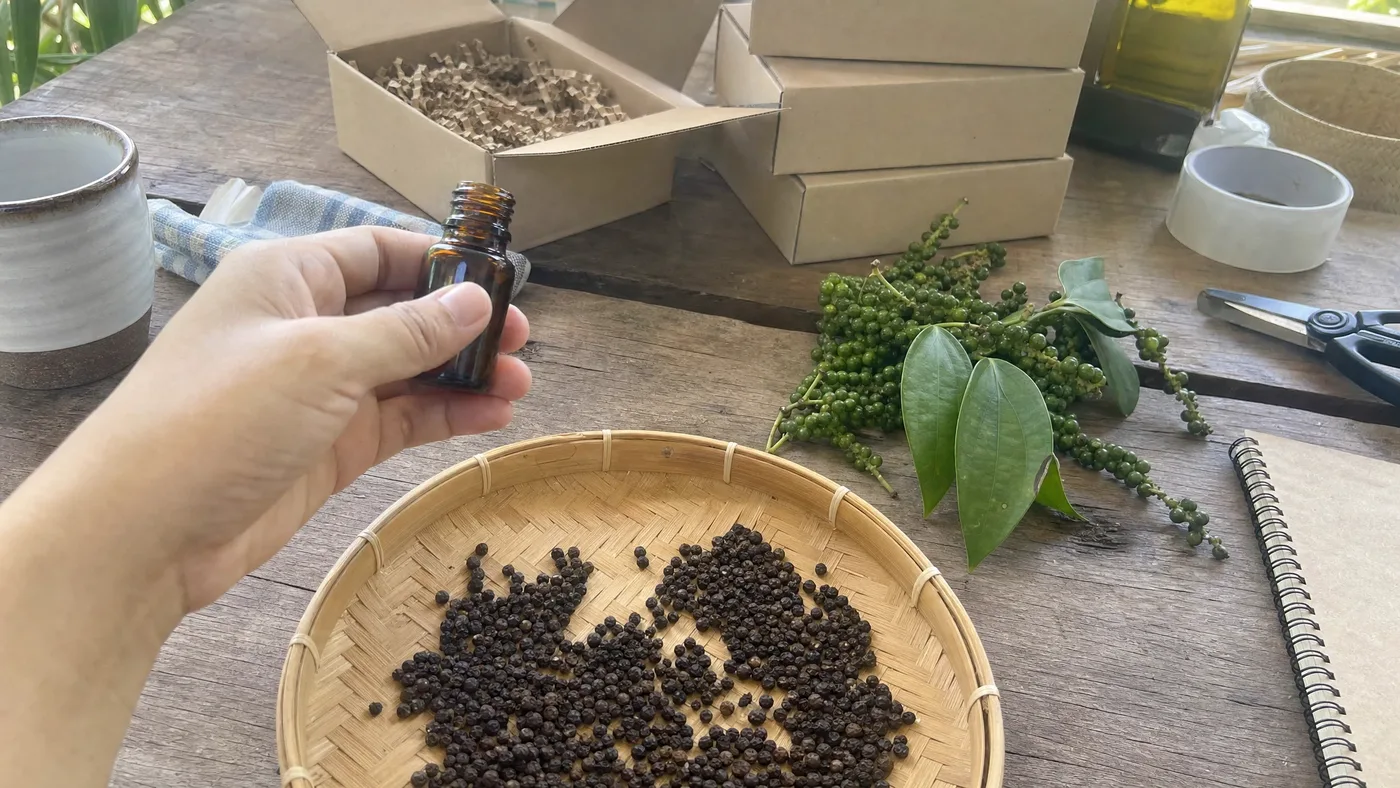
- Put one drop on a paper blotter or a strip of plain card rather than sniffing the bottle neck, which gives you the sharpest, most concentrated version.
- Smell it right away, then again after a minute, after ten minutes, and after an hour. The oil changes character each time.
- Trust the drydown more than the first sniff. That woody, warm stage is where the oil sits in a blend.
A blotter also keeps concentrated oil off your skin. For skin use we recommend 0.5% to 2% in a carrier oil with a patch test first. If you have asthma or another airway condition, check with your physician before diffusing any essential oil.
A few things you may notice
- It is much stronger from the bottle neck than it is from a blotter, so do not judge the oil by the first deep sniff.
- A drop in the open air changes faster than a drop in a closed jar, so give it a moment before you decide.
- It reads differently on paper, on cloth and in a diffuser, so try it in the form you plan to use.
- Your nose tires quickly. If everything starts to smell the same, step outside for a minute and come back.
It is also nice to smell it next to something else. Put a drop of cedarwood on a second strip and hold the two together. The pepper tends to stand out as the drier, sharper partner, and the wood as the rounder one. Doing this once teaches you more about blending than any list of ratios.
Where the scent goes next
That dry spice sits well with citrus, woods and resins. We list bergamot, frankincense, cedarwood, rose and clary sage as natural partners, and black pepper as a perfume note and the blending guide show how. If you would like to see the oil as a chemist does, our GC-MS reading guide explains the numbers, and if you need a GC-MS report for a particular lot, ask us in writing through the contact page.
Smell it on a blotter, give it ten minutes, and let the warm, woody end of the scent tell you what the oil is really about.
Black Pepper Essential Oil
Black Pepper Essential Oil from our own shop, in sizes from 0.5 oz to bulk.
From $13.99
Shop Now →Sources & Further Reading
- Wood C et al., 2008. Rotundone as a pepper aroma compound. J Agric Food Chem 56(10):3738-3744. pubmed.ncbi.nlm.nih.gov/18461961
- Huang AC et al., 2014. Alpha-guaiene as the precursor of rotundone. J Agric Food Chem 62(44):10809-10815. pubmed.ncbi.nlm.nih.gov/25307830
- Jirovetz L et al., 2002. Aroma compound analysis of Piper nigrum and Piper guineense essential oils from Cameroon. J Chromatogr A 976(1-2):265-275. pubmed.ncbi.nlm.nih.gov/12462618
- EFSA FEEDAP Panel, 2022. Safety and efficacy of feed additives prepared from Piper nigrum L. EFSA Journal 20(11):e07599. pmc.ncbi.nlm.nih.gov/PMC9641382