Adding Black Pepper Oil to a Hair Oil: Scent Only
Black pepper oil has a dry, peppery warmth that works nicely in a grooming oil, the way a little spice works in a cologne. That is the whole of what we say for it in hair care: a scent. We sell one steam-distilled black pepper oil and no hair products, and we make no claim about hair growth.

Black Pepper Essential Oil
Our own Black Pepper Essential Oil, in sizes from 0.5 oz to bulk.
From $13.99
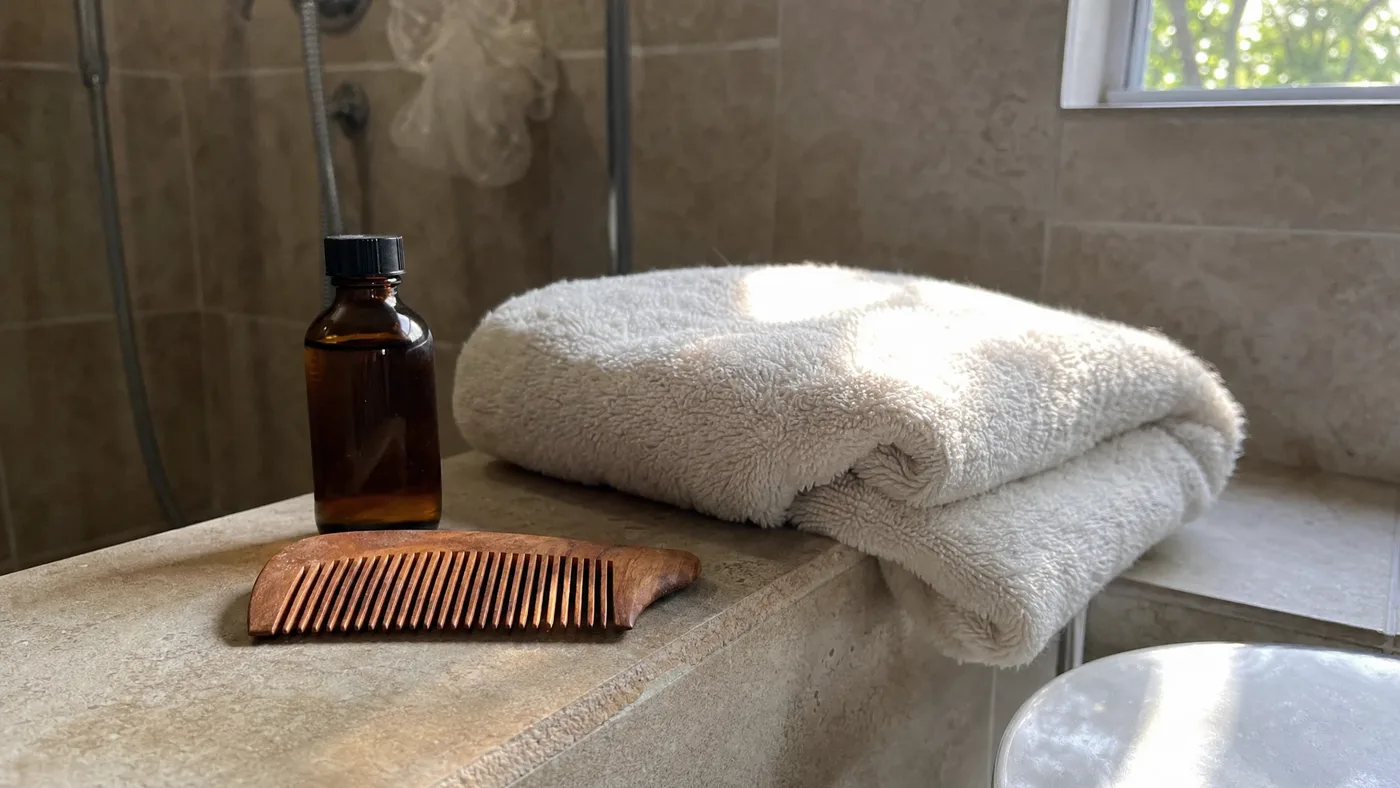
Shop Now →If you have never made a grooming oil before, here is a mental picture. Imagine a small bottle of a carrier oil you already enjoy on your hands or beard. Now imagine that bottle smelling faintly of dry spice and wood when you open it, then fading to almost nothing a few minutes after you use it. That subtle, grown-up result is what a drop or two of black pepper oil is for.
Treat it as a fragrance
A hair oil is mostly its carrier, and the carrier is what your hair will notice. Pepper oil is the finishing note, a few drops in a bottle. Choose the base for your hair, since that decides how the oil feels, and add the pepper last, in very small amounts. We do not sell carrier oils; our post on carrier oils for black pepper oil compares the options.
Before you pick up a dropper, it helps to picture the finished bottle. A good grooming oil smells good as soon as you open the cap and then fades into a quiet background on your hair. Pepper is a middle to base note, so it tends to last longer than a bright citrus top note and show up again when the lighter scents are gone. That staying power is part of the charm, and also a reason to be restrained.
Why we keep it dilute on a scalp
The scalp is not a forearm. A hair oil is used often, spreads toward the eyes and ears, and sits on skin that may be dry or scratched. An EFSA panel reviewing steam-distilled black pepper oil considered it an irritant to skin and eyes and a dermal sensitiser, and our own guidance says it is a skin irritant at any generous dilution. DermNet NZ puts fragrance allergy at about 1% of adults and notes natural extracts are among recognised allergens. The National Capital Poison Center adds that essential oils should not go on damaged skin, and that dilution in a carrier is the best protection.
The tingle some people expect is not piperine, either. EFSA measured piperine in the oil at an average below 0.0005% across five batches, so if a scalp prickles, treat that as a signal to rinse.
The arithmetic on paper
We recommend 0.5% to 2% in a carrier for skin, with a patch test. For a scalp we would stay at the lower end, starting at 0.5% and not going past 1% without good reason. At 20 drops per milliliter, a rough convention that varies by dropper:
- 30 ml (1 oz) of carrier: about 3 drops at 0.5%, about 6 drops at 1%.
- 100 ml of carrier: about 10 drops at 0.5%, about 20 drops at 1%.
If you plan to sell a product, weigh your ingredients instead of counting drops and ask a cosmetic safety assessor about limits for your category. Keep the blend anhydrous, just oil and oil. Anything with water needs a preservative system, which is a separate formulation job.
Smell test before you commit
Once you have your first blend mixed, let it sit in a closed bottle for a day and then smell it again. Fresh blends often smell a little sharper than they do after the oils have settled together. Rub a drop between your palms, hold your hands a little way from your face and breathe in the way you would test a perfume on a card. If the pepper is the first thing you notice and it feels too forward, add a bit more carrier next time.
It also helps to match the oil to the hair. A fine, easily weighed-down head of hair wants a very small amount of a light carrier, while thick or coarse hair can usually take a little more. Whichever you have, use less than you think you need and add more only once the first application has settled.
Trying it
- Patch test the finished blend on the inner forearm first. DermNet NZ notes reactions can take 48 to 96 hours to appear.
- Try a pea-sized amount behind one ear, then wait a day.
- If anything stings or itches, wash it off and stop. Our skin irritation guide covers the next steps.
- Keep it away from eyes and hairline runoff.
Skip it if you react to fragranced products, have a rash or sore scalp, are pregnant or nursing (ask a doctor first, and see our post on pregnancy and breastfeeding), or are buying for a child. Patchy or sudden hair loss belongs with a dermatologist.
Keep it simple to start
A first batch does not need five oils and a long recipe. One carrier you like and one drop of the pepper, in a small bottle, teaches you more about how the scent behaves than a complicated blend would. Write down what you did, so that if you love it you can make it again.
If you want a pepper note for a beard, our beard oil formulation uses different numbers, because the skin sits closer to eyes and mouth.
Black Pepper Essential Oil
Black Pepper Essential Oil from our own shop, in sizes from 0.5 oz to bulk.
From $13.99
Shop Now →Sources & Further Reading
- EFSA FEEDAP Panel, 2022, Safety and efficacy of feed additives prepared from Piper nigrum L.
- DermNet NZ, Fragrance allergy
- DermNet NZ, Patch tests
- National Capital Poison Center, Essential Oils