How Black Pepper Oil Is Made: From Peppercorn to Bottle
Black pepper oil starts as something very ordinary, a peppercorn, and ends as a few milliliters of thin, pale oil. Steam does the work. It slips through cracked peppercorns, picks up their aroma compounds and carries them out to a condenser, where the oil floats off the water. It is a simple idea, and the craft is in the choices around it.

Black Pepper Essential Oil
Our own Black Pepper Essential Oil, in sizes from 0.5 oz to bulk.
From $13.99
Shop Now →The fruit sets the ceiling
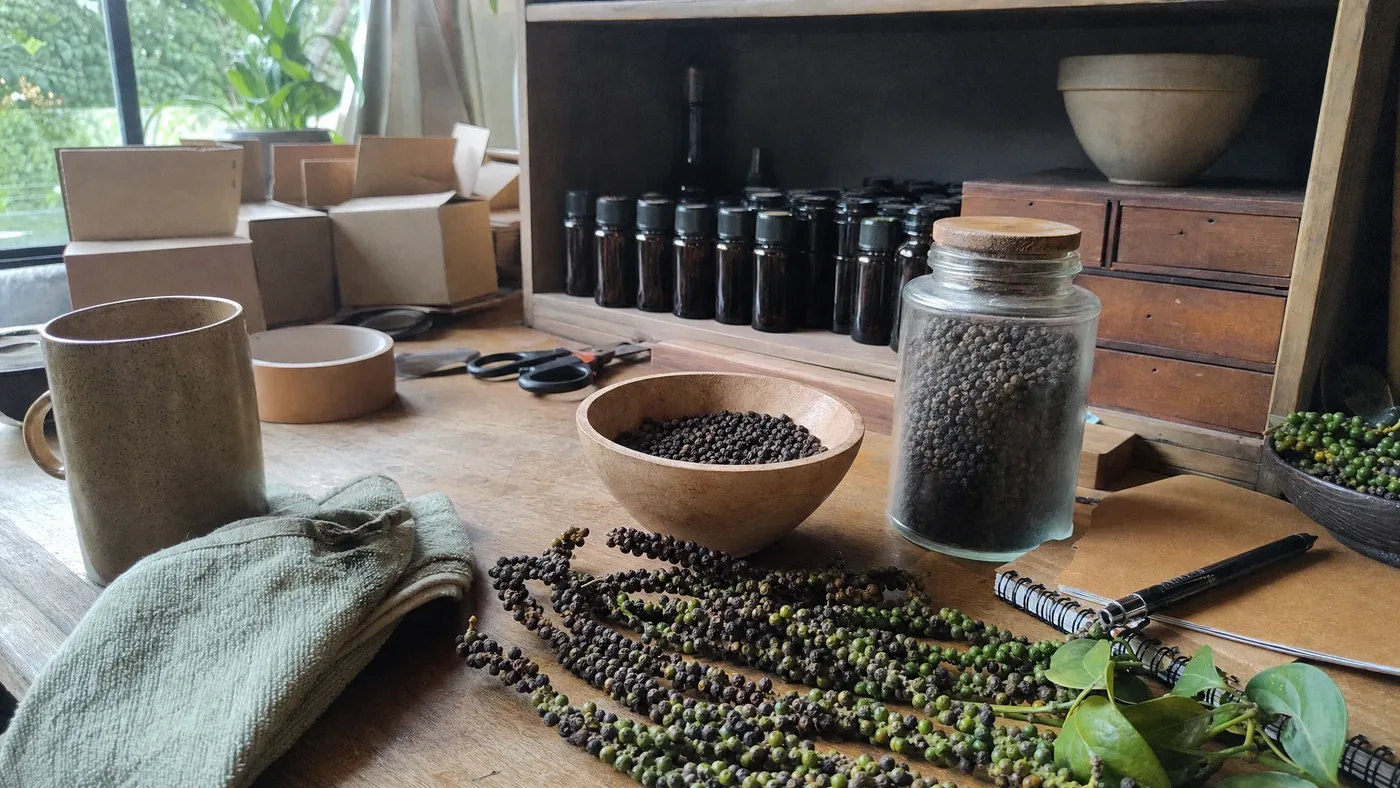
The oil comes from the fruit of the Piper nigrum vine. The standard method described by an EFSA panel is steam distillation of dried, crushed unripe fruit. How much oil a peppercorn gives is surprisingly hard to pin down: one review reports the oil as about 3 to 6% of the fruit, while hydrodistillation of Brazilian cultivars gave just 0.21 to 1.49%. The practical takeaway is that a lot of pepper makes a little oil.
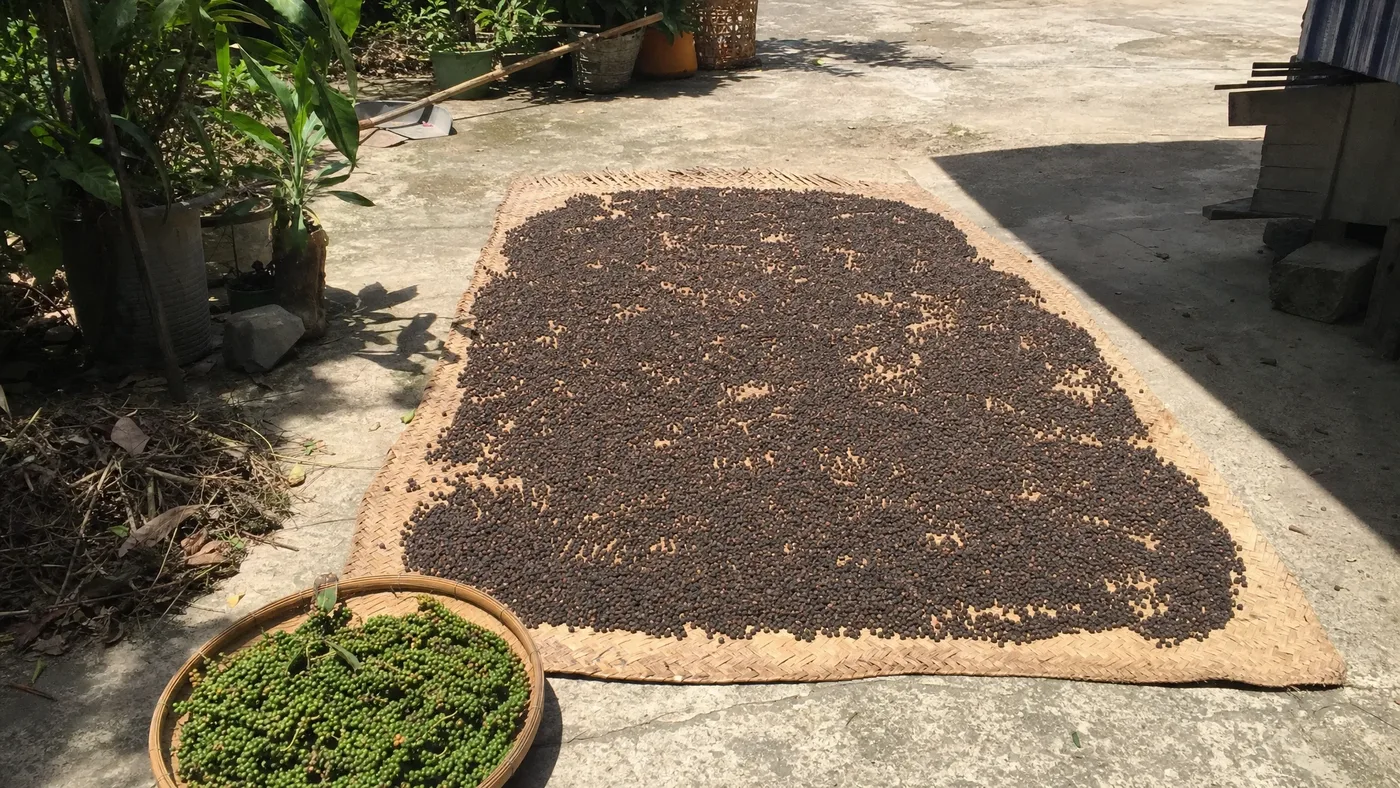
Drying and storage matter too. A study of green peppercorns found that freeze-dried fruit gave far more oil, rich in light monoterpenes, than air-dried fruit, and that stored pepper lost terpenes over a year. In short, the oil is a snapshot of what the fruit was like before the still was lit.
How we describe our process
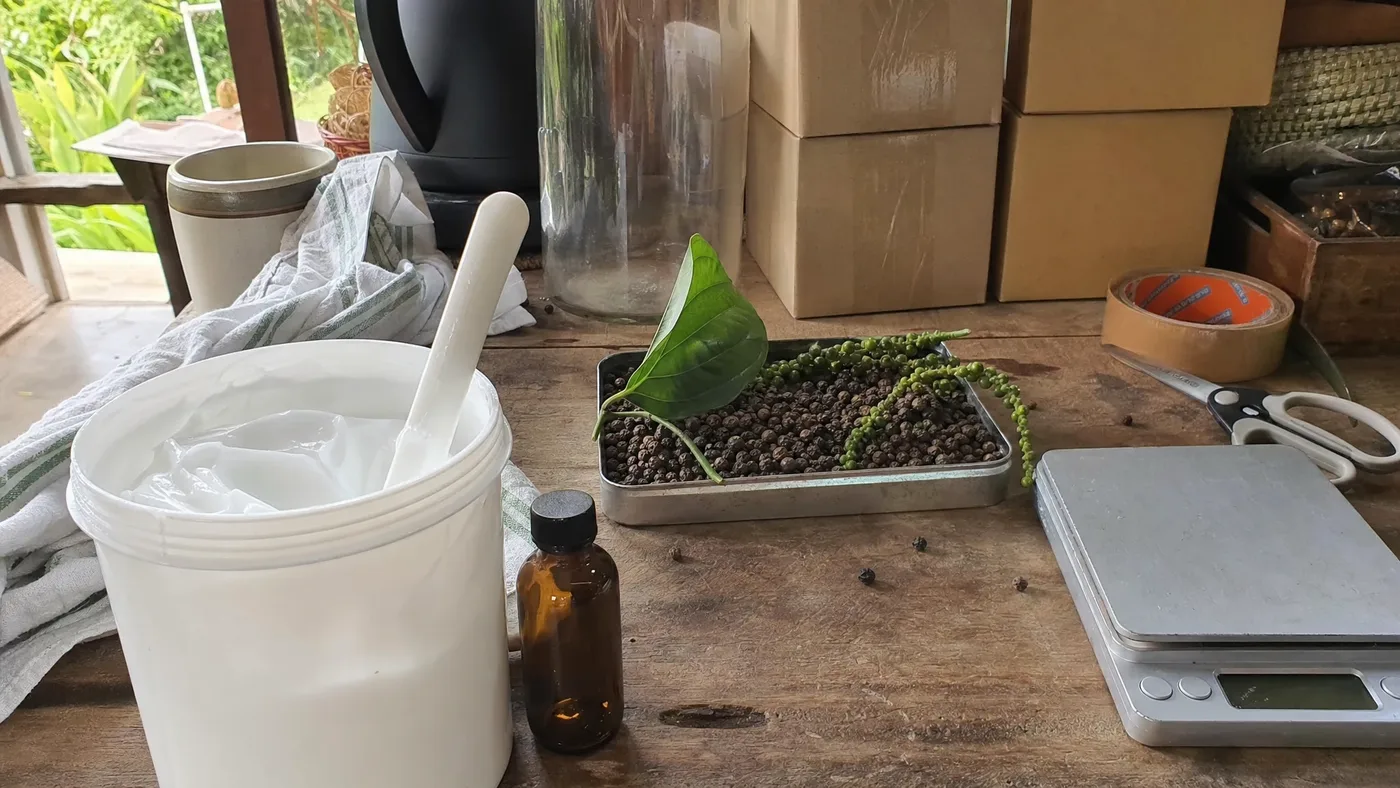
We steam-distil one black pepper oil from Piper nigrum peppercorns grown in India. The corns come whole to a stated screen size with a moisture ceiling, and split, shrivelled, immature or off-colour corns are turned away. They are stored whole and coarse-cracked on site about an hour before the still is charged, so the light, volatile aroma has little time to escape. We run the charge to exhaustion rather than to a clock, which means the run ends when the oil stops coming over. The bottle carries the date it came off the still, and the oil goes into amber glass, undiluted.
What comes out of the still
Open a bottle of the finished oil and the first thing you notice is how un-oily it is. It pours thin and watery, nothing like a cooking oil. Then the aroma: dry, warm and peppery, spicy and sharp at the opening, then settling toward a woody warmth. It smells like the moment a grinder turns, without any sting on the nose.
Why we keep it simple
The recipe is short: peppercorns, steam, a condenser. There are no cheaper spice oils and no solvent-extracted material in our bottle. We like it that way, because the oil you smell is the oil of the peppercorn and nothing else.
What steam leaves behind
Piperine, the compound responsible for the sting of the spice, does not travel with the steam. EFSA measured it in black pepper oil at an average below 0.0005%, against a range of roughly 30 to 40% in oleoresins. That is why the oil smells of pepper without the heat, and our post on piperine in the oil goes further. It is also why we still treat the oil with care: the panel considered it an irritant to skin and eyes, so we recommend 0.5% to 2% in a carrier with a patch test, and our oleoresin comparison shows how a different extract behaves.
What a certificate can tell you
The Certificate of Analysis we publish covers one batch and lists density of 0.873 at 20 C, refractive index of 1.484 and optical rotation of -15.5 degrees, each within its stated range. Those are physical constants; they are a good identity check, not a chemical profile. If you need compound percentages from a GC-MS report for your lot, ask us in writing through our contact page before ordering.
Why a drop goes so far
Because a lot of pepper makes a little oil, every drop is concentrated. That is why a diffuser needs only two or three drops, and why a skin blend is measured in a handful of drops per ounce of carrier. Once you see how much fruit it takes to fill a small bottle, it is easy to understand why a gentle hand is the right habit.
Why we like the slow parts
Some of the best decisions in making an oil are the unglamorous ones: turning away corns that are not right, cracking them just before the still is charged, and letting the run finish when the oil stops coming over, not when a timer says so. None of it is complicated. It simply takes patience, and the patience shows up in the bottle as an oil that smells like pepper rather than like a shortcut.
Questions to ask any distiller
- Which plant part went in: fruit, leaf or stem?
- How was it dried, and how long was it stored?
- When was it crushed, and what ended the run?
- Is there a GC-MS report for the lot, and a date off the still?
Our guides on spotting adulteration and steam versus CO2 extraction help you read the answers. We do not suggest distilling at home, since hot steam and flammable vapor are involved and yields are tiny.
Black Pepper Essential Oil
Black Pepper Essential Oil from our own shop, in sizes from 0.5 oz to bulk.
From $13.99
Shop Now →Sources & Further Reading
- EFSA FEEDAP Panel, 2022, Safety and efficacy of feed additives prepared from Piper nigrum L., EFSA Journal 20(11):e07599
- Dosoky NS et al., 2019, Volatiles of black pepper fruits, Molecules 24(23):4244
- Orav A et al., 2004, Effect of storage on the essential oil composition of Piper nigrum fruits, J Agric Food Chem 52(9):2582-2586