How to Spot Adulterated Black Pepper Oil
Here is the honest answer to the question every buyer asks: you cannot be certain a bottle of black pepper oil is exactly what it says by smelling it. Your nose catches some problems and misses others. The good news is that a few simple checks, plus one piece of paperwork, get you most of the way to confidence.

Black Pepper Essential Oil
Our own Black Pepper Essential Oil, in sizes from 0.5 oz to bulk.
From $13.99
Shop Now →What a nose can and cannot do
Black pepper oil is a complicated mix. The EFSA panel that reviewed it lists beta-caryophyllene, limonene, sabinene, alpha-pinene, beta-pinene and delta-3-carene as the main components, and the standard it cites (ISO 3061:2008) allows quite wide ranges: 12 to 40% beta-caryophyllene and 7 to 20% limonene, for example. Genuine oils therefore differ from one another, which is why a casual sniff is a weak test. Cutting an oil with a cheaper material of similar character, whether another spice oil or terpenes that already occur in pepper oil, can leave the scent in the right neighborhood. That kind of problem needs an analysis, not a sniff.
What a nose can catch is the gross stuff: a flat, thin or off smell, a plasticky or sweet note that does not belong, or a bottle that smells of nothing at all.
Four checks you can do in five minutes
- Read the botanical name. It should say Piper nigrum. Our pink pepper comparison shows why the name matters.
- Look for the extraction method in words. "Steam distilled" is a statement a seller can stand behind. Words like "premium" or "natural" are not. Steam-distilled oil is also what our distilled versus CO2 guide describes, so you will know what to expect from the label.
- Check the ingredient line. If a product is a blend, or cut with a carrier, it should say so. A line that says only "fragrance" is not telling you it is distilled pepper.
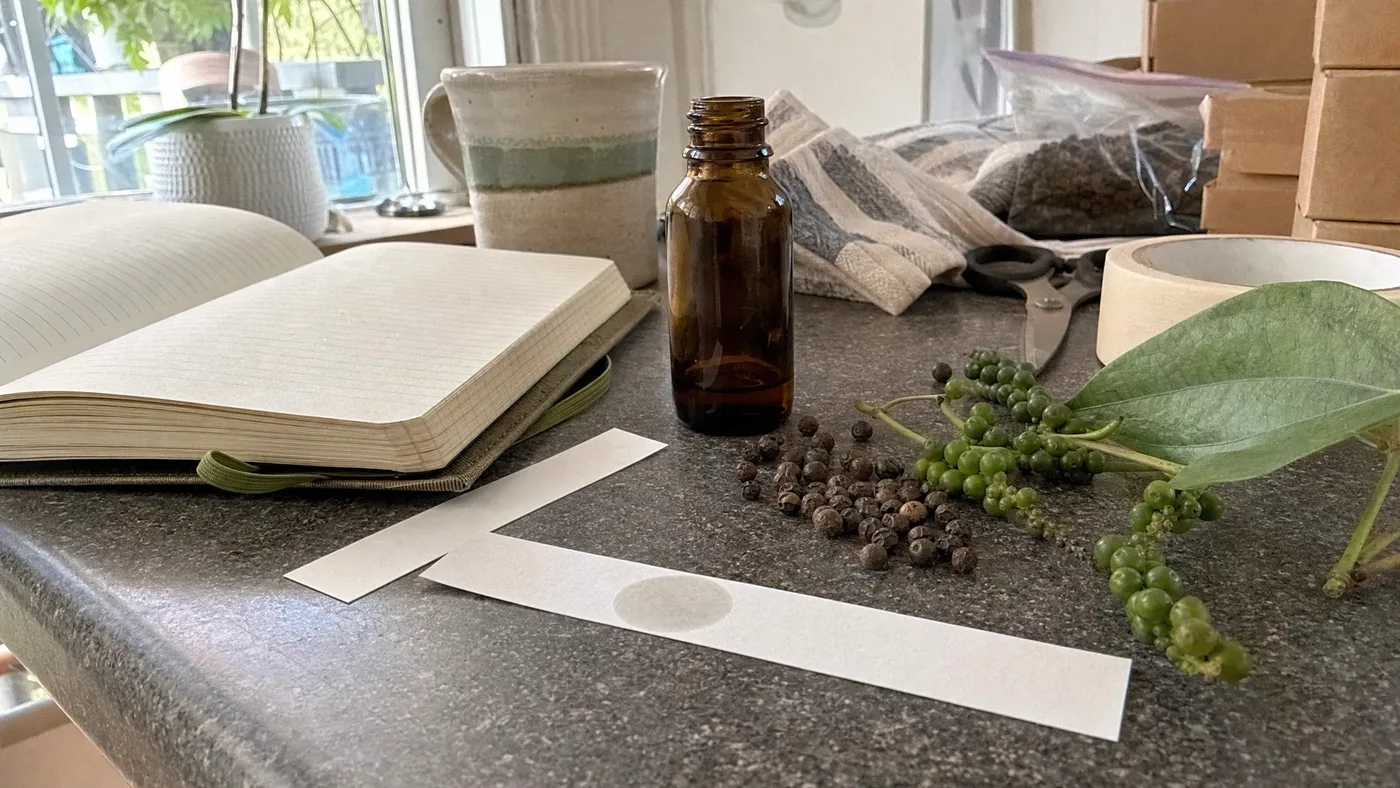
- Try a paper dry-down. Put a drop on clean blotting paper and let it sit. Pepper oil is thin and volatile, so it should fade without a greasy ring that stays. This catches a fatty carrier added to stretch the oil. It is a rough home check and not proof of anything else.
Give the bottle a quick once-over
Before you smell anything, look at the bottle. Dark glass, a tight cap and a label that names Piper nigrum and the extraction method are good signs. Tip it and watch the oil: ours pours thin and watery, so a thick or greasy pour is a reason to stop and ask. Then smell it on paper at three moments: straight away, after ten minutes and after an hour. Black pepper oil should open dry, spicy and a little sharp and settle toward wood. A scent that stays one flat note, or turns sweet or plasticky, deserves a question.
What a certificate of analysis tells you
Paperwork is where the real answers live, and it helps to know what each kind tells you. A basic certificate lists physical constants. The one we publish for a single batch of our oil gives relative density of 0.873 at 20 C (against a standard range of 0.864 to 0.884), refractive index of 1.484 (standard 1.470 to 1.488) and optical rotation of minus 15.5 degrees (standard minus 1 to minus 23), and concludes that the tested parameters comply with pharmacopoeia standards for Black Pepper Essential Oil (Piper nigrum). Constants like these are good at catching a grossly diluted oil. Because a cleverly blended oil can sit inside the same ranges, a GC-MS report goes further by showing the compounds themselves.
If you need GC-MS for a lot, ask us in writing through the contact page before you order. Whoever you buy from, make sure the paperwork matches the batch you are holding, a point our guide to reading a GC-MS report covers in more detail. A report for one batch describes that batch.
Questions to send a seller
- What species and plant part is the oil, and how is it extracted?
- Can you share the report for the lot I will receive?
- Is anything else in the bottle besides the oil?
The answers do not need to be long. They need to be specific.
A short list of things not to worry about
A color that varies a little, or a scent that is slightly different from the last bottle, is normal in a natural oil. Oils from a natural crop shift with the harvest, and the published analyses show wide variation even among genuine samples, as we discuss in our post on origin.
The best protection is a seller who answers specific questions plainly.
Black Pepper Essential Oil
Black Pepper Essential Oil from our own shop, in sizes from 0.5 oz to bulk.
From $13.99
Shop Now →