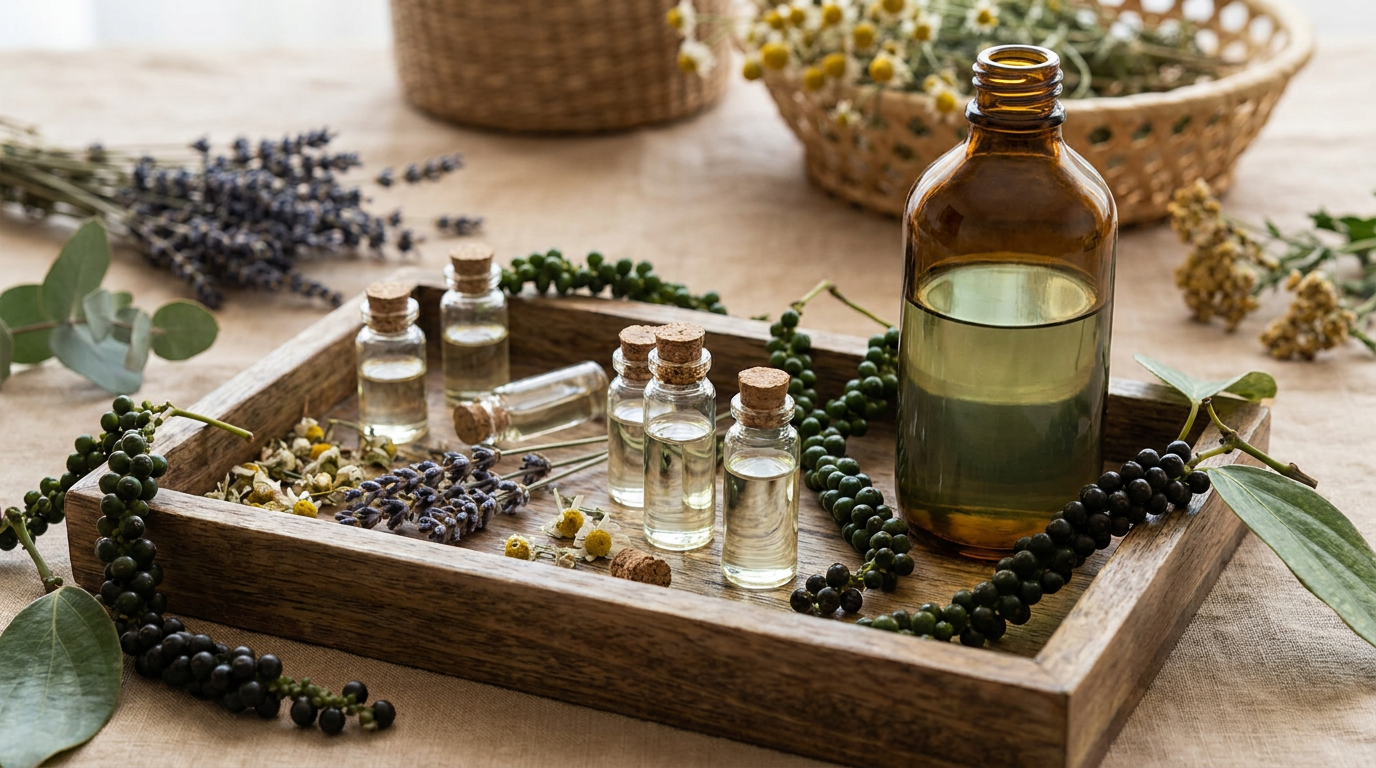
Black Pepper Essential Oil vs Black Pepper Absolute: A Perfumer's Comparison
Walk into any serious perfumer's studio and you'll likely find two very different bottles labeled "black pepper." One is thin, pale, and sharp: the steam-distilled essential oil most home aromatherapy shoppers already know. The other is a dark, viscous, almost syrupy liquid that smells rounder, warmer, and less like a spice rack and more like a finished fragrance. That's black pepper absolute, and the two rarely get compared honestly. Most articles either ignore the absolute entirely or treat it as an interchangeable substitute for the oil. It isn't. This is a black pepper oil extraction comparison built for people who actually want to know which one belongs in their formula, and why.

Black Pepper Essential Oil
Our own Black Pepper Essential Oil, in sizes from 0.5 oz to bulk.
From $11.99
Shop Now →We'll look at how each is made, how they smell and perform on the skin or in a diffuser, what they cost, and where each one genuinely earns its place. If you're weighing black pepper essential oil vs absolute for a project, the honest answer is: it depends on what you're building.
How Each One Is Made
The difference between these two extracts starts long before either one reaches a bottle. It starts with the extraction method, and that single variable explains almost every other difference on this page.
Steam Distillation: The Essential Oil Route
Black pepper essential oil is produced by steam distillation of dried, crushed peppercorns (Piper nigrum). Steam is passed through the plant material, and the volatile aromatic compounds evaporate along with the water vapor. That vapor is then cooled and condensed, and the oil separates naturally from the water. We've walked through the mechanics of this process in more detail in how black pepper oil is made from sun-dried berries, but the short version is that distillation only pulls out the lighter, more volatile molecules. Heavier, waxier compounds get left behind in the plant material.
That matters because black pepper's signature warmth comes partly from those heavier fractions. Steam distillation is efficient and relatively inexpensive, but it's also selective in a way that shapes the final scent profile significantly.
Solvent Extraction: The Absolute Route
Black pepper absolute takes a completely different path. Producers first make a concrete by washing the dried peppercorns with a volatile solvent, commonly hexane, which pulls out a much broader range of aromatic and non-aromatic material, including waxes, resins, and pigments. Once the solvent is evaporated off, what's left is a waxy, semi-solid concrete. That concrete is then washed again, this time with ethanol, to isolate the alcohol-soluble aromatic fraction and leave the waxes behind. The ethanol is removed under vacuum, and the result is the absolute: a concentrated, full-spectrum capture of the plant's aroma.
This is a fundamentally different kind of black pepper oil extraction comparison than distillation versus CO2, which we've covered separately in steam distilled vs CO2 extracted black pepper oil. Solvent extraction for an absolute is a multi-stage process built specifically for the fragrance industry, not for producing a clean, food-safe or skin-focused oil. Trace solvent residue is tightly regulated in the fragrance trade, but absolutes are generally not recommended for topical use at the concentrations essential oils are used at, and they're not used in food or flavor applications at all.
Head-to-Head Comparison Table
| Attribute | Black Pepper Essential Oil | Black Pepper Absolute |
|---|---|---|
| Extraction method | Steam distillation | Solvent extraction (hexane, then ethanol wash) |
| Typical yield | Roughly 1 to 2.5% by weight | Roughly 0.3 to 1% by weight |
| Appearance | Pale yellow to light amber, thin and mobile | Dark amber to olive-brown, thick and viscous |
| Aroma character | Sharp, fresh, peppery, slightly green and woody | Deep, warm, dried-fruit and resinous, less "raw spice" |
| Fragrance note position | Top to top-middle note | Middle to base note, longer-lasting |
| Solubility | Disperses easily in carrier oils; needs an emulsifier for water | Best dissolved in alcohol or fixed oils; poor cold-water solubility |
| Diffuser use | Works well undiluted in an ultrasonic diffuser | Not designed for diffusers; too viscous and concentrated |
| Cosmetic and DIY use | Common in soap, candles, and diluted skin blends | Rare outside fine fragrance and niche perfumery |
| Typical price per gram (retail) | Lower; often sold by the fluid ounce | Significantly higher; sold in small gram quantities |
| Shelf life once opened | 1 to 2 years with proper storage | 2 to 4 years, thanks to the resinous, less volatile profile |
| Best known for | Everyday aromatherapy blends, cosmetics, candle and soap making | Fine fragrance, niche perfumery, high-end blending |
For a deeper dive into how storage conditions affect either extract over time, see how to store black pepper essential oil and its shelf life.
What They Actually Smell Like
Numbers on a table only get you so far. The real test is what happens on a scent strip.
Black pepper essential oil opens sharp. The first impression is almost a sneeze-inducing brightness, green and a little woody, with that unmistakable pepper snap right up front. It's an honest, recognizable pepper smell, close to what you'd get from cracking a peppercorn under your nose. Because it's dominated by lighter, more volatile molecules, it tends to fade relatively quickly on a scent strip or on skin, usually within the first 20 to 40 minutes before the sharper top notes burn off. We cover this arc in detail in what black pepper essential oil actually smells like.
Black pepper absolute tells a different story. The initial sharpness is softened by the heavier compounds pulled in during solvent extraction, so what you get instead is a rounder, warmer, almost dried-fruit or raisin-like sweetness sitting underneath the pepper bite. Some perfumers describe it as pepper with a woody-balsamic undertone, closer to a spice cabinet after the door has been shut for a while. It also simply lasts longer. Because the molecules pulled into an absolute skew heavier and less volatile, it reads as a genuine middle to base note rather than a top note that evaporates quickly.
If you've ever compared black pepper to fragrance oil versions in black pepper essential oil vs black pepper fragrance oil, the absolute sits in an interesting middle ground: it's a real, plant-derived extract like the essential oil, but it performs and projects more like a specialty fragrance ingredient.
Pros and Cons: Black Pepper Essential Oil
Pros
- Widely available and generally more affordable per ounce
- Well suited to diffusers, room sprays, and diluted body applications when properly diluted and patch tested
- Familiar, true-to-spice aroma that reads clearly as "black pepper" to most noses
- Works across cosmetic uses: soap, candles, and grooming products, as covered in this spiced grooming oil recipe
- Simpler supply chain, easier to source a consistently graded, food-grade quality product
Cons
- Top note character means it fades quickly in a finished blend or candle
- Can smell one-dimensional on its own, without the roundness the absolute offers
- Thin viscosity makes it easy to overuse in a formula before you notice
Pros and Cons: Black Pepper Absolute
Pros
- Deeper, more complex aroma with genuine longevity on skin or fabric
- Works beautifully as a supporting note under woods, resins, and other spices
- Small amounts go a long way in a finished perfume concentrate
- Adds a warmth and roundness that steam-distilled oil alone cannot replicate
Cons
- Meaningfully more expensive per gram than the essential oil
- Not appropriate for diffusers, food use, or most DIY cosmetic applications
- Requires alcohol or a compatible fixed oil to dissolve properly; doesn't blend cleanly into water-based products
- Harder to source consistently; quality and trace solvent handling vary meaningfully between suppliers
- Thicker, harder to measure precisely without a scale, since it doesn't pour or drop like a thin oil
Black Pepper Absolute for Perfumery: Where It Actually Shines
Black pepper absolute for perfumery isn't a niche curiosity, it's a working tool in a lot of respected spice-forward and oriental compositions. Perfumers reach for it specifically because it bridges the gap between a bright, recognizable spice note and a resinous base that has staying power. In a fine fragrance formula, a few drops of absolute can do work that would take a much larger, more disruptive amount of essential oil to approximate, and even then the essential oil's top-note profile wouldn't hold through the drydown.
It pairs particularly well with woods like sandalwood and cedar, with resins like labdanum or benzoin, and with warm spices like cardamom or clove bud. If you've read our broader piece on black pepper oil blending and perfumery, you'll recognize the general pairing logic, but the absolute pushes those pairings toward something denser and more gourmand-adjacent, rather than the fresher, more citrus-friendly pairings that work well with the essential oil.
One practical note for anyone experimenting: absolutes are formulated for alcohol-based perfumery and for professional blending at very low percentages, often well under 1% of a finished concentrate. They are not a drop-in substitute for essential oil in a roller bottle or diffuser blend, and dilution guidance written for essential oils does not transfer directly. Anyone working with either extract on skin should follow proper dilution practices and patch test first, exactly as outlined in black pepper oil on skin: dilution rates and patch testing. As with any concentrated botanical extract, check with a qualified healthcare provider if you have particular skin sensitivities or other concerns before use.
Black Pepper Absolute vs Steam Distilled: Cost and Sourcing Reality
The price gap between these two extracts is not marketing. It reflects genuine differences in yield and process complexity. Distillation is a relatively direct, single-stage process, and peppercorns give up their essential oil at a reasonable rate. Solvent extraction, by contrast, involves two separate solvent washes, extended processing time, and a lower final yield of usable absolute per kilogram of raw material. That's before accounting for the more specialized equipment and handling solvent extraction requires.
In practice, this means a gram of black pepper absolute can cost several times more than a gram of the essential oil. For most hobbyist blenders, candle makers, and soap makers, that price difference alone settles the black pepper absolute vs steam distilled question in favor of the essential oil. For a working perfumer building a fine fragrance concentrate at a few milliliters at a time, the absolute's cost per finished bottle is often a rounding error, since so little is needed per formula.
If cost and sourcing consistency matter to your project, our guide on how to buy pure black pepper essential oil walks through the quality markers worth checking, most of which apply equally when shopping for an absolute from a reputable supplier.
Best For: Matching the Extract to the Project
| Use Case | Recommended Extract | Why |
|---|---|---|
| Ultrasonic diffuser blends | Essential oil | Absolute is too viscous and concentrated for standard diffuser use |
| Diluted skin or massage blends | Essential oil | Better-established dilution guidance and easier dispersal in carrier oils |
| Candle and soap making | Essential oil | More predictable scent throw and established cold-process compatibility |
| Fine fragrance and eau de parfum concentrates | Absolute | Longer-lasting, rounder note that supports a base accord |
| Niche or artisan perfumery projects | Absolute | Complexity and depth that a top-note-only oil can't provide alone |
| Budget-conscious hobby blending | Essential oil | Lower cost per project, easier to source reliably |
| Layering under woods and resins for longevity | Absolute (small amount alongside essential oil) | Combines the oil's bright top note with the absolute's lasting base |
A number of experienced blenders actually use both in the same formula rather than choosing one exclusively. A small amount of essential oil supplies the immediate, recognizable pepper snap at the top, while a much smaller amount of absolute underneath carries that character further into the drydown. It's a combination worth testing on a blotter before committing to a full batch, and it's a good example of why the black pepper essential oil vs absolute question isn't always an either-or decision.
The Verdict
Neither extract is objectively better. They're built for different jobs, and the honest recommendation depends entirely on what you're making.
If you're working on diffuser blends, soap, candles, or diluted skin applications, black pepper essential oil is the clear choice. It's more affordable, easier to source with consistent quality, and its scent profile matches what most people expect from black pepper. There's no good reason to reach for the absolute in these applications, and the cost difference would be hard to justify.
If you're building a fine fragrance, working in alcohol-based perfumery, or trying to create a spice note with real staying power in a finished composition, black pepper absolute earns its price. It offers a depth and longevity the essential oil simply can't match on its own, and in professional perfumery it's often used specifically because the essential oil's top-note profile fades before the rest of a composition has finished developing.
The most practical answer for a serious hobbyist or independent perfumer sitting on the fence: start with the essential oil, since it's more forgiving and less expensive to experiment with. Once you have a formula you like and want to extend its longevity or add depth to the base, pick up a small vial of the absolute and test it at a low percentage. You'll learn the difference on your own nose faster than any comparison table can teach it, including this one.
For related buying guidance once you've settled on an extract, see black pepper essential oil bottle sizes: which to order first and black pepper essential oil properties, notes, and chemistry for a closer look at the compounds driving both extracts' aromas.