Piperine in Black Pepper Oil: Where the Bite Goes
Open a jar of ground pepper and you get a sneeze-and-sparkle blend: bite on the tongue, spice in the nose. The essential oil from the same peppercorns smells dry, warm and peppery, but it carries almost none of the compound that makes pepper bite. That compound is piperine, and understanding where it goes explains most of what is different about the oil.

Black Pepper Essential Oil
Our own Black Pepper Essential Oil, in sizes from 0.5 oz to bulk.
From $13.99
Shop Now →What piperine is
Piperine is the alkaloid behind pepper's pungency. A 2021 review in Foods calls (E,E)-piperine the main compound imparting the pungent flavour of Piper nigrum fruit and puts its share of the dried fruit at roughly 2 to 9%, depending on the source (Ziegenhagen et al., Foods, 2021). It is a taste and sensation compound, felt on the tongue and in the throat, not the thing you smell when you lift the cap on a bottle of essential oil.
Where it goes in the still
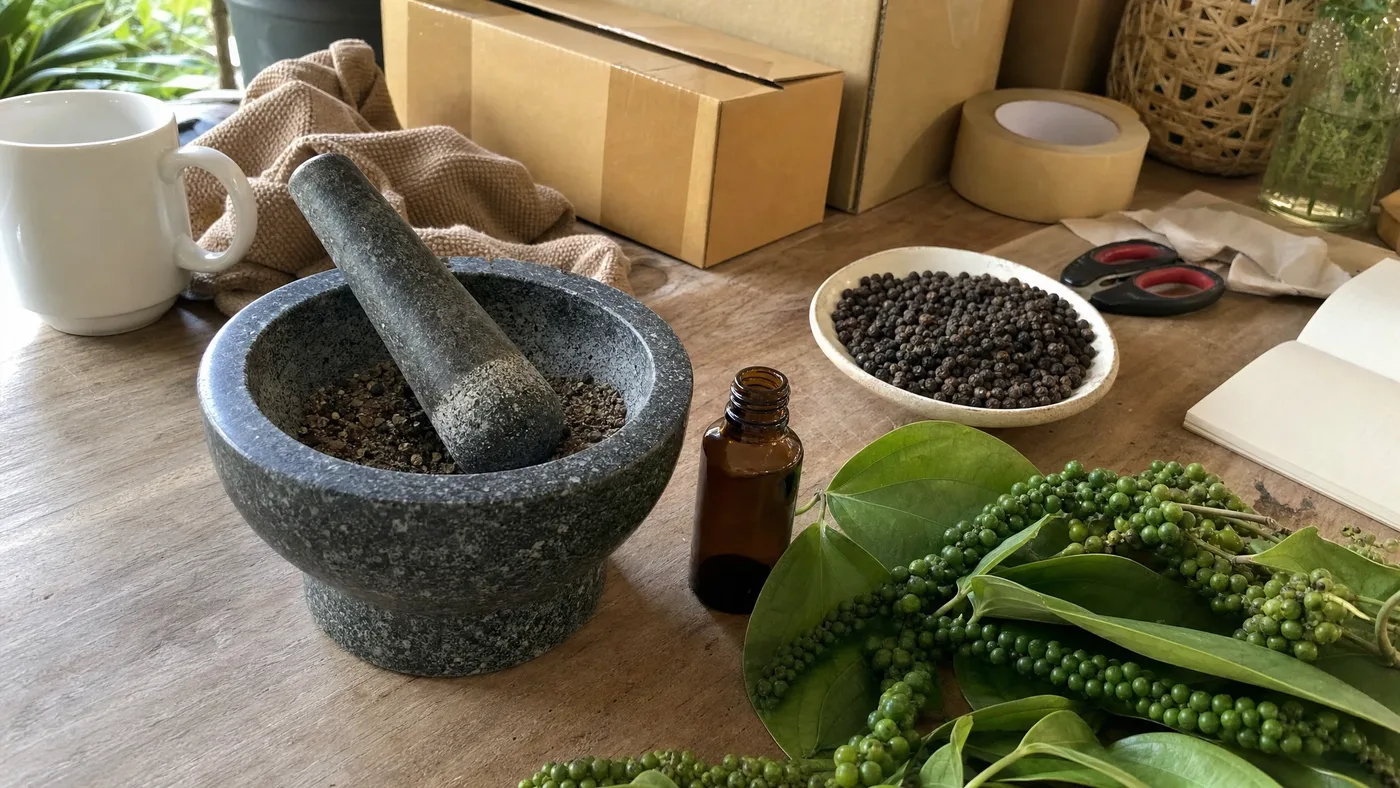
Steam distillation carries volatile aromatic molecules out of crushed peppercorns on steam, and the oil settles on top of the condensed water. Piperine is not volatile enough to travel along. EFSA's opinion on black pepper oil confirms this: in five batches of steam-distilled oil, piperine averaged below 0.0005% (EFSA FEEDAP Panel, 2022). Distillation leaves piperine behind, which is why our oil does not carry it in any meaningful amount.
It is a good detail to keep in your pocket the next time someone tells you that pepper oil must be "hot." The heat you taste and the aroma you smell are carried by different parts of the plant. One stays behind in the kitchen, and the other fills a small amber bottle.
What does build the aroma
The scent comes from terpenes. In those same EFSA batches the main ones were beta-caryophyllene (about 25.6% of the profile), limonene (12.5%), sabinene (9.4%) and alpha-pinene (8.9%). You do not need to memorise any of that. The takeaway is that the warm, woody spice and the bright, resinous lift come from this volatile mix, not from the alkaloid. Our notes and chemistry post gives a friendlier tour, and how to read a GC-MS report helps if you hold one.
The Certificate of Analysis we publish for one batch lists appearance, smell, density, refractive index and optical rotation. If you need a compound profile for a specific lot, ask us in writing through the contact page before ordering.
If you ever want to see the difference for yourself, compare the two in your hands. Put a little ground pepper on a saucer and smell it, then put a single drop of the oil on a tissue and smell that. The ground pepper hits the nose with dust and heat, while the oil is drier, more polished and woodier. Neither is better, but they are clearly different things.
Where piperine does end up
If you are shopping for piperine, you want a different product. Extracts made with solvents or supercritical carbon dioxide capture far more of the non-volatile fraction. The same EFSA opinion describes black pepper oleoresin with piperine specified at 20 to 50%, and a supercritical extract with piperine in the 0.5 to 2.0% range in its batches. Culinary infused oils and ground pepper sit on that side of the line too. We cover the differences in oleoresin and infused pepper oil.
So what is the oil for?
Scent, mostly. We think of it as a finishing touch: a dry, warm, peppery note that makes a bright blend feel grown up, adds depth to a candle or soap, and gives a diluted massage oil a spicy accent. It is a lovely ingredient to play with, and knowing it is all aroma and no bite makes it easier to use with confidence.
Piperine supplements are a separate subject
Piperine is often discussed as a supplement ingredient because of how it influences absorption of other compounds. A 1998 study found that 20 mg of piperine given with curcumin raised curcumin's serum levels in rats and in healthy volunteers (Shoba et al., Planta Medica, 1998). That was a swallowed dose of an isolated compound, a long way from an essential oil with almost no piperine in it. Our oil is a cosmetic aroma ingredient for external use, never to be taken internally, so it is not a stand-in for any supplement. One related myth gets its own treatment in black pepper oil myths and facts.
A short note on using it
Because the oil carries so little of the pungent part, people sometimes assume it is milder than it is. It is still a concentrated, undiluted oil, so the usual rules apply: keep it away from eyes, dilute it before it goes near skin, and store it capped in a cool, dim place.
For skin, dilute it to 0.5% to 2% in a carrier oil and patch test first.
Black Pepper Essential Oil
Black Pepper Essential Oil from our own shop, in sizes from 0.5 oz to bulk.
From $13.99
Shop Now →