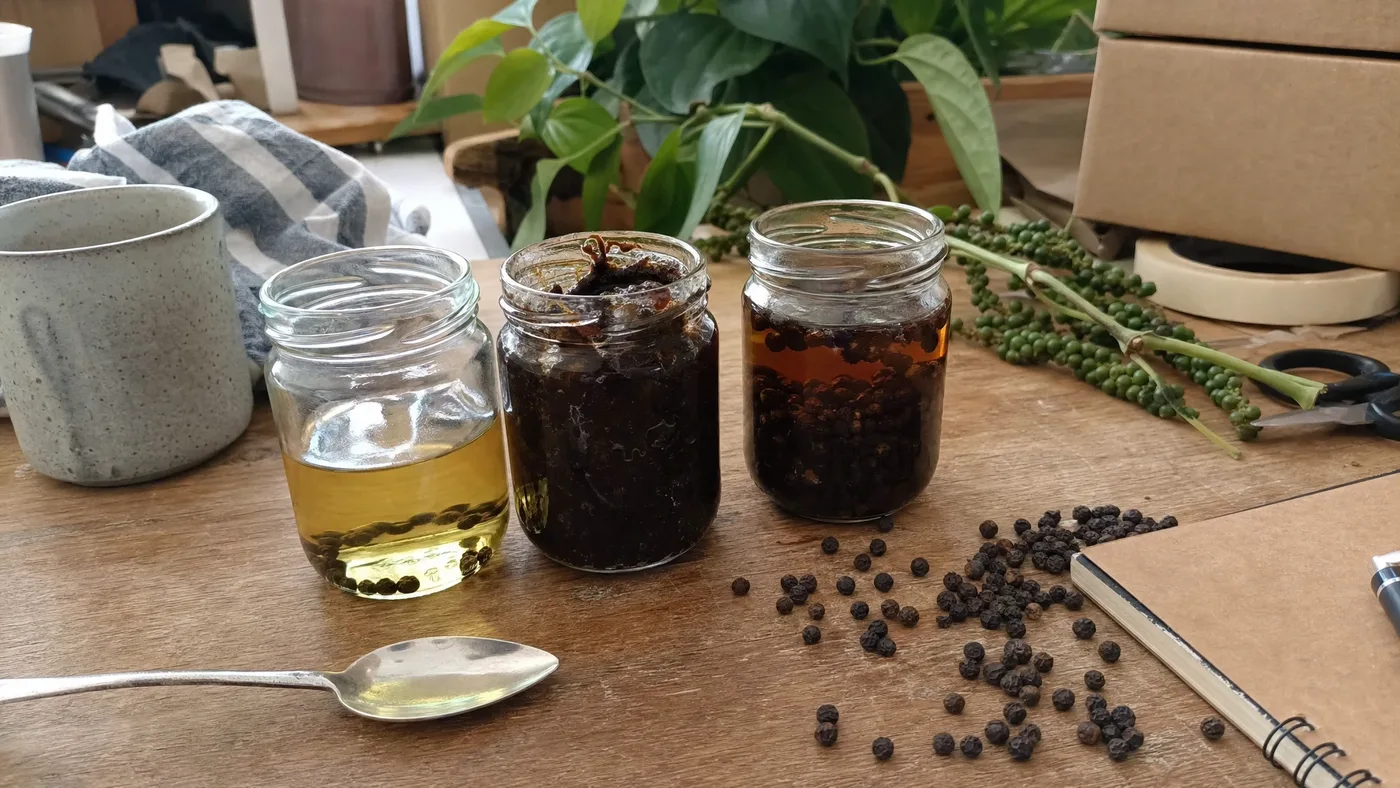
Black Pepper Oil vs Oleoresin vs Infused Oil
Search "black pepper oil" and you will meet three quite different products on the same page. There is a thin, clear oil made for diffusers and perfumery, a thick amber concentrate that food manufacturers buy by the drum, and a jar of peppercorns steeped in olive oil that looks like it came out of a home kitchen. All three come from Piper nigrum. Beyond that, they are not interchangeable, and knowing which one you are holding saves a wasted purchase.

Black Pepper Essential Oil
Our own Black Pepper Essential Oil, in sizes from 0.5 oz to bulk.
From $13.99
Shop Now →The distilled oil: scent without the bite
This is what we sell. Steam passes through cracked peppercorns and carries the light, volatile aromatic compounds with it, then condenses into the oil. Piperine, the compound behind pepper's heat on the tongue, is not volatile and stays behind. In the EU panel's analysis of distilled pepper oil, piperine averaged below 0.0005 percent. The scent, on the other hand, is unmistakable: our oil is dry, warm and peppery, opening spicy and sharp before settling into a woody warmth. It suits diffusers, candles, perfumery and, diluted, skin products. Our chemistry and scent article tells that story in more detail.
The oleoresin: everything the solvent can reach
Oleoresin is made by extracting dried unripe fruit with solvents, and it keeps both the volatile oil and the heavier pungent compounds. The same EU review lists piperine in the oleoresin at roughly 30 to 40 percent across the batches described, and specifies 20 to 50 percent (EFSA FEEDAP Panel, 2022). That is a food and flavouring ingredient, not an aromatherapy oil, and it is a different composition rather than the same oil at a different strength. We do not sell it.
The infused oil: a kitchen product
Infused pepper oil is peppercorns left to steep in a carrier such as olive or sunflower oil. What transfers depends on how long it steeped, how finely the pepper was cracked and how fresh it was, so there is no standard strength behind it. It is a lovely thing for cooking and has no connection to essential oil. Because an infusion is a carrier oil with flavour in it, it should never be confused with the concentrated distilled oil, and it is not something to drop into a diffuser. If you ever find a bottle labelled only "pepper oil," check whether it names the plant, the plant part and the method. Those three details tell you at once which of the three you are holding.
Why the names get mixed up
Part of the confusion is that "oil" is doing three jobs. In a shop, "black pepper oil" might mean an aromatic oil, a flavoring concentrate or a cooking oil, and the name on the bottle is not always careful. Online listings are even looser, since a seller may copy a short title and leave the details to a sentence further down the page. That is why the plant part, the method and the intended use are the three details we keep returning to.
Little habits that keep you from the wrong bottle
- Read the whole listing, not just the title.
- Look for the Latin name, Piper nigrum, and a statement of how it was made.
- Check whether it says "for food use" or "for aroma and external use."
- If the product page does not say, send a message and ask.
A short way to choose
- You want the aroma for a diffuser, candle, perfume or diluted skin product: the steam-distilled essential oil.
- You want pepper heat in food manufacturing: oleoresin, from a food-grade supplier.
- You want pepper flavour in your own cooking: an infused oil, or just a pepper mill.
One more tip from the kitchen side: if a bottle smells sharply of pepper and a little oily, like a salad dressing, it is probably something to cook with. If it smells thin, dry and woody, with no hint of the pantry, it is probably an aroma oil. Your nose is a good first guide, and the label can confirm it.
It also helps to know that "black pepper oil" can mean a made-up scent rather than any of these. If that is your question, our fragrance oil comparison covers it, and the absolute article covers one more extract you may see listed.
Black Pepper Essential Oil
Black Pepper Essential Oil from our own shop, in sizes from 0.5 oz to bulk.
From $13.99
Shop Now →