Does Black Pepper Oil Go Bad? How to Tell
Open a bottle you bought a couple of years ago and the first thing you want to know is simple: is this still good? Black pepper oil does not spoil the way milk does, with a sour cliff you fall off one morning. It ages slowly, a little at a time, and the useful skill is knowing how to read that change.

Black Pepper Essential Oil
Our own Black Pepper Essential Oil, in sizes from 0.5 oz to bulk.
From $13.99
Shop Now →What "going bad" means for an essential oil
The word we would use is oxidation. Black pepper oil is a mix of terpenes, and a European safety assessment of steam-distilled black pepper oil reported limonene, alpha-pinene and beta-pinene among them, alongside the beta-caryophyllene that makes up about a quarter of the oil (EFSA FEEDAP Panel, 2022). Terpenes react with oxygen over time, and heat and ultraviolet light speed the reaction up. A 2021 review in Molecules lists storage time, age, oxygen and UV exposure as the factors that change an essential oil's composition, and it names limonene, delta-3-carene and alpha-pinene as compounds whose oxidation products can be more reactive than the originals (Sharmeen et al., 2021).
Pepper itself shows the pattern. In a study of whole Piper nigrum fruits kept for a year at room temperature in glass, the oil that could be recovered had lower terpene content and more oxygenated terpenoids than at the start (Orav et al., 2004). That was fruit, not a bottle of finished oil, so we read it as a hint about direction rather than a timetable. The direction is the same one the review describes: fresh, light hydrocarbons give way to heavier, oxidised molecules.
Why it matters more on skin than in a diffuser
A flatter aroma is a disappointment. A change in how the oil behaves on skin is the more important point. In patch tests on dermatitis patients and controls, non-oxidised limonene and linalool caused no irritation at any tested concentration, while the air-oxidised versions did, limonene more than linalool (Bråred Christensson et al., 2009). Black pepper oil already carries a skin-irritant warning at generous strengths, so we would rather you start from a bottle that smells the way it did when it was new. If you are using an older bottle, our usual 0.5% to 2% dilution guidance applies, and the low end is the sensible place to begin. The dilution chart gives the drop counts.
Three checks you can run at the kitchen counter
1. Smell it fresh, in a clean spot
Fresh black pepper oil opens dry, spicy and sharp, then settles into something woody. Hold the bottle a few centimetres from your nose, not against it, and ask whether both halves are still there. If the opening has gone dull, or the whole thing reads as sour, harsh or oddly like varnish, the oil has moved on. Our scent profile post walks through what to listen for.
2. Watch the pour
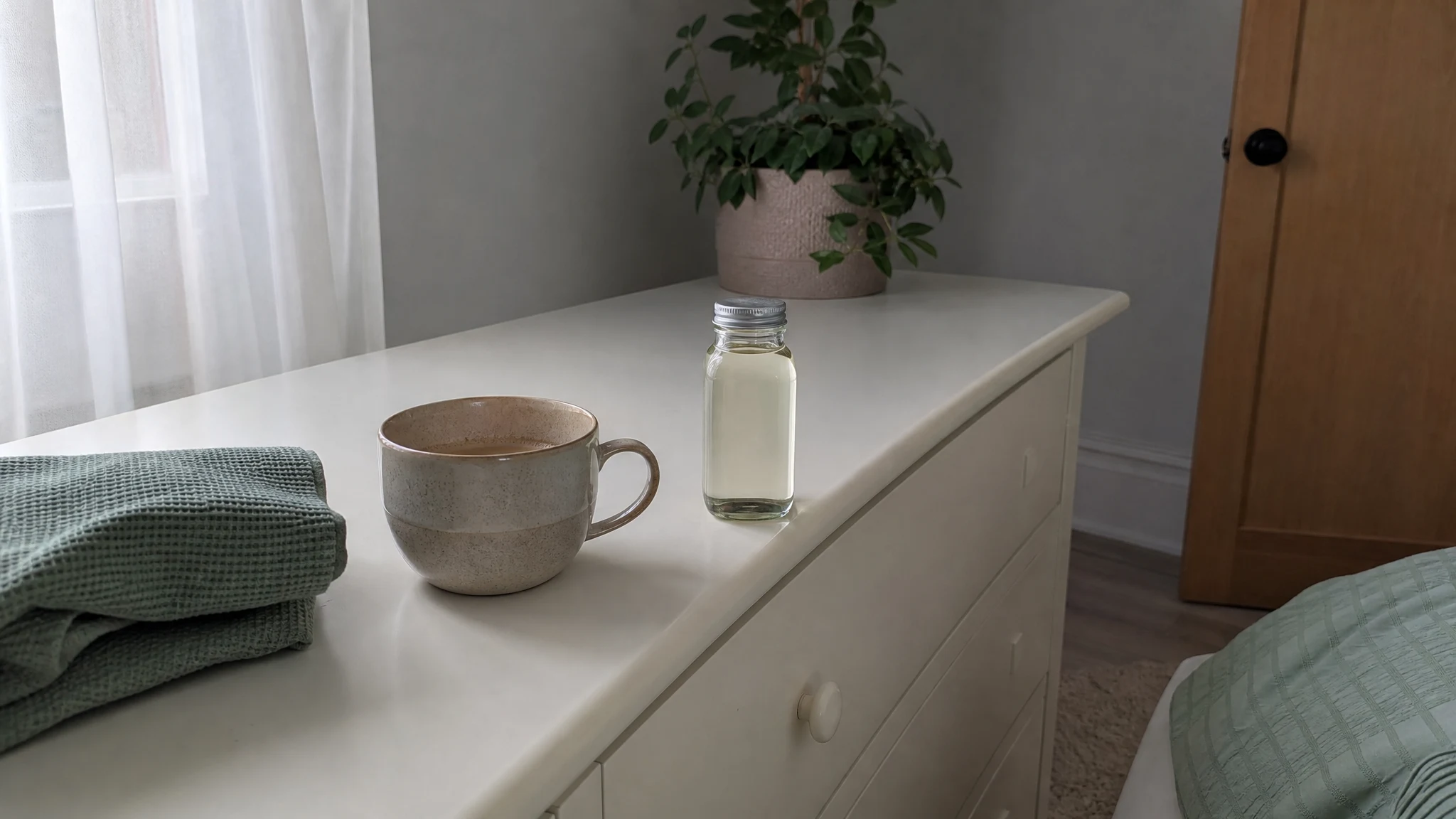
Our oil typically pours as a thin, watery liquid. Oil that has turned syrupy, cloudy, or leaves a tacky ring around the neck of the bottle has changed. Wipe the threads clean when you cap it, because residue there can look like ageing when it is only spillover.
3. Compare colour with your own memory, not a chart
The EFSA assessment describes black pepper oil as a colourless to light-coloured (yellow, green or blue) clear mobile liquid (EFSA FEEDAP Panel, 2022). Because a healthy range is that wide, a single colour tells you very little. A noticeable darkening compared with the same bottle when you bought it is more informative. Take a photo when the bottle is new, and you have your own reference.
What we would do with an older bottle
- If it smells right and pours right, use it, and keep to the low end of the dilution range.
- If the scent has dulled but nothing else has changed, it can still be fine for a diffuser, where you are only after a little warmth in the air. Keep it off skin, though.
- If it smells off, looks thick, or leaves a sticky film, retire it from skin use. Ask your local household hazardous waste programme where an unwanted bottle should go.
- If you ever see a reaction after using an older bottle, stop, wash the area, and read what to do next.
For unopened, capped bottles kept away from heat and light, we say typically 4 to 5 years. Once the seal is broken, the oil meets more air every time you open it, so we treat an opened bottle as something to use in good time rather than something to keep forever. Our storage routine covers how to slow the process. If you reach for the oil only now and then, our bottle size post helps you pick a size you will finish in good time.
If you ever need to know exactly what is in a particular lot, get in touch and ask for the report for that lot; reading one is easier than it looks, as the GC-MS report guide shows.
In the end, an essential oil is a living mixture, and your nose is the first and best instrument you own. A bottle you have kept capped and dark will usually tell you honestly how it is doing.
Black Pepper Essential Oil
Black Pepper Essential Oil from our own shop, in sizes from 0.5 oz to bulk.
From $13.99
Shop Now →Sources & Further Reading
- EFSA FEEDAP Panel, "Safety and efficacy of feed additives prepared from Piper nigrum L.: black pepper oil and black pepper oleoresin for use in all animal species and a supercritical extract for use in dogs and cats (FEFANA asbl)", EFSA Journal 2022;20(11):e07599. pmc.ncbi.nlm.nih.gov/articles/PMC9641382
- Sharmeen JB, Mahomoodally FM, Zengin G, Maggi F, "Essential Oils as Natural Sources of Fragrance Compounds for Cosmetics and Cosmeceuticals", Molecules 2021;26(3):666. pmc.ncbi.nlm.nih.gov/articles/PMC7865210
- Orav A, Stulova I, Kailas T, Müürisepp M, "Effect of storage on the essential oil composition of Piper nigrum L. fruits of different ripening states", Journal of Agricultural and Food Chemistry 2004;52(9):2582-2586. pubmed.ncbi.nlm.nih.gov/15113161
- Bråred Christensson J, Forsström P, Wennberg AM, Karlberg AT, Matura M, "Air oxidation increases skin irritation from fragrance terpenes", Contact Dermatitis 2009;60(1):32-40. pubmed.ncbi.nlm.nih.gov/19125719