Black Pepper Oil vs Absolute: What Sets Them Apart
On a perfumer's shelf, "oil" and "absolute" are not interchangeable words. They mark two different ways of getting scent out of a plant, and they leave behind two different materials. Black pepper is a good example of why it matters, because the part of pepper you feel on your tongue behaves very differently from the part you smell.

Black Pepper Essential Oil
Our own Black Pepper Essential Oil, in sizes from 0.5 oz to bulk.
From $13.99
Shop Now →Distilling versus dissolving
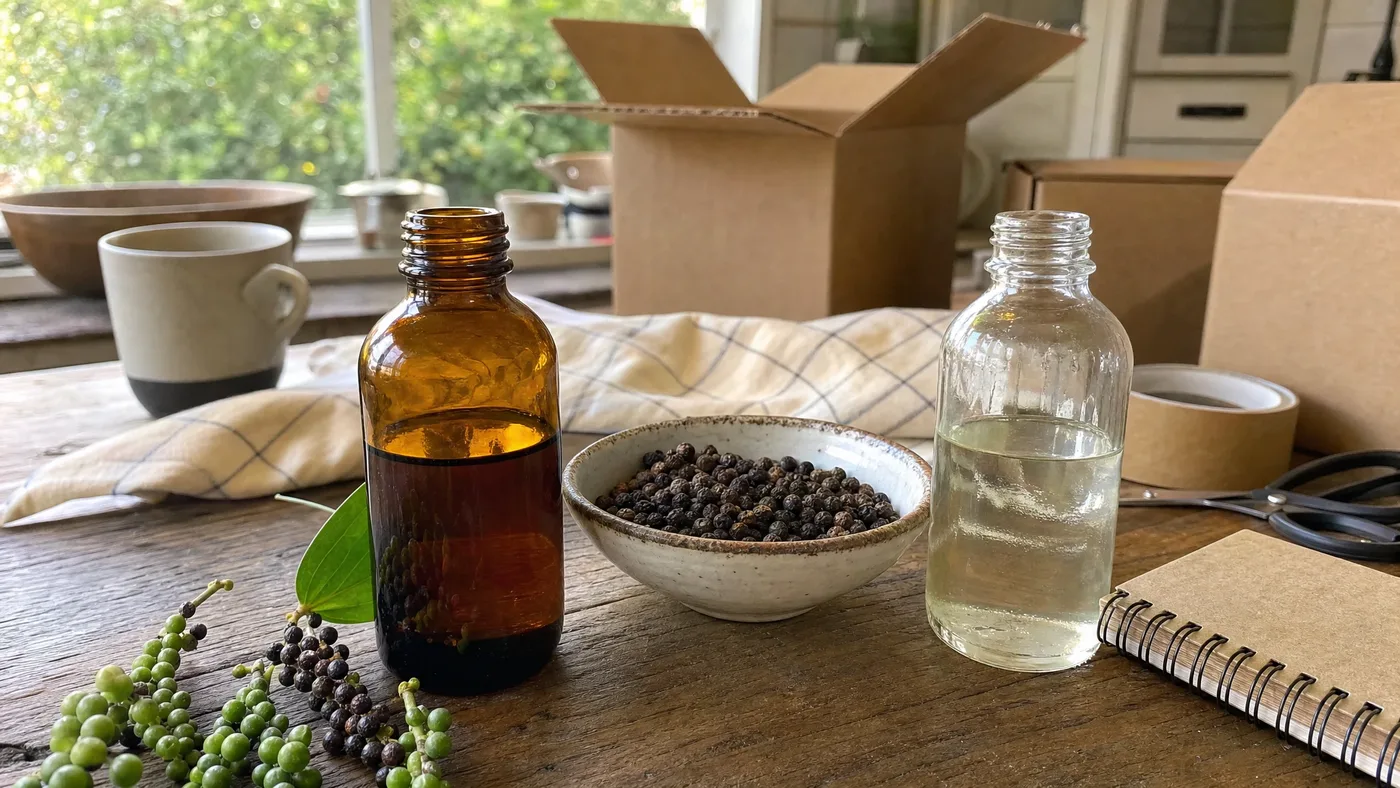
An essential oil is carried out of the plant by steam or taken by pressing. An absolute comes from a solvent route: the plant is washed with a solvent such as hexane to make a waxy concrete, which is then taken up in alcohol, chilled, filtered and evaporated (overview of the process). We make our oil the first way. We sell black pepper essential oil steam-distilled from Piper nigrum peppercorns, with no solvent-extracted material in the bottle, neat and undiluted.
Why the pepper heat stays behind
Piperine is the compound that gives pepper its bite, and it is not volatile. Steam does not carry it over, which is why a distilled pepper oil smells like pepper without tasting hot. The EU safety panel's figures make the point neatly: in the distilled oil piperine averaged below 0.0005 percent, while a solvent-extracted pepper oleoresin carried it at roughly 30 to 40 percent (EFSA FEEDAP Panel, 2022). The oleoresin is a food-flavouring material rather than an absolute, but it shows what solvents tend to pull in that steam leaves out. Our oleoresin article goes further, and so does our piperine explainer.
A word about the word
"Absolute" sounds like a promotion, as if it were a stronger or finer grade of the same thing. It is not. It simply names a different route with a different result, and each route has its place in a perfumer's cabinet. Thinking of them as two separate ingredients, the way you would think of butter and olive oil, removes most of the confusion. Neither is the "real" one. They are different tools.
Which one for which job
For a diffuser, room spray or candle, the steam-distilled oil is the natural choice, because a thin, volatile material is what a wick or a diffuser wants to evaporate. For a perfume that needs a hard, lingering pepper, some perfumers do reach for an extract. If you go that way, ask the supplier for the specification and the maximum-use guidance before you blend, because that information belongs to the product rather than to pepper in general. For skin products, neither material is a shortcut, and an extract should not be assumed to be gentler. The EU panel classed the distilled oil as irritating to skin and eyes and a skin and respiratory sensitiser, so we recommend diluting to 0.5% to 2% in a carrier and patch testing first.
Compare them by smell, not by name
If you ever get to hold both, the best test is to put them on separate strips and smell them over an hour. Notice how each opens, how fast it fades and what it leaves behind. Notice how it feels as well as how it smells: some materials are thin and quick, others heavier and slower. Ask the supplier what the product is and how it was made, and write it on the strip so you do not lose track. After an hour, you will know far more about your own preferences than any description can tell you.
If you are scenting something you sell
Makers have an extra reason to be careful. A candle, a soap or a perfume carries a label, and the label should say exactly what went into it. Get the specification in writing, keep the paperwork with your recipe, and use the maker's recommended levels, not a guess. It is a bit of homework, and it pays off every time a customer asks what is in the bottle.
Questions worth asking any seller
- Is it an absolute, an oleoresin or a CO2 extract? They are three different products.
- Which solvent was used, and what is the residual-solvent limit on the specification?
- Is there a GC-MS report for this lot? For ours, the Certificate of Analysis we publish covers one batch with density, refractive index and optical rotation, so ask us in writing through the contact page for the report on your lot.
- What does the maker recommend as a maximum use level?
Those four answers will tell you more than any name on a label.
Black Pepper Essential Oil
Black Pepper Essential Oil from our own shop, in sizes from 0.5 oz to bulk.
From $13.99
Shop Now →