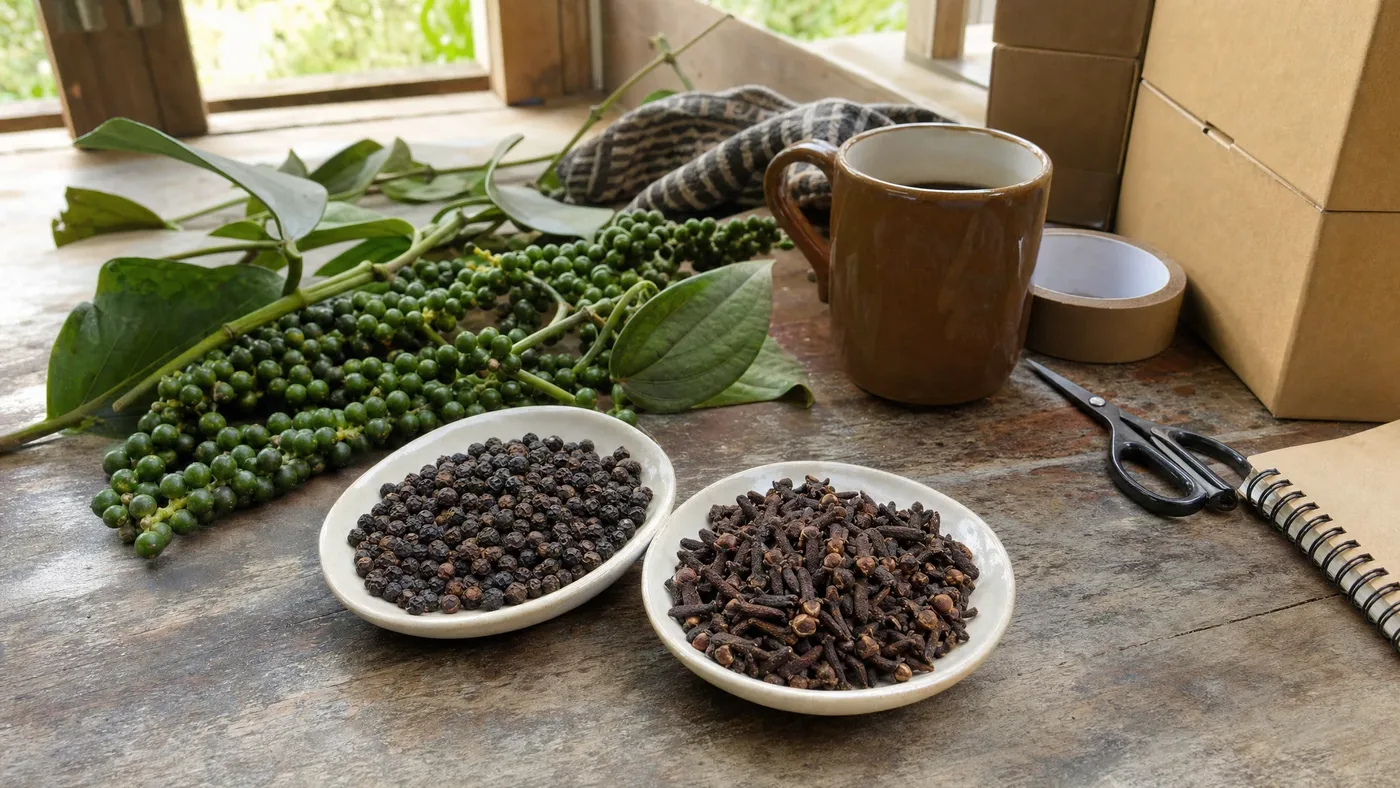
Is Black Pepper Oil Like Clove Oil? How They Differ
On the warm-spice shelf, black pepper and clove bud sit side by side as if they were cousins. Both smell cosy, and both turn up in the same autumn diffuser recipes. The packaging invites you to treat them alike, but the chemistry underneath is quite different, and so are the ground rules for handling them.

Black Pepper Essential Oil
Our own Black Pepper Essential Oil, in sizes from 0.5 oz to bulk.
From $13.99
Shop Now →How they smell side by side
Put a drop of each on its own strip of blotting paper and smell them at the start, again after ten minutes and again after an hour. Clove is sweet, round and assertive, and it tends to stay loud. Black pepper opens dry, spicy and a little sharp, then settles into a woody warmth that sits further back. Many people find that the pepper strip changes more as it dries, while the clove strip keeps one steady voice.
One compound runs the show in clove
Clove bud oil is dominated by eugenol. In one recent analysis of a clove oil, eugenol made up 55 percent, with beta-caryophyllene at about 33 percent (Sytykiewicz et al., 2026). Other clove oils run higher in eugenol. Black pepper oil has no single compound with that kind of dominance. In an EU review of five distilled batches, beta-caryophyllene led at a mean of 25.6 percent, followed by limonene, sabinene and alpha-pinene (EFSA FEEDAP Panel, 2022). Interestingly, both oils share caryophyllene, which is part of why they feel related. It is the eugenol that sets them apart.
Why eugenol changes the handling
Eugenol is a recognised fragrance allergen, and the International Fragrance Association has a standard that limits it by product type. For a body lotion category the limit is 0.64 percent eugenol, and for a fine fragrance category it is 2.5 percent (IFRA Standards Library). Some quick arithmetic helps you picture that. If the clove oil is 55 percent eugenol, 0.64 percent eugenol works out to roughly 1.2 percent clove oil in a lotion, and less if the oil is richer in eugenol. The Tisserand Institute also lists clove among the oils more likely to cause skin reactions, and notes that sensitisation can last for life (Tisserand Institute safety guidelines).
Where that leaves black pepper
We did not find an IFRA standard for black pepper oil, and that is worth stating plainly rather than reading too much into. It does not make pepper oil a gentle oil. The EU panel classed it as irritating to skin and eyes and a skin and respiratory sensitiser. So our own guidance applies: dilute to 0.5% to 2% in a carrier, patch test on a small area first, and keep it away from eyes, children and pets. If you are making something for a skin product you intend to sell, check the current IFRA standards for your category instead of relying on any single number from us.
If you want both in one blend
Treat them like seasoning in a recipe. Start with the pepper as the backbone and add clove a drop at a time, smelling as you go, because the clove will take over faster than you expect. For anything that touches skin, count both oils toward the same total and use the more cautious oil's rules for the whole blend. Clove has its own handling notes, so read your clove supplier's safety sheet before you use it. We sell black pepper oil only.
Where to find clove, and what to look for
Clove bud oil is easy to find at a pharmacy, a craft supplier or a health-food shop. Check that the label names the plant part, clove bud, and the botanical name, and ask the seller for its safety paperwork. Neither oil belongs in the spice rack: they are aroma materials, not food.
A small tasting-room trick
If you are choosing between the two for a project, do what a cook does with spices: smell them in the context you will use them. Dab each on a strip, then hold a strip near a cedar block, a cinnamon stick or a bar of plain soap, whatever your project will smell like. The partner changes the picture. Pepper tends to sharpen a woody room, while clove tends to sweeten it. Seeing that in front of you is worth more than any description.
Which one for what
Clove brings a sweet, assertive spice note that can dominate quickly, so it tends to go in as a small touch. Black pepper brings a dry, woody warmth that sits in the background and gives a blend structure. In a diffuser or a room spray the choice is mostly about aroma, and for ideas, see our warm spice comparison and our dilution and patch test guide.
Whichever you choose, treat both as concentrated materials with their own rules.
Black Pepper Essential Oil
Black Pepper Essential Oil from our own shop, in sizes from 0.5 oz to bulk.
From $13.99
Shop Now →