Piper Nigrum: The Vine Behind Black Pepper Oil
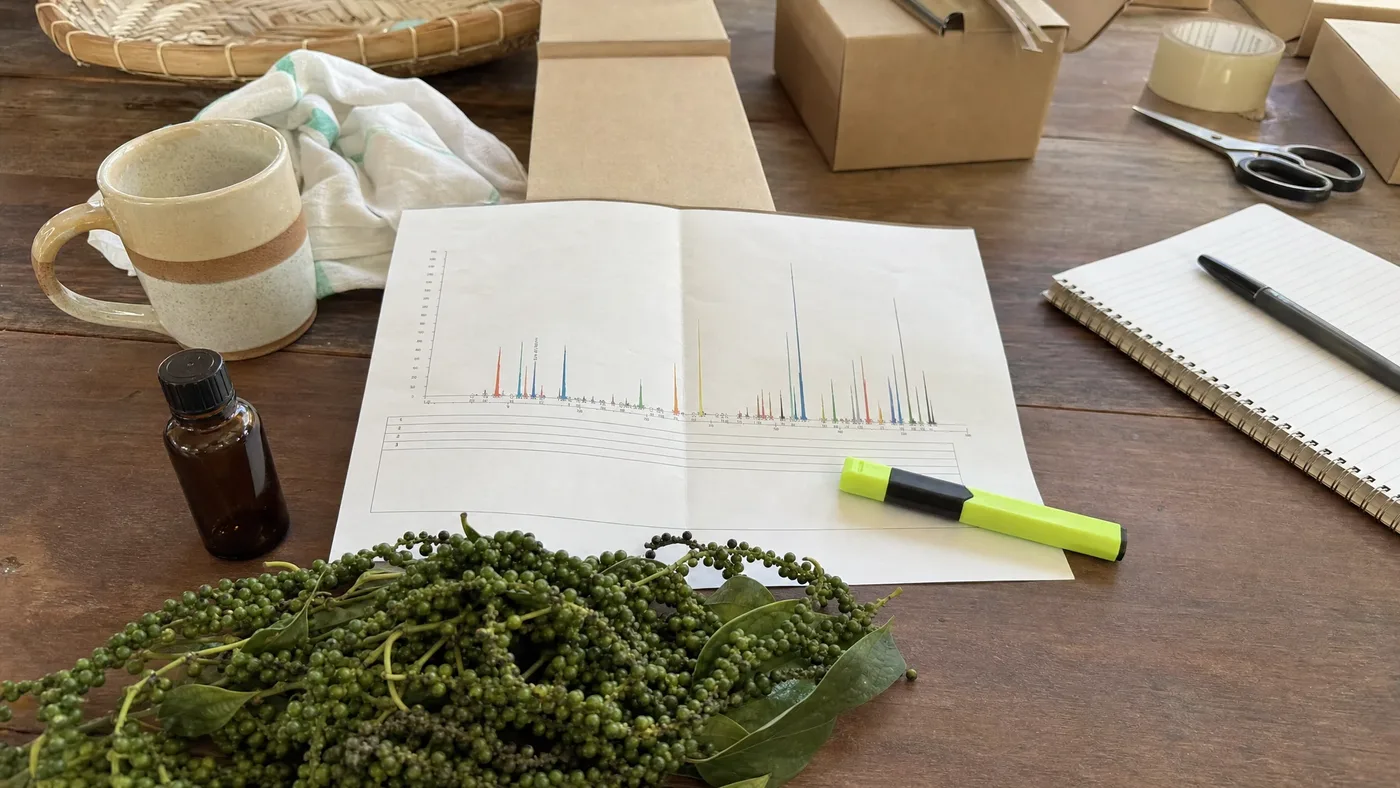
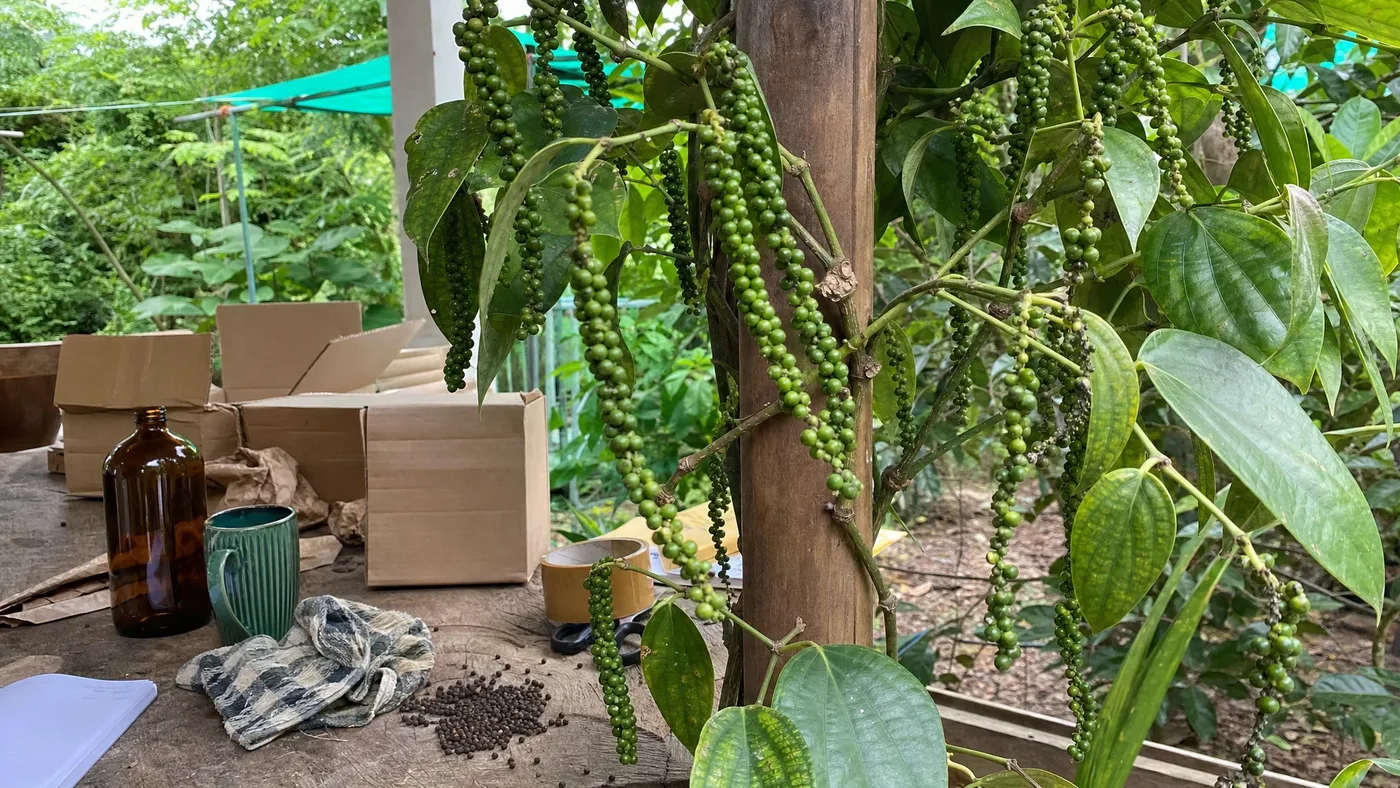
Picture a woody vine climbing a post or a tree, hung with slim spikes of berries no bigger than a pea. That is Piper nigrum, and every bottle of black pepper essential oil starts as its fruit. The vine is more interesting than it looks, because small choices about the fruit decide what the oil smells like.

Black Pepper Essential Oil
Our own Black Pepper Essential Oil, in sizes from 0.5 oz to bulk.
From $13.99
Shop Now →A climber that grows to about four metres
Black pepper is a perennial vine that, given a trellis or a tree, reaches around 4 m. The flowers hang in spikes, and each one ripens into a small single-seeded fruit, a drupe about 5 mm across that turns dark red when fully ripe (Wikipedia, Black pepper). Harvest starts when the first one or two berries at the base of a spike begin to redden, because fully ripe fruit loses its bite and drops off.
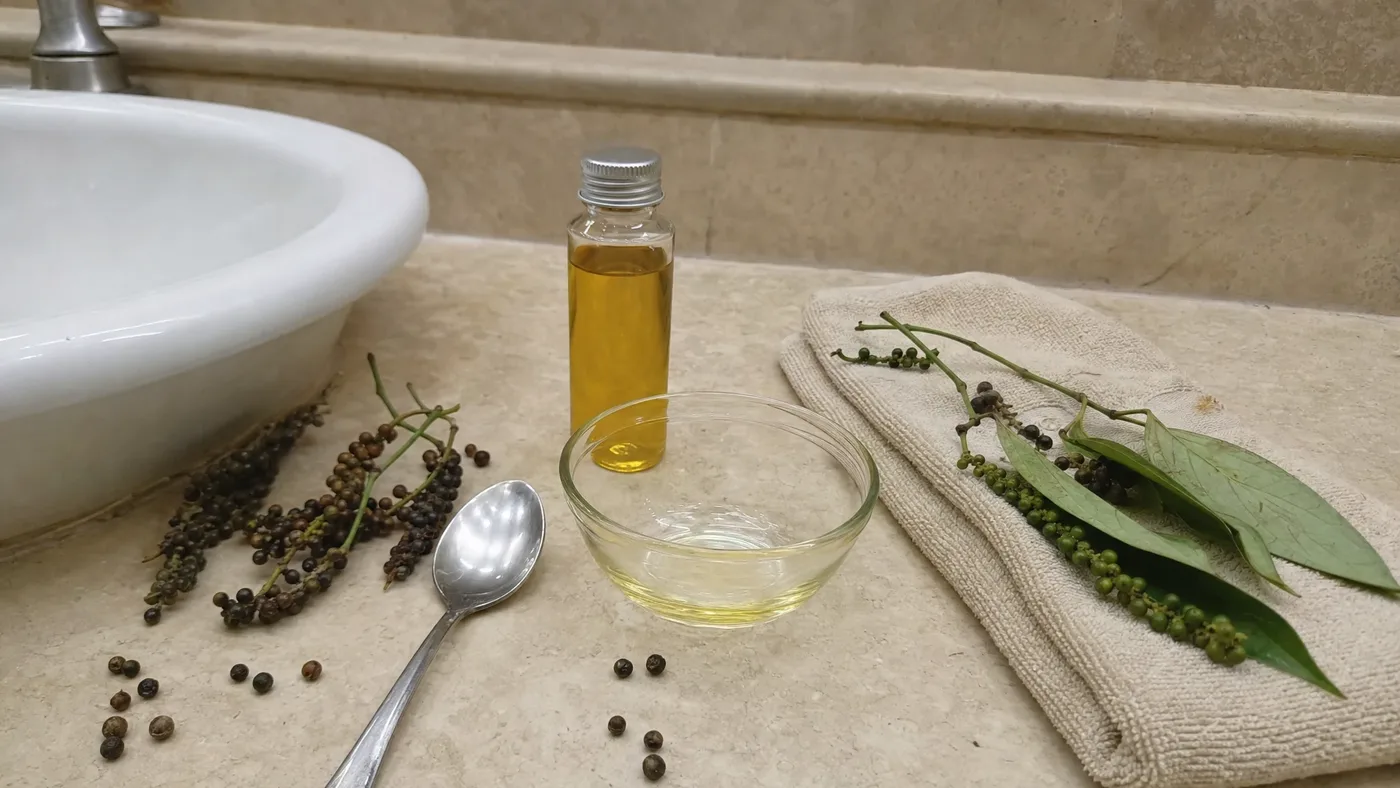
The oil comes from that fruit. Steam passes through the crushed peppercorns, carries off the volatile aromatic part, and condenses into a thin liquid that is lighter than water. That is the oil we sell: one black pepper oil, steam-distilled from Piper nigrum peppercorns grown in India.
If you ever walk past a black pepper vine in a botanical garden or a greenhouse, stop and look closely at the spikes. Berries along one spike are often at different stages, some still green and a few starting to redden, which shows you why the timing of the pick matters so much. The leaves are glossy and dark, and the whole plant looks more like a tropical houseplant than a spice.
Black, green, white: one plant, different handling
Black, green and white peppercorns all come from the same species. The difference is when the fruit is picked and what happens afterwards: black pepper is unripe fruit that is briefly heated and dried until the skin darkens, white pepper is the seed of ripe fruit with the flesh removed, and green pepper is unripe fruit dried in a way that keeps its colour.
For oil, handling matters a great deal. In one study of pepper fruits at different ripening stages, green peppercorns that were freeze-dried gave about 12.1 mg of oil per gram, while green peppercorns dried in air gave only 0.8 mg per gram, and the aroma profile changed too (Orav et al., J Agric Food Chem, 2004). Same vine, same moment of harvest, very different oil. It is a nice reminder that a distiller starts with more decisions than the still itself.
Why the plant part on the label matters
Leaves, stems and spikes can be distilled as well as fruit, and they do not smell like peppercorns. A study of the Brazilian cultivar Guajarina found that its leaf oil was dominated by gamma-elemene and curzerene, a very different signature from the pinene, limonene and caryophyllene most people associate with pepper (Feitosa et al., Molecules, 2024). An Indonesian study that distilled seeds, stems and leaves separately likewise found distinct profiles for each part (Nurjanah et al., Food Sci Nutr, 2025).
So when we say black pepper oil, we mean the fruit. If you want the dry, warm, peppery scent, look for a listing that names the berry or fruit. The Certificate of Analysis we publish for one batch lists the part as berry, alongside its density, refractive index and optical rotation.
The heat stays in the peppercorn
The sting of table pepper comes from piperine, and piperine does not travel with steam. The EFSA panel that reviewed black pepper oil measured it at well under 0.0005% on average across five batches (EFSA FEEDAP Panel, 2022). The oil carries the volatile, aromatic side of the fruit: bright, woody, spicy and dry. If you are curious, we explain it in more detail in our post on piperine.
That aroma is still concentrated. For skin we recommend diluting to 0.5% to 2% in a carrier oil and patch testing first, and the oil stays out of eyes and away from children and pets.
Smell the peppercorn, then the oil
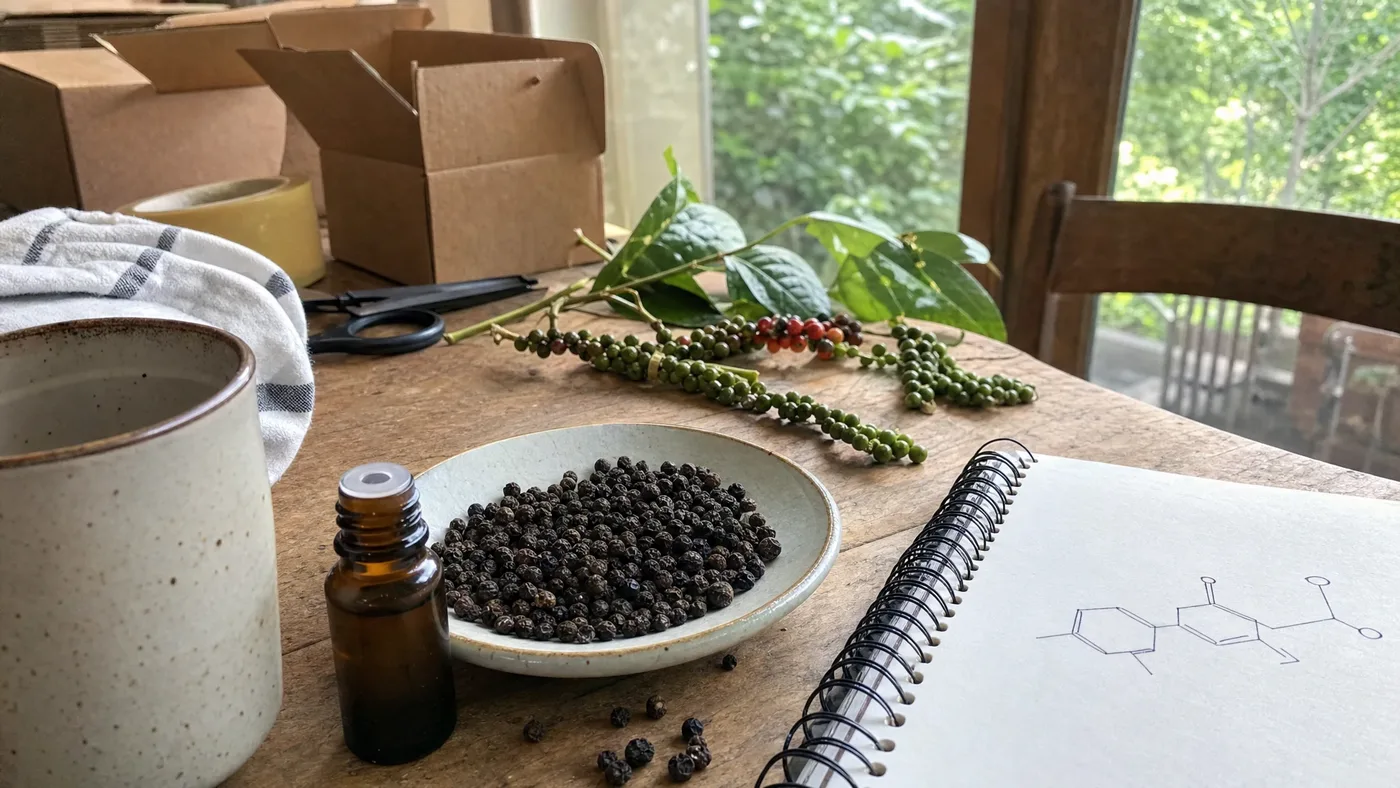
There is a good way to appreciate all of this. Crack a few peppercorns from your kitchen and smell them in the second after they split. Then open a bottle of the oil. The oil is that first second, held on the page of a bottle: dry, warm and peppery, sharp at the opening, with a woody warmth settling after. Notice what is missing, too. There is no sting in the nose, because the heat of the peppercorn stays behind in the still.
Where to go next
If the scent is what draws you in, our scent profile walks through it from first sniff to drydown. To see how origin and buying decisions play into the bottle, try the origin guide, and the long trade story of this vine lives in our history of black pepper. Our full range of sizes is on the shop page.
A vine that makes a fiery alkaloid and a bright, woody oil from the same tiny fruit is a good reason to love the plant.
Black Pepper Essential Oil
Black Pepper Essential Oil from our own shop, in sizes from 0.5 oz to bulk.
From $13.99
Shop Now →Sources & Further Reading
- Wikipedia. Black pepper (botany, harvest and processing). en.wikipedia.org/wiki/Black_pepper
- Orav A et al., 2004. Effect of storage on the essential oil composition of Piper nigrum L. fruits of different ripening states. J Agric Food Chem 52(9):2582-2586. pubmed.ncbi.nlm.nih.gov/15113161
- Feitosa BS et al., 2024. Piper nigrum L. cv. Guajarina essential oils and aroma. Molecules 29(5):947. pmc.ncbi.nlm.nih.gov/PMC10934927
- Nurjanah S et al., 2025. Essential oils from different parts of Piper nigrum L. Food Sci Nutr 13(11):e71205. pmc.ncbi.nlm.nih.gov/PMC12618210
- EFSA FEEDAP Panel, 2022. Safety and efficacy of feed additives prepared from Piper nigrum L. EFSA Journal 20(11):e07599. pmc.ncbi.nlm.nih.gov/PMC9641382